Institute of Ecology and Evolution, University of Bern, Switzerland.
Swiss Institute of Bioinformatics, Quartier Sorge, Bâtiment Génopode, Lausanne, Switzerland.
PLoS Biol. 2019 Feb 20;17(2):e3000142. doi: 10.1371/journal.pbio.3000142. eCollection 2019 Feb.
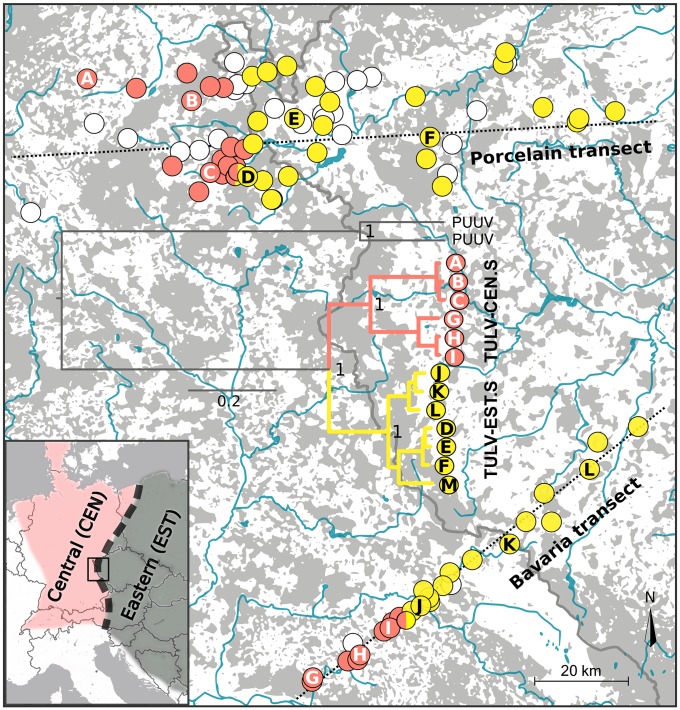
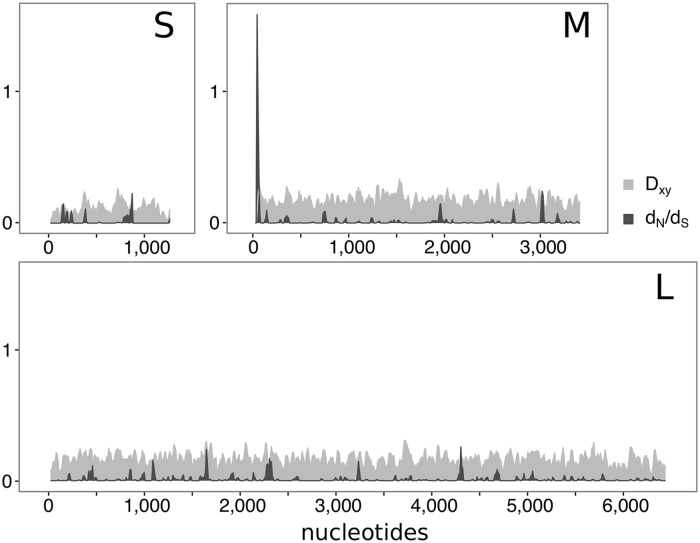
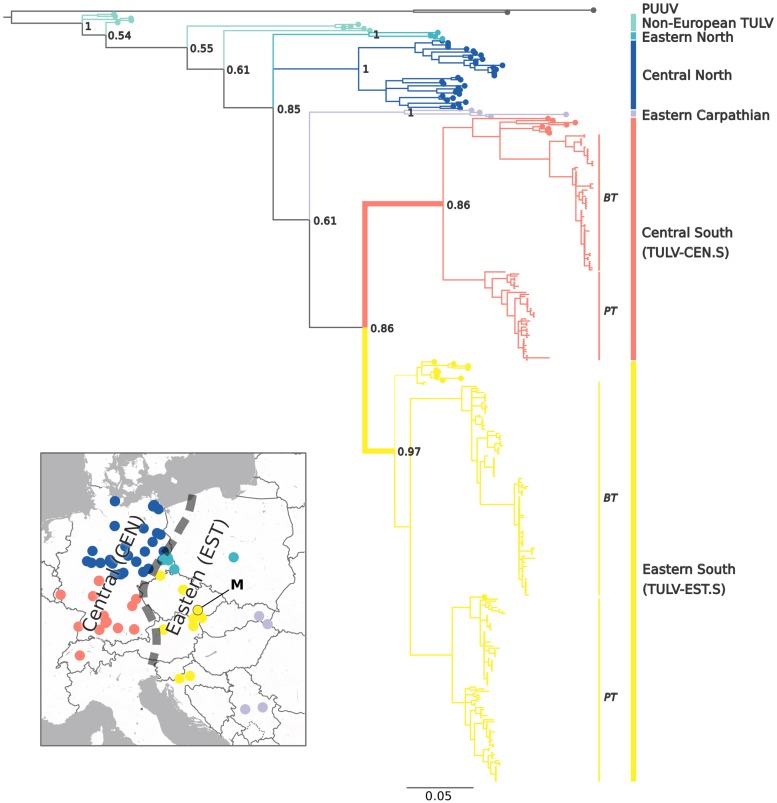
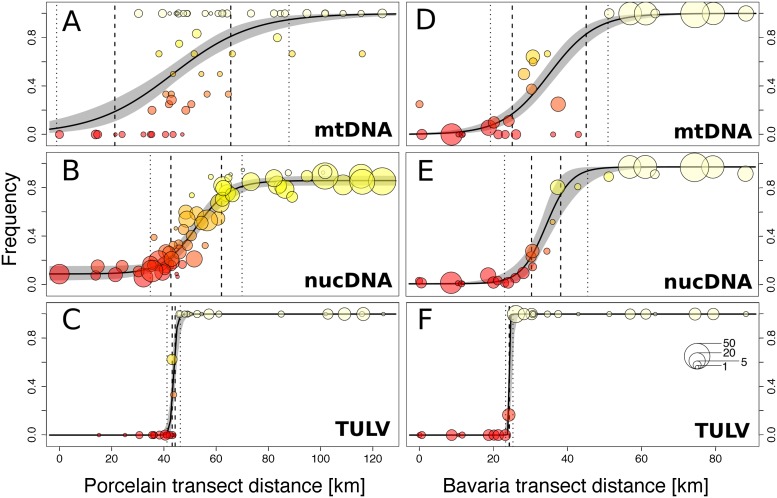
The diversity of viruses probably exceeds biodiversity of eukaryotes, but little is known about the origin and emergence of novel virus species. Experimentation and disease outbreak investigations have allowed the characterization of rapid molecular virus adaptation. However, the processes leading to the establishment of functionally distinct virus taxa in nature remain obscure. Here, we demonstrate that incipient speciation in a natural host species has generated distinct ecological niches leading to adaptive isolation in an RNA virus. We found a very strong association between the distributions of two major phylogenetic clades in Tula orthohantavirus (TULV) and the rodent host lineages in a natural hybrid zone of the European common vole (Microtus arvalis). The spatial transition between the virus clades in replicated geographic clines is at least eight times narrower than between the hybridizing host lineages. This suggests a strong barrier for effective virus transmission despite frequent dispersal and gene flow among local host populations, and translates to a complete turnover of the adaptive background of TULV within a few hundred meters in the open, unobstructed landscape. Genetic differences between TULV clades are homogenously distributed in the genomes and mostly synonymous (93.1%), except for a cluster of nonsynonymous changes in the 5' region of the viral envelope glycoprotein gene, potentially involved in host-driven isolation. Evolutionary relationships between TULV clades indicate an emergence of these viruses through rapid differential adaptation to the previously diverged host lineages that resulted in levels of ecological isolation exceeding the progress of speciation in their vertebrate hosts.
病毒的多样性可能超过真核生物的生物多样性,但人们对新病毒物种的起源和出现知之甚少。实验和疾病爆发调查允许对快速分子病毒适应进行特征描述。然而,导致自然界中具有功能区别的病毒分类群建立的过程仍然不清楚。在这里,我们证明了在自然宿主物种中初生的物种形成产生了不同的生态位,导致 RNA 病毒的适应性隔离。我们发现,在欧洲普通田鼠(Microtus arvalis)的自然杂交区,图拉正粘病毒(TULV)的两个主要系统发育分支与啮齿动物宿主谱系之间存在非常强的相关性。病毒分支在复制的地理梯度中的空间过渡至少比杂交宿主谱系之间的过渡窄八倍。这表明尽管在当地宿主群体之间经常发生扩散和基因流动,但病毒的有效传播仍然存在很强的障碍,这导致在开阔、无障碍的景观中,TULV 的适应性背景在几百米内完全更替。TULV 分支之间的遗传差异在基因组中均匀分布,大部分是同义的(93.1%),除了病毒包膜糖蛋白基因 5'区域的一组非同义变化,可能涉及宿主驱动的隔离。TULV 分支之间的进化关系表明,这些病毒通过快速的差异适应先前分化的宿主谱系而出现,从而导致生态隔离水平超过其脊椎动物宿主的物种形成进展。