Leverhulme Centre for Integrate Research on Agriculture and Health, 36 Gordon Square, London, WC1H 0PD, UK.
SOAS, University of London, Bloomsbury, London, WC1H 0XG, UK.
Global Health. 2019 Feb 20;15(1):15. doi: 10.1186/s12992-019-0456-z.
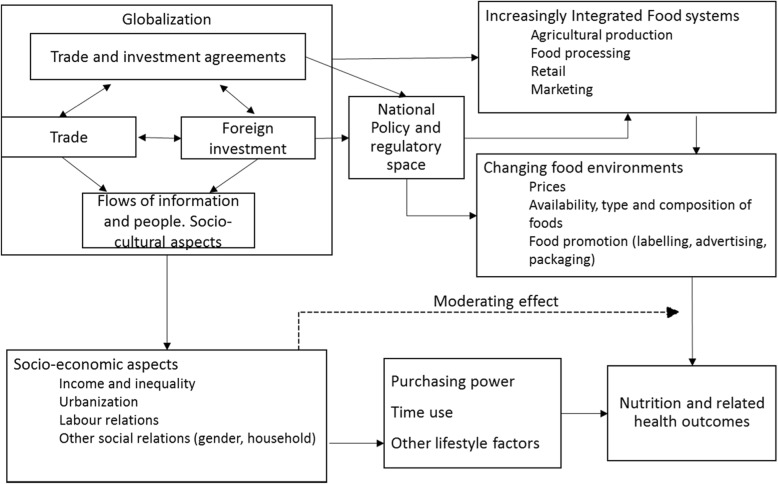
Unhealthy dietary patterns have in recent decades contributed to an endemic-level burden from non-communicable disease (NCDs) in high-income countries. In low- and middle-income countries rapid changes in diets are also increasingly linked to malnutrition in all its forms as persistent undernutrition and micronutrient deficiencies continue to coexist with a rising prevalence of obesity and associated NCDs. Economic globalization and trade liberalization have been identified as potentially important factors driving these trends, but the mechanisms, pathways and actual impact are subject to continued debate.
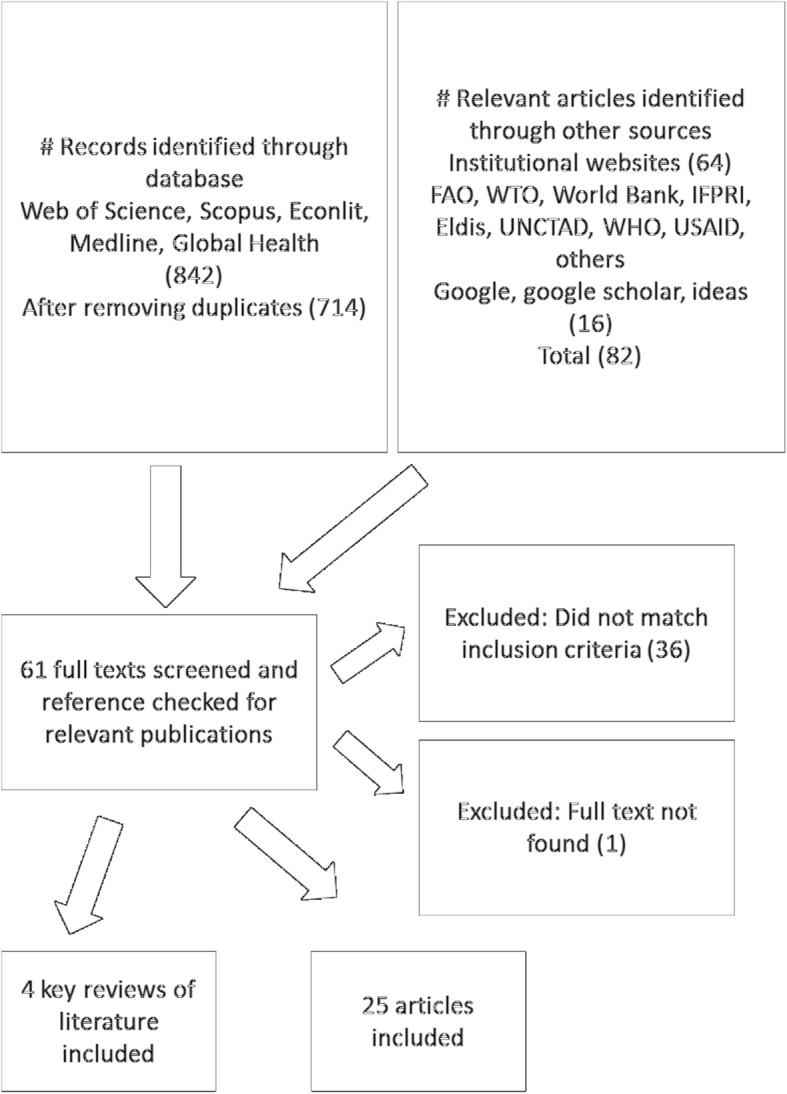
We use a 'rigorous review' to synthesize evidence from empirical quantitative studies analysing the links between economic globalization processes and nutritional outcomes, with a focus on impact as well as improving the understanding of the main underlying mechanisms and their interactions.
While the literature remains mixed regarding the impacts of overall globalization, trade liberalization or economic globalization on nutritional outcomes, it is possible to identify different patterns of association and impact across specific sub-components of globalization processes. Although results depend on the context and methods of analysis, foreign direct investment (FDI) appears to be more clearly associated with increases in overnutrition and NCD prevalence than to changes in undernutrition. Existing evidence does not clearly show associations between trade liberalization and NCD prevalence, but there is some evidence of a broad association with improved dietary quality and reductions in undernutrition. Socio-cultural aspects of globalization appear to play an important yet under-studied role, with potential associations with increased prevalence of overweight and obesity. The limited evidence available also suggests that the association between trade liberalization or globalization and nutritional outcomes might differ substantially across population sub-groups. Overall, our findings suggest that policymakers do not necessarily face a trade-off when considering the implications of trade or economic liberalization for malnutrition in all its forms. On the contrary, a combination of nutrition-sensitive trade policy and adequate regulation of FDI could help reduce all forms of malnutrition. In the context of trade negotiations and agreements it is fundamental, therefore, to protect the policy space for governments to adopt nutrition-sensitive interventions.
近几十年来,不健康的饮食模式导致高收入国家的非传染性疾病(NCDs)负担达到流行水平。在中低收入国家,饮食的快速变化也与各种形式的营养不良日益相关,因为持续存在的营养不足和微量营养素缺乏仍然与肥胖症及相关的非传染性疾病患病率的上升并存。经济全球化和贸易自由化被认为是推动这些趋势的潜在重要因素,但这些因素的机制、途径和实际影响仍存在争议。
我们使用“严格审查”来综合分析经济全球化进程与营养结果之间联系的实证定量研究证据,重点关注影响以及更好地理解主要潜在机制及其相互作用。
虽然关于全球化总体、贸易自由化或经济全球化对营养结果的影响的文献仍然存在分歧,但可以在全球化进程的特定子成分中确定不同的关联和影响模式。尽管结果取决于背景和分析方法,但外国直接投资(FDI)似乎与营养过剩和非传染性疾病患病率的增加比与营养不足的变化更密切相关。现有证据并未清楚表明贸易自由化与非传染性疾病患病率之间存在关联,但有一些证据表明与饮食质量改善和营养不足减少有关。全球化的社会文化方面似乎发挥了重要但研究不足的作用,与超重和肥胖症患病率的增加有潜在关联。现有的有限证据还表明,贸易自由化或全球化与营养结果之间的关联在人口亚组之间可能存在很大差异。总的来说,我们的研究结果表明,政策制定者在考虑贸易或经济自由化对所有形式营养不良的影响时,不一定需要在两者之间做出取舍。相反,采取对营养敏感的贸易政策和充分监管外国直接投资的结合,可能有助于减少所有形式的营养不良。因此,在贸易谈判和协议中,保护政府采取对营养敏感的干预措施的政策空间至关重要。