Laboratoire de Parasitologie Mycologie, CHU Lille, Université Lille, INSERM U995-LIRIC (Lille Inflammation Research International Centre), Lille, France.
Laboratoire de Parasitologie Mycologie, CHU Lille, Université Lille, INSERM U995-LIRIC (Lille Inflammation Research International Centre), Lille, France
J Clin Microbiol. 2019 Apr 26;57(5). doi: 10.1128/JCM.01867-18. Print 2019 May.
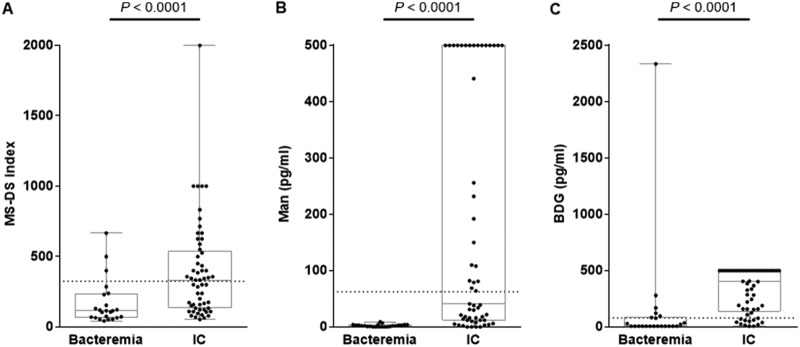
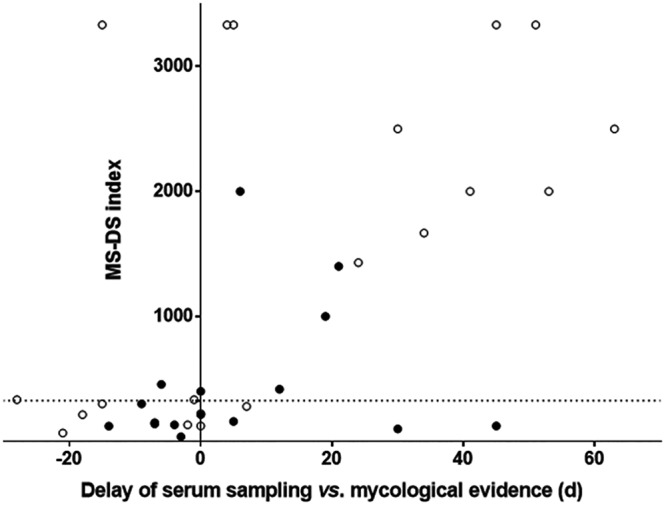
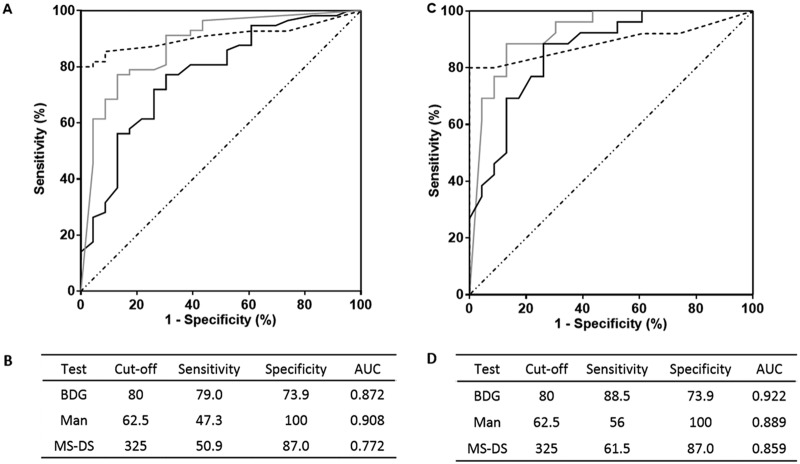
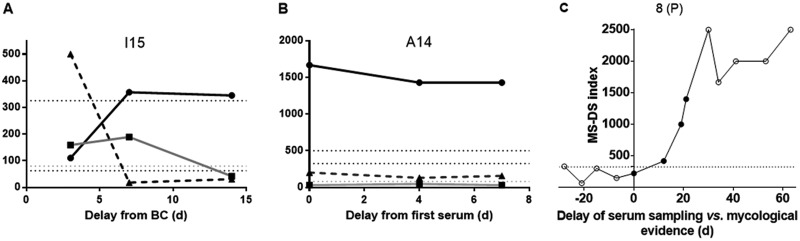
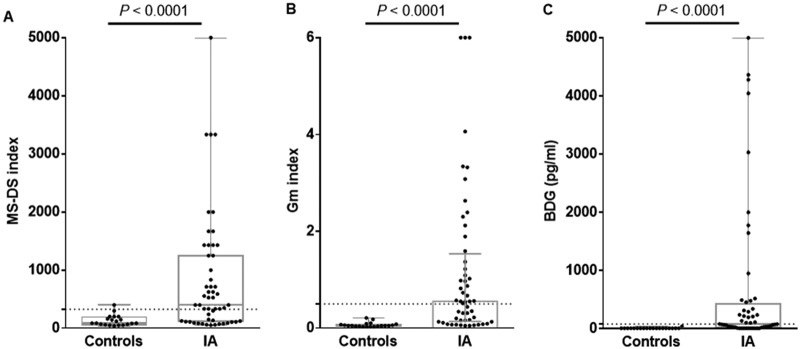
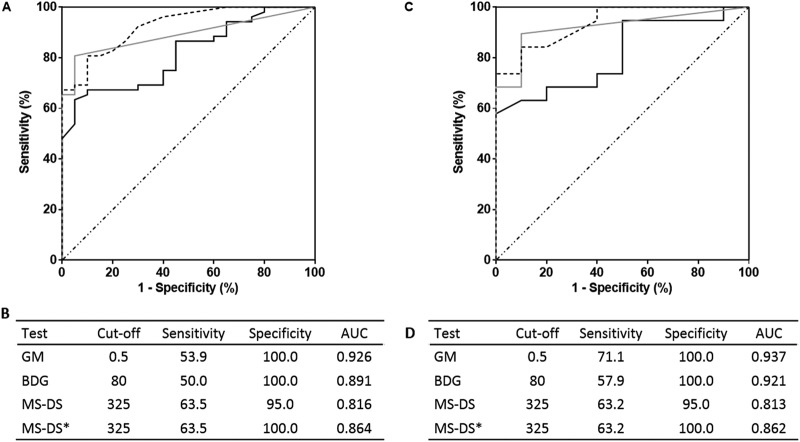
A mass spectrometry (MS) method that detects a serum disaccharide (DS) (MS-DS) was recently described for the diagnosis of invasive fungal infections (IFI). We carried out a European collaborative study to evaluate this assay. Patients with the following IFI were selected according to the availability of sera obtained at about the time that IFI was documented: invasive candidiasis (IC; = 26 patients), invasive aspergillosis (IA; = 19), and mucormycosis (MM; = 23). Control sera originated from 20 neutropenic patients and 20 patients with bacteremia. MS-DS was carried out in blind manner for the diagnosis of IFI. A diagnosis of IC or IA was confirmed by detection of mannan (Man) or galactomannan (GM), respectively, associated with detection of (1,3)-β-d-glucan (BDG) in both infections. MM was detected by quantitative real-time PCR (qPCR). All tests discriminated sera from patients with IC from sera from control subjects with bacteremia ( ≤ 0.0009). For IC, the MS-DS sensitivity and specificity were 51% and 87%, respectively. MS-DS complemented the high specificity of Man monitoring. All tests discriminated sera from IA patients from sera from neutropenic controls ( ≤ 0.0009). For IA, MS-DS sensitivity and specificity were 64% and 95%, respectively. Only 13/36 serum samples from patients with MM were concordant by MS-DS and qPCR (6 were positive, and 7 were negative); 14 were positive by MS-DS alone. qPCR and MS-DS made a similar contribution to the diagnosis of MM. In patients undergoing long-term monitoring, the persistent circulation of serum disaccharide was observed, whereas DNA was detected only for a short period after initiation of treatment. MS-DS has an important role to play in the early diagnosis of IFI. Its panfungal nature and complementarity with other tests may justify its use in the management of IFI.
一种用于检测血清二糖(MS-DS)的质谱(MS)方法最近被描述用于侵袭性真菌感染(IFI)的诊断。我们进行了一项欧洲合作研究来评估该检测方法。根据获得疑似 IFI 时的血清样本,选择了以下 IFI 患者:侵袭性念珠菌病(IC;=26 例)、侵袭性曲霉病(IA;=19 例)和毛霉病(MM;=23 例)。对照血清来自 20 例中性粒细胞减少症患者和 20 例菌血症患者。MS-DS 以盲法进行,用于 IFI 的诊断。IC 或 IA 的诊断通过分别检测甘露聚糖(Man)或半乳甘露聚糖(GM),以及在两种感染中检测(1,3)-β-D-葡聚糖(BDG)来确认。MM 通过定量实时 PCR(qPCR)检测。所有检测方法均能区分 IC 患者血清与菌血症对照血清(≤0.0009)。对于 IC,MS-DS 的灵敏度和特异性分别为 51%和 87%。MS-DS 补充了 Man 监测的高特异性。所有检测方法均能区分 IA 患者血清与中性粒细胞减少症对照血清(≤0.0009)。对于 IA,MS-DS 的灵敏度和特异性分别为 64%和 95%。仅 36 例 MM 患者的血清样本中有 13 例通过 MS-DS 和 qPCR 检测结果一致(6 例阳性,7 例阴性);14 例仅通过 MS-DS 检测阳性。qPCR 和 MS-DS 对 MM 的诊断均有重要作用。在接受长期监测的患者中,观察到血清二糖的持续循环,而在开始治疗后仅短时间内检测到 DNA。MS-DS 在 IFI 的早期诊断中具有重要作用。其泛真菌特性和与其他检测方法的互补性可能使其在 IFI 的管理中具有应用价值。