Duesenberg Moritz, Wolf Oliver T, Metz Sophie, Roepke Stefan, Fleischer Juliane, Elias Valentina, Renneberg Babette, Otte Christian, Wingenfeld Katja
Charité - Universitätsmedizin Berlin, corporate member of Freie Universität Berlin, Humboldt-Universität zu Berlin and Berlin Institute of Health, Klinik für Psychiatrie und Psychotherapie, Campus Benjamin Franklin, Berlin, Germany.
Institute of Cognitive Neuroscience, Department of Cognitive Psychology, Ruhr University Bochum, Bochum, Germany.
Eur J Psychotraumatol. 2019 Feb 13;10(1):1568134. doi: 10.1080/20008198.2019.1568134. eCollection 2019.
: Previously, we found that patients with borderline personality disorder (BPD) but not healthy controls (HC) showed improved memory retrieval after hydrocortisone administration. In this study, we examined whether increases in endogenous cortisol after psychosocial stress are associated with memory function in patients with BPD and in healthy individuals. : We recruited 49 female patients with BPD and 49 female HC. All participants were exposed to a psychosocial stressor, the Trier Social Stress Test (TSST) and a control condition (Placebo (P-)TSST) in randomized order. Salivary cortisol, alpha amylase (sAA) and blood pressure were measured in response to stress. Subsequently, we examined free recall of a previously learned word list, autobiographical memory, and working memory. : We found a stresstimegroup interaction effect for the cortisol response and for sAA to stress, which is mainly triggered by a slightly different increase in cortisol between groups from pre to post TSST. Furthermore, BPD patients showed a less pronounced increase in diastolic blood pressure compared to HC after stress. There was no effect of stress on memory performance in any tests, either in healthy controls or in patients with BPD. : Our results suggest a slightly blunted response of the HPA axis and the sympathetic nervous system to stress in BPD compared to healthy women. In contrast to hydrocortisone administration, psychosocial stress did not improve memory retrieval in BPD patients. This might be explained by lower cortisol concentrations and parallel increases in norepinephrine and negative affect after stress.
此前,我们发现边缘型人格障碍(BPD)患者而非健康对照者(HC)在给予氢化可的松后记忆提取能力有所改善。在本研究中,我们检验了社会心理应激后内源性皮质醇的增加是否与BPD患者及健康个体的记忆功能相关。
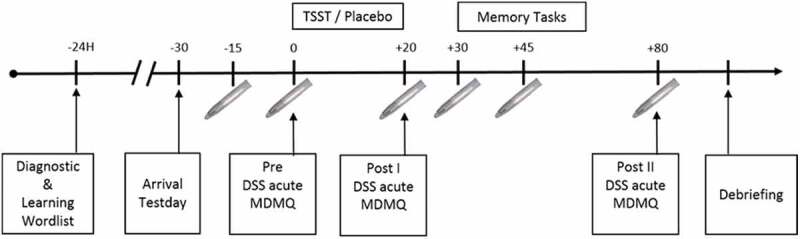
我们招募了49名女性BPD患者和49名女性HC。所有参与者按随机顺序接受社会心理应激源——特里尔社会应激测试(TSST)和对照条件(安慰剂(P-)TSST)。测量对应激的唾液皮质醇、α淀粉酶(sAA)和血压。随后,我们检验了对先前学习的单词列表的自由回忆、自传体记忆和工作记忆。
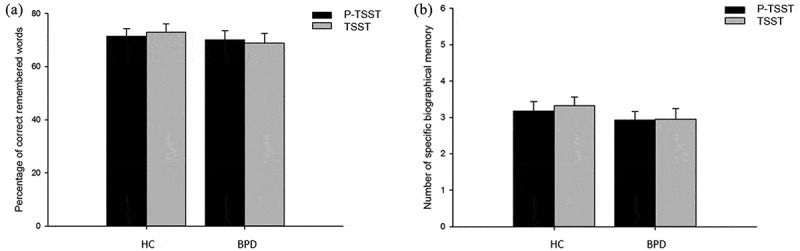
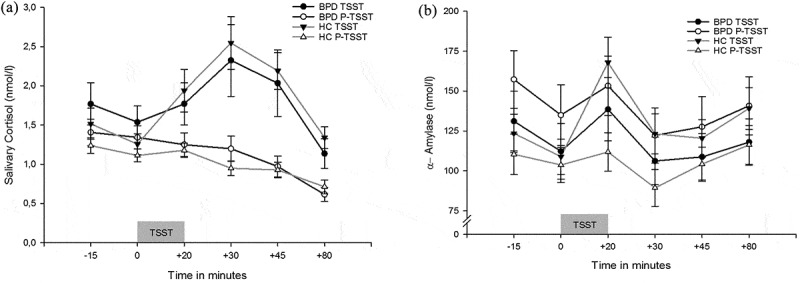
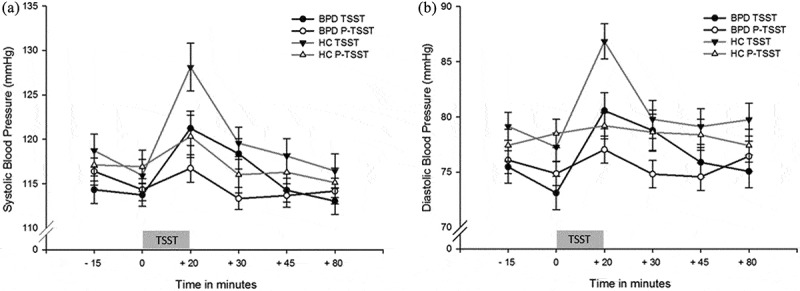
我们发现皮质醇反应和sAA对应激的反应存在应激时间组交互效应,这主要是由TSST前后各组皮质醇的轻微不同增加所引发。此外,应激后BPD患者的舒张压升高不如HC明显。在健康对照者或BPD患者中,应激对任何测试中的记忆表现均无影响。
我们的结果表明,与健康女性相比,BPD患者的下丘脑-垂体-肾上腺(HPA)轴和交感神经系统对应激反应略有迟钝。与给予氢化可的松不同,社会心理应激并未改善BPD患者的记忆提取。这可能是由于应激后皮质醇浓度较低以及去甲肾上腺素和消极情绪同时增加所致。