Unit of Obstetrics and Gynecology, Department of Biomedical and Clinical Sciences, ASST Fatebenefratelli Sacco, Hospital "L. Sacco", University of Milan, Milan, Italy.
Centre for Fetal Research Giorgio Pardi, University of Milan, Milan, Italy.
PLoS One. 2019 Feb 21;14(2):e0212194. doi: 10.1371/journal.pone.0212194. eCollection 2019.
HIV-1 infected patients show impaired semen parameters. Currently, it is not clear whether HIV-1 infection itself or antiretroviral therapy have an effect on semen parameters. We aim evaluate semen quality in a large cohort of fertile HIV-1 infected men under stable highly active antiretroviral therapy (HAART) and to assess the effect of HAART type and duration on semen parameters.
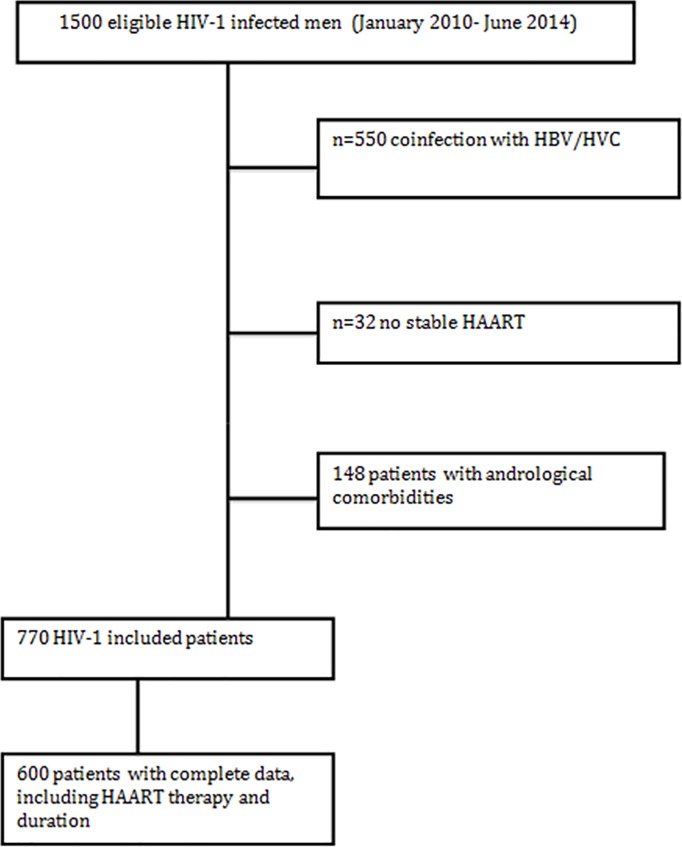
Between January 2010 and June 2014, we enrolled in a retrospective case-control study 770 HIV-1 patients under stable HAART asking a reproductive counselling with their HIV negative partner. Co-infections with HBV or HCV, genital tract infections and known causes of infertility represented exclusion criteria. Semen samples were analysed and compared with the WHO reference values. A multivariate analysis including HAART type and duration, age, viral load and CD4 count, was performed on 600 patients out of 770.
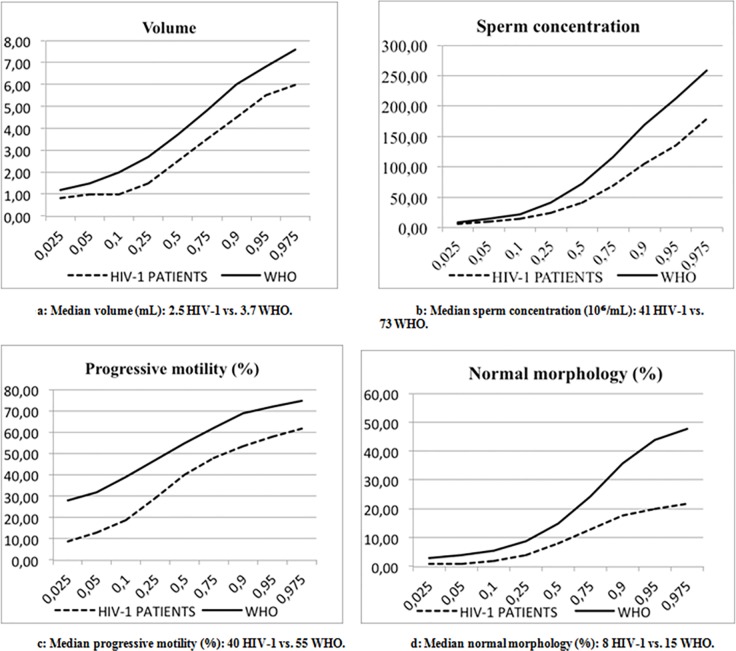
The median values of all semen parameters were significantly lower among HIV-1 infected patients compared to the WHO reference group, with a significant proportion of patients having values below the 5th percentile of the WHO reference value. In a multivariate analysis, only age and viral load negatively impacted progressive motility (β -0.3 (95% CI: -0.5; -0.0) %, p<0.05) and semen morphology (β -0.00 (95% CI: -0.00; -0.00) %, p≤0.01), while no associations were detected as regards HAART type and duration.
HIV-1 infected patients showed a significant impairment of semen parameters compared to the reference values. HAART type and duration showed no associations with semen quality. Further research is needed to investigate implications for clinical care of HIV infected men desiring a child.
HIV-1 感染者的精液参数受损。目前尚不清楚 HIV-1 感染本身还是抗逆转录病毒治疗(ART)对精液参数有影响。我们旨在评估在接受稳定高效抗逆转录病毒治疗(HAART)的大量 HIV-1 感染且有生育能力的男性中精液质量,并评估 HAART 类型和持续时间对精液参数的影响。
2010 年 1 月至 2014 年 6 月,我们对 770 名 HIV-1 感染者进行了回顾性病例对照研究,这些患者正在接受稳定的 HAART,并向其 HIV 阴性的伴侣进行生育咨询。合并乙型肝炎或丙型肝炎感染、生殖道感染和已知不孕原因的患者被排除在外。分析精液样本,并与世界卫生组织(WHO)参考值进行比较。对 770 例患者中的 600 例进行了包括 HAART 类型和持续时间、年龄、病毒载量和 CD4 计数的多变量分析。
与 WHO 参考组相比,HIV-1 感染者的所有精液参数中位数均显著降低,且有相当比例的患者的精液参数值低于 WHO 参考值的第 5 百分位数。多变量分析显示,只有年龄和病毒载量对前向运动精子(β -0.3(95%CI:-0.5;-0.0)%,p<0.05)和精液形态(β -0.00(95%CI:-0.00;-0.00)%,p≤0.01)有负面影响,而 HAART 类型和持续时间与精液质量无关。
与参考值相比,HIV-1 感染者的精液参数明显受损。HAART 类型和持续时间与精液质量无关。需要进一步研究以探讨对希望生育子女的 HIV 感染者的临床护理的影响。