Infectious Disease Department, North Metropolitan International Health Unit PROSICS, Germans Trias i Pujol University Hospital, Universitat Autònoma de Barcelona, Badalona, Spain.
North Metropolitan International Health Unit PROSICS, Institut Català de la Salut, Santa Coloma de Gramenet, Barcelona, Spain.
PLoS One. 2019 Feb 21;14(2):e0212791. doi: 10.1371/journal.pone.0212791. eCollection 2019.
Amoebic colitis is the most frequent clinical manifestation of invasive intestinal infection due to Entamoeba histolytica and a common cause of diarrhoea worldwide. Since higher transmission rates are usually related to poor health and exposure to unhygienic conditions, cases reported in Europe usually involve immigrants and international travellers. The goal of this study was to characterise both the clinical and the epidemiological features of a European population diagnosed with amoebic colitis and then to evaluate the diagnostic tools and therapeutic options applied.
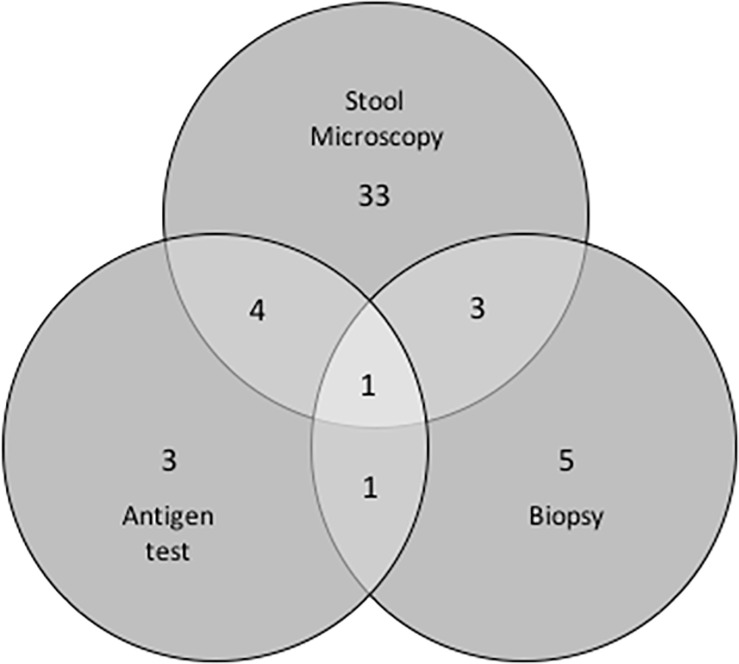
This was a retrospective observational study in which data from all patients diagnosed with amoebic colitis attending at the International Health Units of two tertiary referral hospitals, Germans Trias i Pujol University Hospital (Badalona, North Barcelona Metropolitan Area) and Vall d'Hebron University Hospital (Barcelona city) between 2007 and 2017 were analysed. During the study period 50 patients were diagnosed with amoebic colitis. Thirty-six (72%) were men, and immigrants accounted for 46% of all cases. Antecedents of any international travel were reported for 28 (56%), the most frequent destinations having been the Indian subcontinent, South and Central America and sub-Saharan Africa. Preexisting pathological conditions or any kind of immunosuppression were identified in 29 (58%) patients; of these, 13 (26%) had HIV infection-all of them men who have sex with men-and 5 (10%) had inflammatory bowel disease. Diarrhoea, abdominal pain and dysentery were the most frequently recorded symptoms of invasive amoebae. Diagnosis was made through microbiological study in 45 (90%) and/or histological identification of amoebae in colon biopsies in 10 (20%). After treatment with metronidazole (82%) or tinidazole (8%), all patients had good outcomes. Post-acute intraluminal treatment was indicated in 28 (56%).
Amoebic colitis should be suspected in patients with diarrhoea and compatible epidemiological risk factors (immigration, travelling abroad or men who have sex with men), especially if some degree of immunosuppression concurs. These risk factors must be taken into account in any diagnostic approach to inflammatory bowel disease (IBD), and active searches for stool parasites should be performed in such cases to rule out misdiagnosis or simultaneous amoebic infection. Treatment should include intraluminal anti-amoebic treatment in order to avoid relapse and prevent further spread of the disease.
阿米巴结肠炎是由溶组织内阿米巴引起的侵袭性肠道感染最常见的临床表现,也是全球腹泻的常见病因。由于较高的传播率通常与健康状况不佳和接触不卫生条件有关,因此在欧洲报告的病例通常涉及移民和国际旅行者。本研究的目的是描述在两家三级转诊医院的国际卫生单位就诊的被诊断为阿米巴结肠炎的欧洲人群的临床和流行病学特征,然后评估应用的诊断工具和治疗选择。
这是一项回顾性观察性研究,分析了 2007 年至 2017 年间在两家三级转诊医院的国际卫生单位就诊的所有被诊断为阿米巴结肠炎的患者的数据,这两家医院分别是 Germans Trias i Pujol 大学医院(巴塞罗那市北巴塞隆纳大都市区的 Badalona)和 Vall d'Hebron 大学医院(巴塞罗那市)。在研究期间,共诊断出 50 例阿米巴结肠炎患者。其中 36 例(72%)为男性,移民占所有病例的 46%。28 例(56%)有任何国际旅行史,最常见的目的地是印度次大陆、南美和中美洲以及撒哈拉以南非洲。29 例(58%)患者存在先前存在的病理状况或任何类型的免疫抑制,其中 13 例(26%)为 HIV 感染-均为男男性行为者,5 例(10%)为炎症性肠病。侵袭性阿米巴最常记录的症状是腹泻、腹痛和痢疾。通过微生物研究在 45 例(90%)和/或在 10 例(20%)结肠活检中组织学鉴定阿米巴虫做出诊断。在接受甲硝唑(82%)或替硝唑(8%)治疗后,所有患者均有良好的结局。28 例(56%)需要进行急性腔内治疗。
对于有腹泻和符合流行病学风险因素(移民、出国旅行或男男性行为者)的患者,应怀疑为阿米巴结肠炎,尤其是如果存在某种程度的免疫抑制。在任何炎症性肠病(IBD)的诊断方法中都应考虑这些风险因素,并且应在这些情况下积极搜索粪便寄生虫,以排除误诊或同时发生的阿米巴感染。治疗应包括腔内抗阿米巴治疗,以避免复发并防止疾病进一步传播。