European Programme for Public Health Microbiology Training (EUPHEM), European Centre for Disease Prevention and Control (ECDC), 17165 Solna, Sweden.
National Centre for Microbiology, Institute of Health Carlos III, 28220 Majadahonda, Spain.
Viruses. 2019 Feb 20;11(2):179. doi: 10.3390/v11020179.
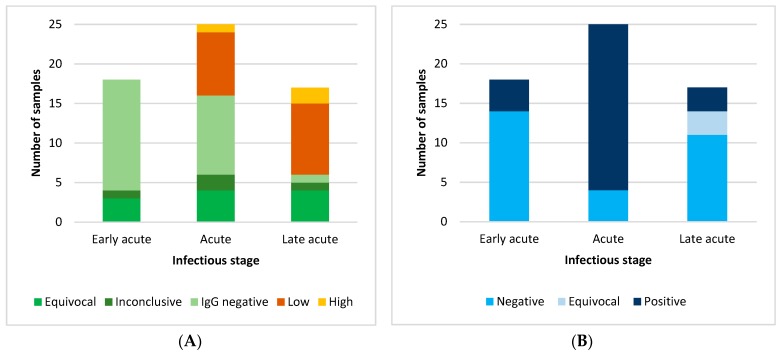
In the absence of viremia, the diagnostics of Zika virus (ZIKV) infections must rely on serological techniques. In order to improve the serological diagnosis of ZIKV, ZIKV-IgA and ZIKV-IgG avidity assays were evaluated. Forty patients returning from ZIKV endemic areas, with confirmed or suspected ZIKV infections were studied. Samples were classified as early acute, acute and late acute according to the number of days post illness onset. Low avidity IgG was only detected at acute and late acute stages and IgA mostly at the early acute and acute stages. The date of sampling provides useful information and can help to choose the best technique to use at a determined moment in time and to interpret low avidity IgG and IgA results, improving the serological diagnosis of ZIKV.
在没有病毒血症的情况下,寨卡病毒(ZIKV)感染的诊断必须依赖血清学技术。为了提高寨卡病毒的血清学诊断,评估了寨卡病毒 IgA 和 IgG 亲和力检测。对 40 名从寨卡病毒流行地区返回、确诊或疑似寨卡病毒感染的患者进行了研究。根据发病后天数,将样本分为早期急性、急性和晚期急性。低亲和力 IgG 仅在急性和晚期急性阶段检测到,IgA 主要在早期急性和急性阶段检测到。采样日期提供了有用的信息,并有助于在特定时间选择最佳技术,并解释低亲和力 IgG 和 IgA 结果,从而改善寨卡病毒的血清学诊断。