Department of Addiction Studies, School of Medical, Kashan University of Medical Sciences, Kashan, I.R, Iran.
Department of Pharmacology, School of Medicine, Kashan University of Medical Sciences, Kashan, I.R, Iran.
BMC Psychiatry. 2019 Feb 21;19(1):77. doi: 10.1186/s12888-019-2059-x.
This study determined the effects of a novel combination of vitamin D and probiotic on metabolic and clinical symptoms in chronic schizophrenia.
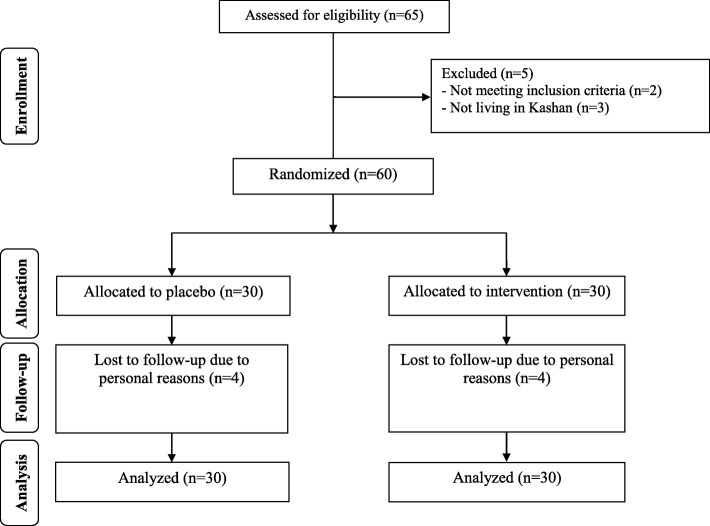
This trial was conducted among 60 patients with chronic schizophrenia to receive either 50,000 IU vitamin D3 every 2 weeks plus 8 × 10 CFU/day probiotic (n = 30) or placebo (n = 30) for 12 weeks.
Vitamin D and probiotic co-supplementation was associated with a significant improvement in the general (- 3.1 ± 4.7 vs. + 0.3 ± 3.9, P = 0.004) and total PANSS scores (- 7.4 ± 8.7 vs. -1.9 ± 7.5, P = 0.01). Vitamin D and probiotic co-supplementation also significantly increased total antioxidant capacity (+ 51.1 ± 129.7 vs. -20.7 ± 53.3 mmol/L, P = 0.007), and significantly decreased malondialdehyde (- 0.3 ± 0.9 vs. + 0.2 ± 0.4 μmol/L, P = 0.01) and high sensitivity C-reactive protein levels (- 2.3 ± 3.0 vs. -0.3 ± 0.8 mg/L, P = 0.001) compared with the placebo. Moreover, taking vitamin D plus probiotic significantly reduced fasting plasma glucose (- 7.0 ± 9.9 vs. -0.2 ± 9.9 mg/dL, P = 0.01), insulin concentrations (- 2.7 ± 2.3 vs. + 0.4 ± 2.0 μIU/mL, P < 0.001), homeostasis model of assessment-estimated insulin resistance (- 0.8 ± 0.7 vs. + 0.1 ± 0.7, P < 0.001), triglycerides (- 7.8 ± 25.2 vs. + 10.1 ± 30.8 mg/dL, P = 0.01) and total cholesterol levels (- 4.9 ± 15.0 vs. + 5.9 ± 19.5 mg/dL, P = 0.04) and total-/HDL-cholesterol ratio (- 0.1 ± 0.6 vs. + 0.3 ± 0.8, P = 0.04).
Probiotic and vitamin D for 12 weeks to chronic schizophrenia had beneficial effects on the general and total PANSS score, and metabolic profiles.
This study was retrospectively registered in the Iranian website ( www.irct.ir ) for clinical trials registration ( http://www.irct.ir : IRCT2017072333551N2). 07-31-2017 2.
本研究旨在确定维生素 D 和益生菌的新组合对慢性精神分裂症患者代谢和临床症状的影响。
本试验纳入了 60 例慢性精神分裂症患者,分别接受 50,000IU 维生素 D3 每 2 周一次加 8×10CFU/天益生菌(n=30)或安慰剂(n=30)治疗 12 周。
维生素 D 和益生菌联合补充与一般(-3.1±4.7 与 +0.3±3.9,P=0.004)和总 PANSS 评分(-7.4±8.7 与 -1.9±7.5,P=0.01)的显著改善相关。维生素 D 和益生菌联合补充还显著增加了总抗氧化能力(+51.1±129.7 与 -20.7±53.3mmol/L,P=0.007),并显著降低了丙二醛(-0.3±0.9 与 +0.2±0.4μmol/L,P=0.01)和高敏 C 反应蛋白水平(-2.3±3.0 与 -0.3±0.8mg/L,P=0.001)与安慰剂相比。此外,服用维生素 D 加益生菌可显著降低空腹血糖(-7.0±9.9 与 -0.2±9.9mg/dL,P=0.01)、胰岛素浓度(-2.7±2.3 与 +0.4±2.0μIU/mL,P<0.001)、稳态模型评估的胰岛素抵抗(-0.8±0.7 与 +0.1±0.7,P<0.001)、甘油三酯(-7.8±25.2 与 +10.1±30.8mg/dL,P=0.01)和总胆固醇水平(-4.9±15.0 与 +5.9±19.5mg/dL,P=0.04)以及总/高密度脂蛋白胆固醇比值(-0.1±0.6 与 +0.3±0.8,P=0.04)。
益生菌和维生素 D 联合治疗慢性精神分裂症 12 周对一般和总 PANSS 评分以及代谢指标均有有益影响。
本研究在伊朗网站(www.irct.ir)进行了回顾性登记(http://www.irct.ir:IRCT2017072333551N2)。2017 年 7 月 31 日 2 点。