Raciborski Filip, Bousquet Jean, Bousqet Jean, Namysłowski Andrzej, Krzych-Fałta Edyta, Tomaszewska Aneta, Piekarska Barbara, Samel-Kowalik Piotr, Białoszewski Artur Z, Walkiewicz Artur, Lipiec Agnieszka, Wojas Oksana, Samoliński Krzysztof, Szylling Anna, Zieliński Wojciech, Sybilski Adam, Grąbczewska Aleksandra, Samoliński Bolesław
1Department of Prevention of Environmental Hazards and Allergology, Medical University of Warsaw, Warsaw, Poland.
MACVIA-France and Fondation FMC VI-LR, Montpellier, France.
Clin Transl Allergy. 2019 Feb 11;9:4. doi: 10.1186/s13601-019-0246-y. eCollection 2019.
Links between multimorbidity of allergic diseases and allergen sensitization are still under debate, especially in adults. This study aimed to establish a relationship between polysensitization and allergic multimorbidity in children and adults and the allergens involved in multimorbidity.
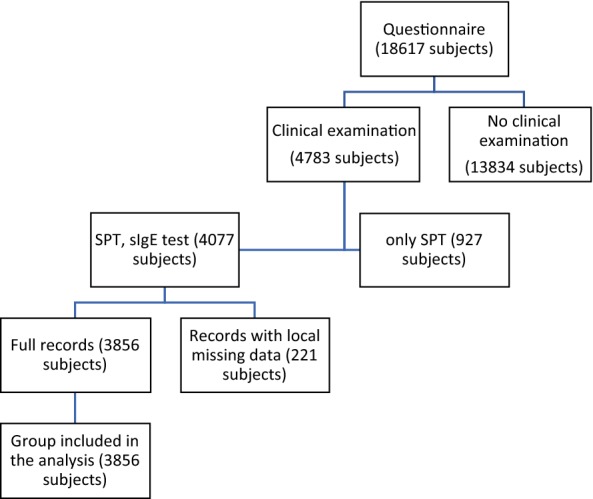
A cross-sectional multicentre study enrolled children aged 6-7 and 13-14 years and adults aged 20-44 years from a Polish national cohort. The diagnosis of allergic diseases was made by a physician. Skin prick tests to 13 allergens and serum IgE levels to 4 allergens were tested.
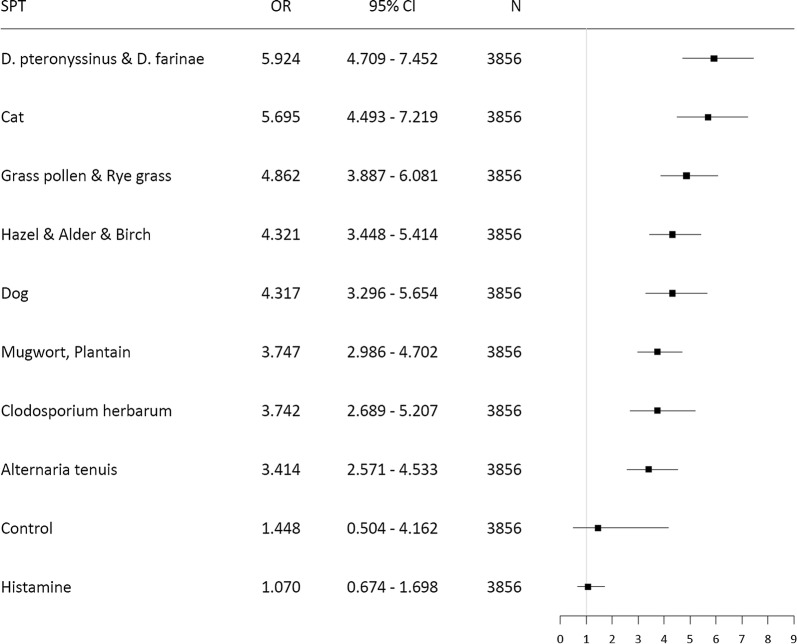
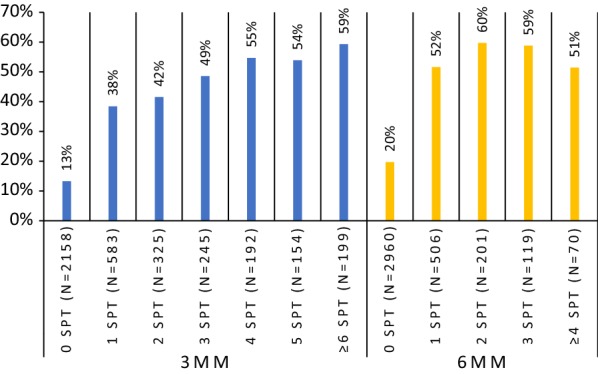
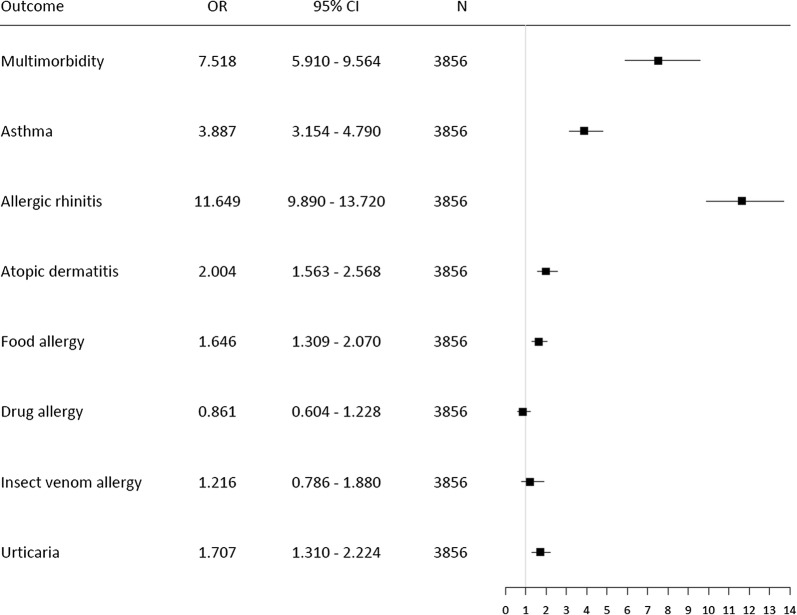
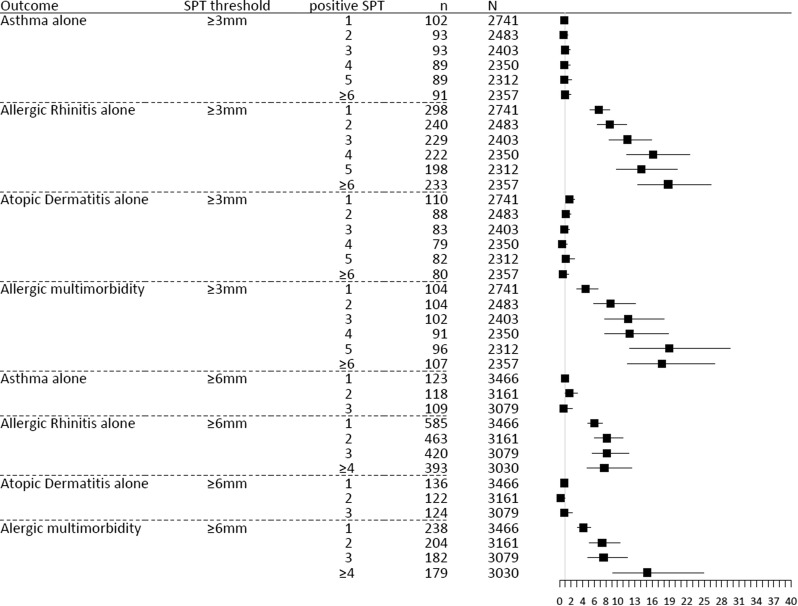
Among the 3856 participants, single disease (asthma, allergic rhinitis or atopic dermatitis) was diagnosed in 27.7% subjects and allergic multimorbidity in 9.3%. Allergic multimorbidity occurred more commonly in children than in adults (p < 0.01). Asthma or atopic dermatitis alone were not associated with polysensitization. Rhinitis and multimorbidity were associated with polysensitization. Allergic multimorbidity occurred in 2.2% of participants with negative skin prick tests, 9.8% of those with one positive prick test (SPT ≥ 3 mm) and 20.6% of polysensitized ones (p < 0.001). There was an increasing risk of multimorbidity depending on the number of positive prick tests for both SPT ≥ 3 mm (OR 9.6-16.5) and SPT ≥ 6 mm (OR 5.9-13.7). A statistically significant relationship was found between allergic multimorbidity and sensitization to cat and mite allergens.
Multimorbidity is associated with polysensitization especially in children compared with adults in Polish population cohort. New insights into single disease patterns were found: bronchial asthma is the strongest risk factor for the development of multimorbidity in comparison with allergic rhinitis and atopic dermatitis.
过敏性疾病的多种合并症与过敏原致敏之间的联系仍存在争议,尤其是在成年人中。本研究旨在确定儿童和成人中多重致敏与过敏性多种合并症之间的关系以及涉及多种合并症的过敏原。
一项横断面多中心研究纳入了来自波兰国家队列的6 - 7岁和13 - 14岁儿童以及20 - 44岁成年人。过敏性疾病由医生诊断。对13种过敏原进行皮肤点刺试验,并检测针对4种过敏原的血清IgE水平。
在3856名参与者中,27.7%的受试者被诊断为单一疾病(哮喘、过敏性鼻炎或特应性皮炎),9.3%被诊断为过敏性多种合并症。过敏性多种合并症在儿童中比在成人中更常见(p < 0.01)。单独的哮喘或特应性皮炎与多重致敏无关。鼻炎和多种合并症与多重致敏有关。在皮肤点刺试验阴性的参与者中,2.2%发生了过敏性多种合并症;在一项点刺试验阳性(SPT≥3mm)的参与者中,9.8%发生了过敏性多种合并症;在多重致敏的参与者中,20.6%发生了过敏性多种合并症(p < 0.001)。对于SPT≥3mm(OR 9.6 - 16.5)和SPT≥6mm(OR 5.9 - 13.7),根据阳性点刺试验的数量,多种合并症的风险增加。发现过敏性多种合并症与对猫和螨过敏原的致敏之间存在统计学显著关系。
在波兰人群队列中,与成人相比,多种合并症与多重致敏相关,尤其是在儿童中。发现了关于单一疾病模式的新见解:与过敏性鼻炎和特应性皮炎相比,支气管哮喘是发生多种合并症的最强危险因素。