Vita Roberto, Di Bari Flavia, Perelli Sarah, Capodicasa Giovanni, Benvenga Salvatore
Department of Clinical and Experimental Medicine, University of Messina, Viale Gazzi, 98125 Messina, Italy.
Master Program on Childhood, Adolescent and Women's Endocrine Health, University of Messina, Viale Gazzi, 98125 Messina, Italy.
J Clin Transl Endocrinol. 2019 Jan 19;15:65-69. doi: 10.1016/j.jcte.2019.01.001. eCollection 2019 Mar.
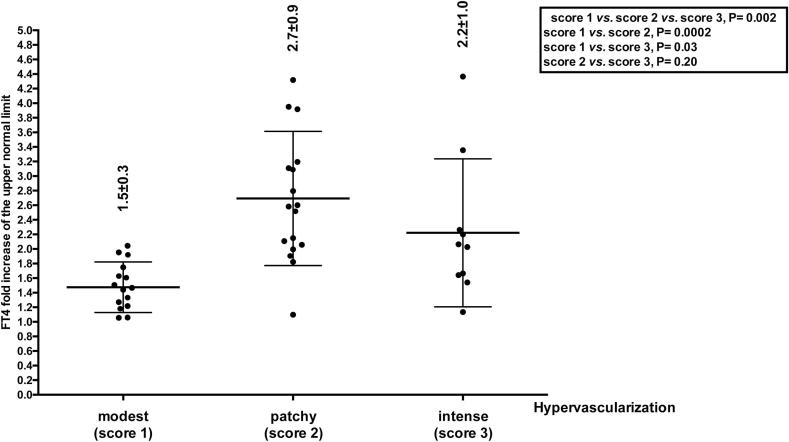
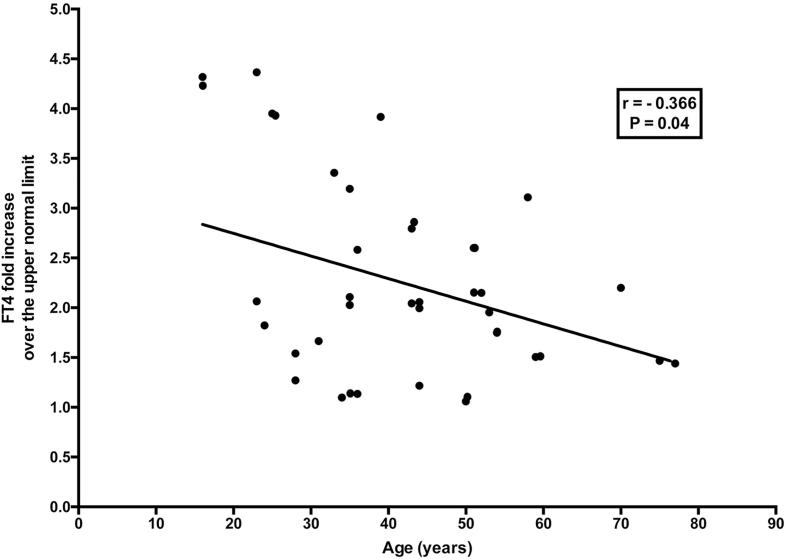
Graves' disease is characterized by two sonographic features, hypoechogenicity and increased blood flow. The aim of this study was to review retrospectively ultrasound features and biochemical data of a cohort of untreated Graves' disease patients. We reviewed charts of 42 such patients, who were referred to our Endocrinology Unit from January 2013 to May 2018. One operator performed all the thyroid sonographic scans. Serum TSH, FT3, FT4 and TSH-receptor antibodies (TRAb) levels at the time of ultrasound examination were evaluated. Over a mean follow-up of 30.9 months, about one in three patients (38%) experienced at least one recurrence of hyperthyroidism (1.4 ± 0.6 recurrence per patient), either on or off antithyroid drugs. We found that thyroid vascularization correlated directly with thyroid volume and that larger thyroids tended to be more vascularized. We also found that greater vascularization was associated with marked hypoechogenicity, and greater FT4 and TRAb levels. Patients who experienced recurrence(s) had 1.7-fold higher levels of TRAb at onset. In conclusion, thyroid hypervascularization at onset of Graves' disease is an important sonographic feature.
格雷夫斯病具有两个超声特征,即低回声性和血流增加。本研究的目的是回顾一组未经治疗的格雷夫斯病患者的超声特征和生化数据。我们回顾了2013年1月至2018年5月转诊至我们内分泌科的42例此类患者的病历。由一名操作人员进行所有甲状腺超声扫描。评估超声检查时血清促甲状腺激素(TSH)、游离三碘甲状腺原氨酸(FT3)、游离甲状腺素(FT4)和促甲状腺激素受体抗体(TRAb)水平。在平均30.9个月的随访中,约三分之一的患者(38%)经历了至少一次甲状腺功能亢进复发(每位患者1.4±0.6次复发),无论是否使用抗甲状腺药物。我们发现甲状腺血管化与甲状腺体积直接相关,且甲状腺越大,血管化程度往往越高。我们还发现,血管化程度越高与明显的低回声性、更高的FT4和TRAb水平相关。经历复发的患者发病时TRAb水平高出1.7倍。总之,格雷夫斯病发病时甲状腺血管过度增生是一个重要的超声特征。