Ma Xinyue, Qiao Shangna, Sun Hongjing, Su Ruifang, Sun Chunyan, Zhang Mingdi
Department of Food Quality and Safety, College of Food Science and Engineering, Jilin University, Changchun, China.
Department of Food Science and Engineering, College of Food Science and Engineering, Jilin University, Changchun, China.
Front Chem. 2019 Feb 7;7:29. doi: 10.3389/fchem.2019.00029. eCollection 2019.
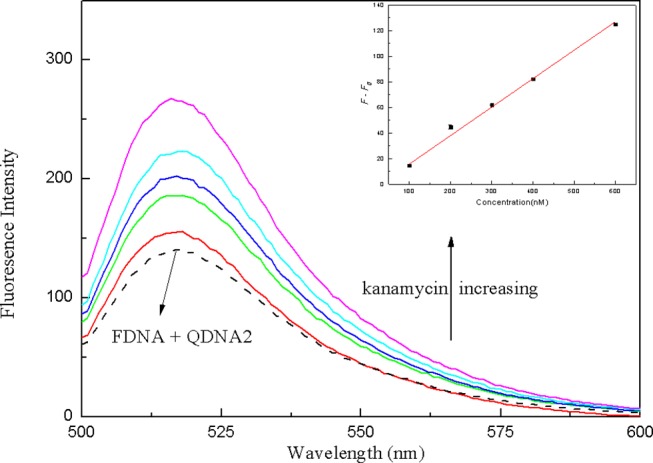
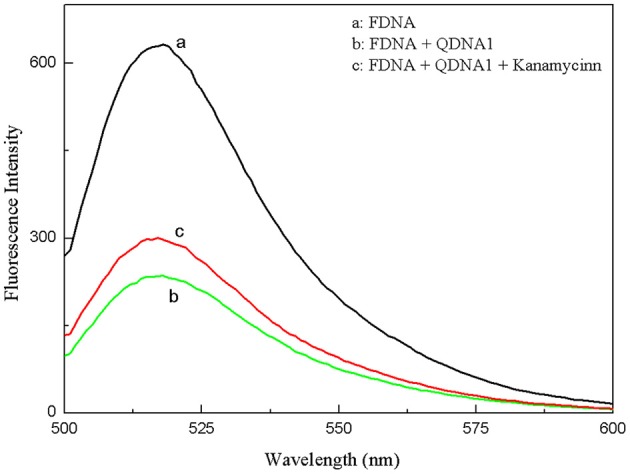
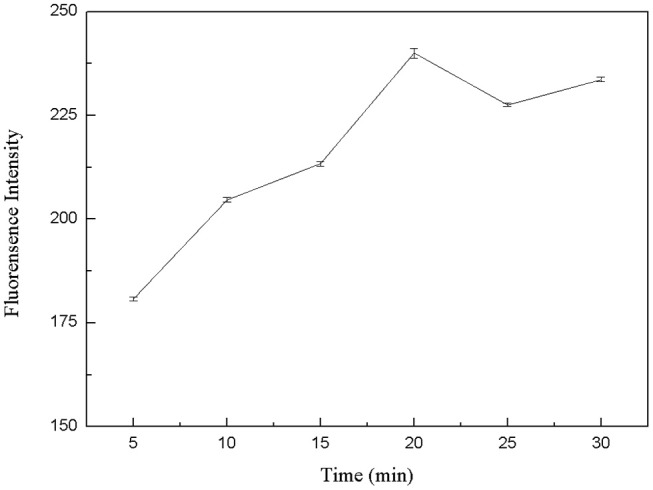
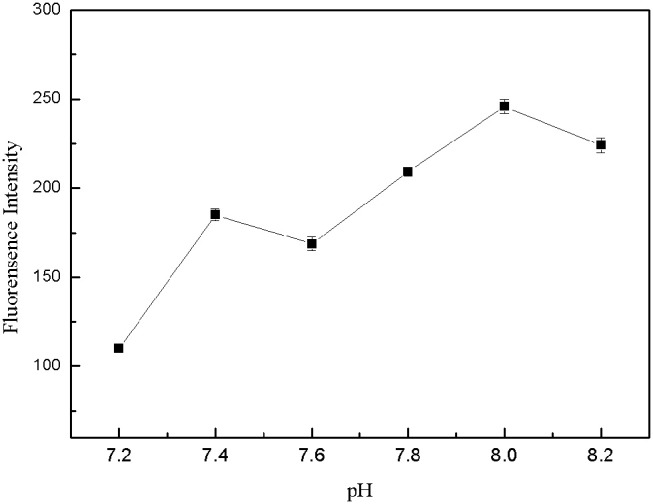
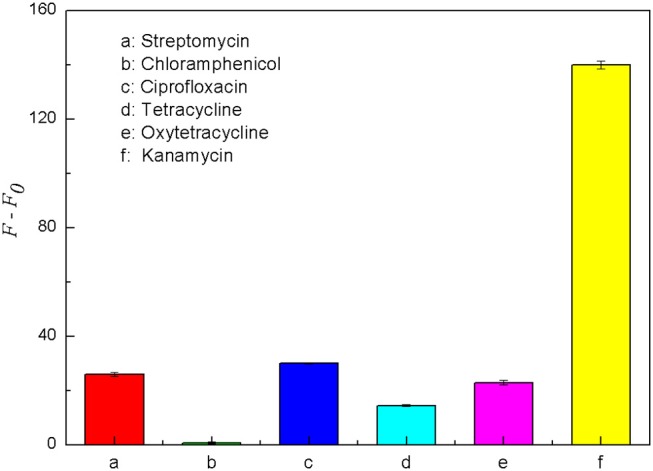
The structure-switching aptamers are designed for the simple and rapid detection of kanamycin based on the signal transduction principle of fluorescence resonance energy transfer (FRET). The structure switch is composed of kanamycin-binding aptamers and the complementary strands, respectively labeled with fluorophore and quencher, denoted as FDNA and QDNA. In the absence of kanamycin, FDNA and QDNA form the double helix structure through the complementary pairing of bases. The fluorophore and the quencher are brought into close proximity, which results in the fluorescence quenching because of the FRET mechanism. In the presence of kanamycin, the FDNA specifically bind to the target due to the high affinity of aptamers, and the QDNA are dissociated. The specific recognition between aptamers and kanamycin will obstruct the formation of structure switch and reduce the efficiency of FRET between FDNA and QDNA, thus leading to the fluorescence enhancement. Therefore, based on the structure-switching aptamers, a simple fluorescent assay for rapid detection of kanamycin was developed. Under optimal conditions, there was a good linear relationship between kanamycin concentration and the fluorescence signal recovery. The linear range of this method in milk samples was 100-600 nM with the detection limit of 13.52 nM (σ), which is well below the maximum residue limit (MRL) of kanamycin in milk. This method shows excellent selectivity for kanamycin over the other common antibiotics. The structure-switching aptamers have been successfully applied to the detection of kanamycin spiked in milk samples with the satisfying recoveries between 101.3 and 109.1%, which is well-consistent with the results from LC-MS/MS. Due to the outstanding advantages of facile operation, rapid detection, high sensitivity, excellent specificity, and low cost, the application and extension of this strategy for rapid determination of antibiotics in food samples may greatly improve the efficiency in food safety and quality supervision.
基于荧光共振能量转移(FRET)信号转导原理,设计了用于简单快速检测卡那霉素的结构转换适体。该结构转换由分别标记有荧光团和猝灭剂的卡那霉素结合适体和互补链组成,分别记为FDNA和QDNA。在没有卡那霉素的情况下,FDNA和QDNA通过碱基互补配对形成双螺旋结构。荧光团和猝灭剂紧密靠近,由于FRET机制导致荧光猝灭。在有卡那霉素的情况下,由于适体的高亲和力,FDNA特异性结合靶标,QDNA解离。适体与卡那霉素之间的特异性识别将阻碍结构转换的形成,并降低FDNA和QDNA之间的FRET效率,从而导致荧光增强。因此,基于结构转换适体,开发了一种用于快速检测卡那霉素的简单荧光测定法。在最佳条件下,卡那霉素浓度与荧光信号恢复之间具有良好的线性关系。该方法在牛奶样品中的线性范围为100 - 600 nM,检测限为13.52 nM(σ),远低于牛奶中卡那霉素的最大残留限量(MRL)。该方法对卡那霉素的选择性优于其他常见抗生素。结构转换适体已成功应用于牛奶样品中添加卡那霉素的检测,回收率在101.3%至109.1%之间,与LC-MS/MS的结果高度一致。由于操作简便、检测快速、灵敏度高、特异性强和成本低等突出优点,该策略在食品样品中抗生素快速测定的应用和推广可能会大大提高食品安全和质量监管的效率。