Laboratory of Molecular Immunobiology, Division of Biological Science, Graduate School of Science and Technology, Nara Institute of Science and Technology, Ikoma, Japan.
Int Rev Cell Mol Biol. 2019;344:1-30. doi: 10.1016/bs.ircmb.2018.08.004. Epub 2018 Oct 26.
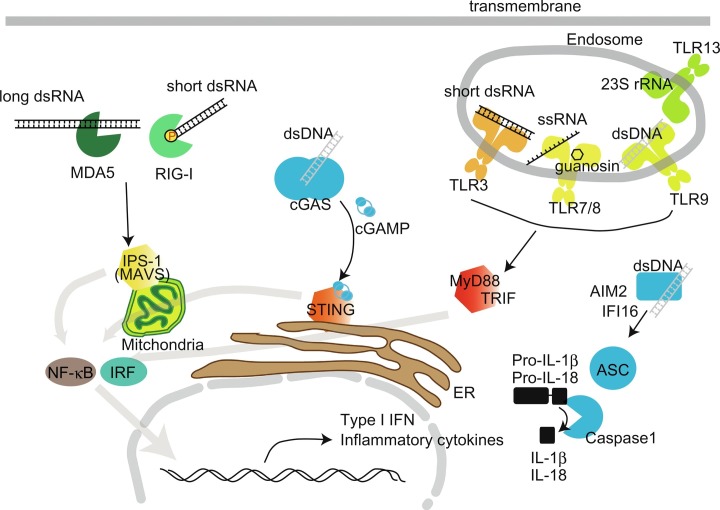
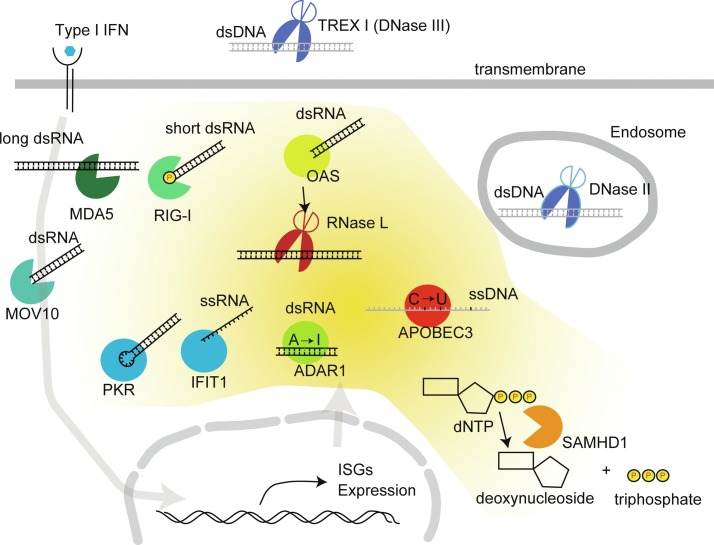
During viral and bacterial infections, the innate immune system recognizes various types of pathogen-associated molecular patterns (PAMPs), such as nucleic acids, via a series of membrane-bound or cytosolic pattern-recognition receptors. These include Toll-like receptors (TLRs), RIG-I-like receptors (RLRs), AIM2-like receptors (ALRs), and cytosolic DNA sensors. The binding of PAMPs to these receptors triggers the production of type I interferon (IFN) and inflammatory cytokines. Type I IFN induces the expression of interferon stimulated genes (ISGs), which protect surrounding cells from infection. Some ISGs are nucleic acids-binding proteins that bind viral nucleic acids and suppress their replication. As nucleic acids are essential components that store and transmit genetic information in every species, infectious pathogens have developed systems to escape from the host nucleic acid recognition system. Host cells also have their own nucleic acids that are frequently released to the extracellular milieu or the cytoplasm during cell death or stress responses, which, if able to bind pattern-recognition receptors, would induce autoimmunity and inflammation. Therefore, host cells have acquired mechanisms to protect themselves from contact with their own nucleic acids. In this review, we describe recent research progress into the nucleic acid recognition mechanism and the molecular bases of discrimination between self and non-self-nucleic acids.
在病毒和细菌感染期间,先天免疫系统通过一系列膜结合或胞质模式识别受体识别各种类型的病原体相关分子模式 (PAMP),例如核酸。这些包括 Toll 样受体 (TLR)、RIG-I 样受体 (RLR)、AIM2 样受体 (ALR) 和胞质 DNA 传感器。PAMP 与这些受体的结合触发 I 型干扰素 (IFN) 和炎症细胞因子的产生。I 型 IFN 诱导干扰素刺激基因 (ISG) 的表达,这些基因保护周围细胞免受感染。一些 ISG 是结合病毒核酸并抑制其复制的核酸结合蛋白。由于核酸是每种物种中存储和传递遗传信息的必需成分,因此感染性病原体已开发出逃避宿主核酸识别系统的系统。宿主细胞在细胞死亡或应激反应期间也会经常将自身核酸释放到细胞外环境或细胞质中,如果能够与模式识别受体结合,就会引起自身免疫和炎症。因此,宿主细胞已经获得了保护自身免受自身核酸接触的机制。在这篇综述中,我们描述了核酸识别机制和自我与非自我核酸区分的分子基础的最新研究进展。