Tsujii Naohito, Nishide Akinori, Hayakawa Jun, Mori Takao
International Center for Materials Nanoarchitectonics (MANA) and Center for Functional Sensor & Actuator (CFSN), National Institute for Materials Science, Tsukuba, Ibaraki 305-0047, Japan.
Center for Exploratory Research, Research & Development Group, Hitachi Ltd., Akanuma 2520, Hatoyama-machi, Hiki-gun, Saitama 350-0395, Japan.
Sci Adv. 2019 Feb 22;5(2):eaat5935. doi: 10.1126/sciadv.aat5935. eCollection 2019 Feb.
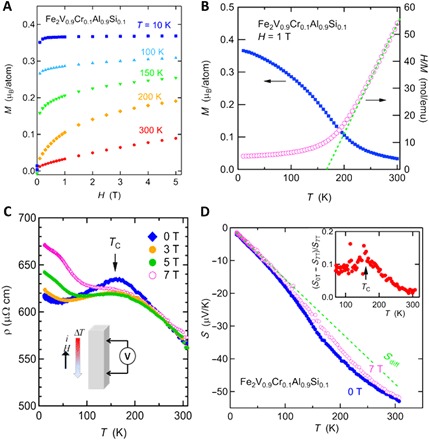
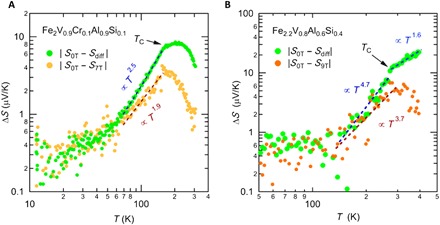
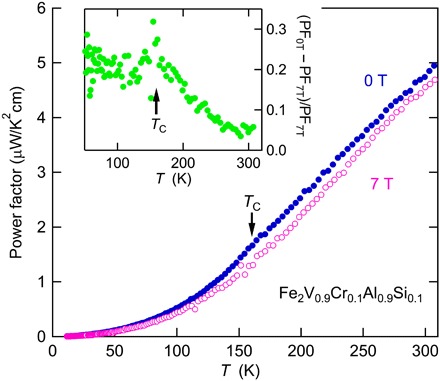
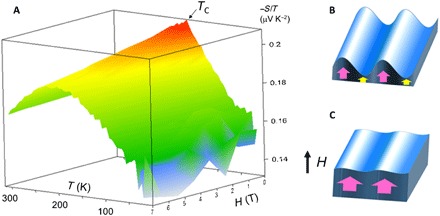
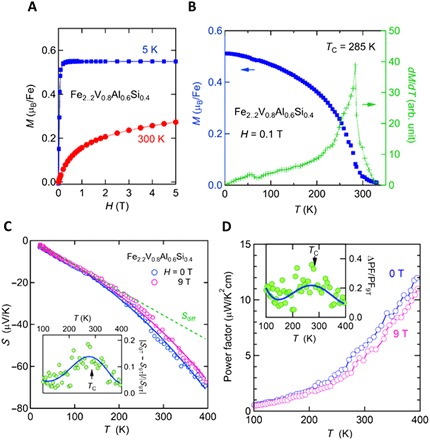
Increasing demand for higher energy efficiency calls for waste heat recovery technology. Thus, facilitating practical thermoelectric generation systems is strongly desired. One option is enhancing the thermoelectric power factor, /, where is the Seebeck coefficient and is the electrical resistivity, although it is still challenging because of the trade-off between and . We demonstrate that enhanced / can be achieved by incorporating magnetic interaction in ferromagnetic metals via the spin fluctuation arising from itinerant electrons. We show that electron-doped Heusler alloys exhibit weak ferromagnetism at near room temperature with a small magnetic moment. A pronounced enhancement around was observed, with a 20% improvement in the power factor from the case where spin fluctuation is suppressed by applying magnetic field. This result supports the merit of using spin fluctuation to further enhance thermoelectric properties and the potential to further probe correlations and synergy between magnetic and thermoelectric fields.
对更高能源效率的需求不断增加,这就需要废热回收技术。因此,迫切需要推动实用的热电发电系统。一种选择是提高热电功率因数,即 / ,其中 是塞贝克系数, 是电阻率,不过由于 和 之间的权衡,这仍然具有挑战性。我们证明,通过巡游电子产生的自旋涨落,在铁磁金属中引入磁相互作用,可以提高 / 。我们表明,电子掺杂的赫斯勒合金在接近室温的 时表现出弱铁磁性,磁矩较小。在 附近观察到显著增强,与通过施加磁场抑制自旋涨落的情况相比,功率因数提高了20%。这一结果支持了利用自旋涨落进一步提高热电性能的优点,以及进一步探索磁场和热电场之间相关性和协同作用的潜力。