Cheng Catherine J, Gelfond Jonathan A L, Strong Randy, Nelson James F
Department of Cell Systems & Anatomy, UT Health San Antonio, San Antonio, Texas.
Barshop Institute for Longevity and Aging Studies, UT Health San Antonio, San Antonio, Texas.
Aging Cell. 2019 Jun;18(3):e12905. doi: 10.1111/acel.12905. Epub 2019 Feb 23.
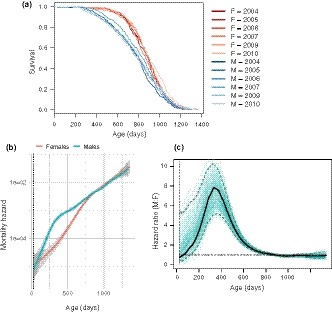
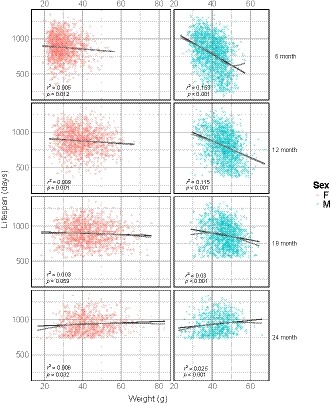
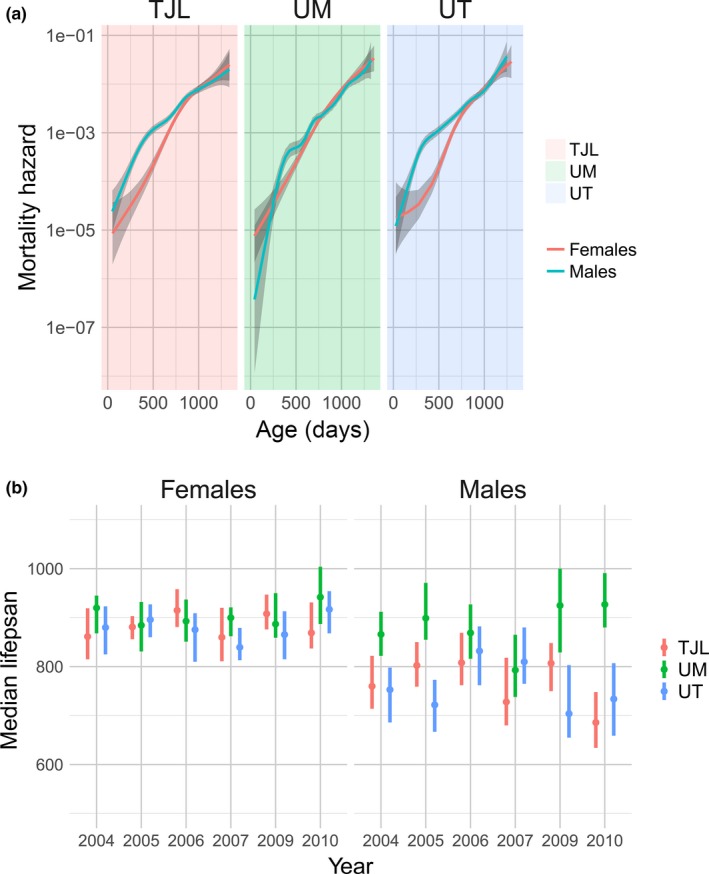
The female survival advantage is a robust characteristic of human longevity. However, underlying mechanisms are not understood, and rodent models exhibiting a female advantage are lacking. Here, we report that the genetically heterogeneous (UM-HET3) mice used by the National Institute on Aging Interventions Testing Program (ITP) are such a model. Analysis of age-specific survival of 3,690 control ITP mice revealed a female survival advantage paralleling that of humans. As in humans, the female advantage in mice was greatest in early adulthood, peaking around 350 days of age and diminishing progressively thereafter. This persistent finding was observed at three geographically distinct sites and in six separate cohorts over a 10-year period. Because males weigh more than females and bodyweight is often inversely related to lifespan, we examined sex differences in the relationship between bodyweight and survival. Although present in both sexes, the inverse relationship between bodyweight and longevity was much stronger in males, indicating that male mortality is more influenced by bodyweight than is female mortality. In addition, male survival varied more across site and cohort than female survival, suggesting greater resistance of females to environmental modulators of survival. Notably, at 24 months the relationship between bodyweight and longevity shifted from negative to positive in both sexes, similar to the human condition in advanced age. These results indicate that the UM-HET3 mouse models the human female survival advantage and provide evidence for greater resilience of females to modulators of survival.
女性生存优势是人类长寿的一个显著特征。然而,其潜在机制尚不清楚,且缺乏表现出女性优势的啮齿动物模型。在此,我们报告美国国立衰老研究所干预测试项目(ITP)所使用的基因异质性(UM-HET3)小鼠就是这样一种模型。对3690只ITP对照小鼠的年龄特异性生存情况分析显示,其女性生存优势与人类相似。与人类一样,小鼠中的女性优势在成年早期最为明显,在约350日龄时达到峰值,此后逐渐减弱。在10年时间里,在三个地理位置不同的地点以及六个独立队列中均观察到了这一持续存在的现象。由于雄性体重比雌性重,且体重通常与寿命呈负相关,我们研究了体重与生存之间关系的性别差异。虽然两性中均存在体重与寿命的负相关关系,但在雄性中这种关系要强得多,这表明雄性死亡率比雌性死亡率受体重的影响更大。此外,雄性生存情况在不同地点和队列间的差异比雌性生存情况更大,这表明雌性对生存环境调节因素的抵抗力更强。值得注意的是,在24个月时,两性中体重与寿命的关系均从负相关转变为正相关,这与人类高龄时的情况相似。这些结果表明,UM-HET3小鼠模拟了人类女性生存优势,并为雌性对生存调节因素具有更强的恢复力提供了证据。