Department of Obstetrics and Gynecology, University of Groningen, University Medical Center Groningen, Groningen, the Netherlands.
Department of Epidemiology, University of Groningen, University Medical Center Groningen, Groningen, the Netherlands.
PLoS One. 2019 Feb 25;14(2):e0212914. doi: 10.1371/journal.pone.0212914. eCollection 2019.
Obesity is an increasing problem worldwide and is associated with serious health risks. Obesity not only reduces physical health, but can also negatively affect levels of perceived stress, mood symptoms, sleep quality and quality of life (QoL), which may lead to further weight gain. We have previously shown that a pre-conception lifestyle intervention reduced weight and improved physical QoL in the short term. In the current study, we assessed the effects of this intervention in women with obesity and infertility on perceived stress, mood symptoms, sleep quality and QoL five years after randomization.
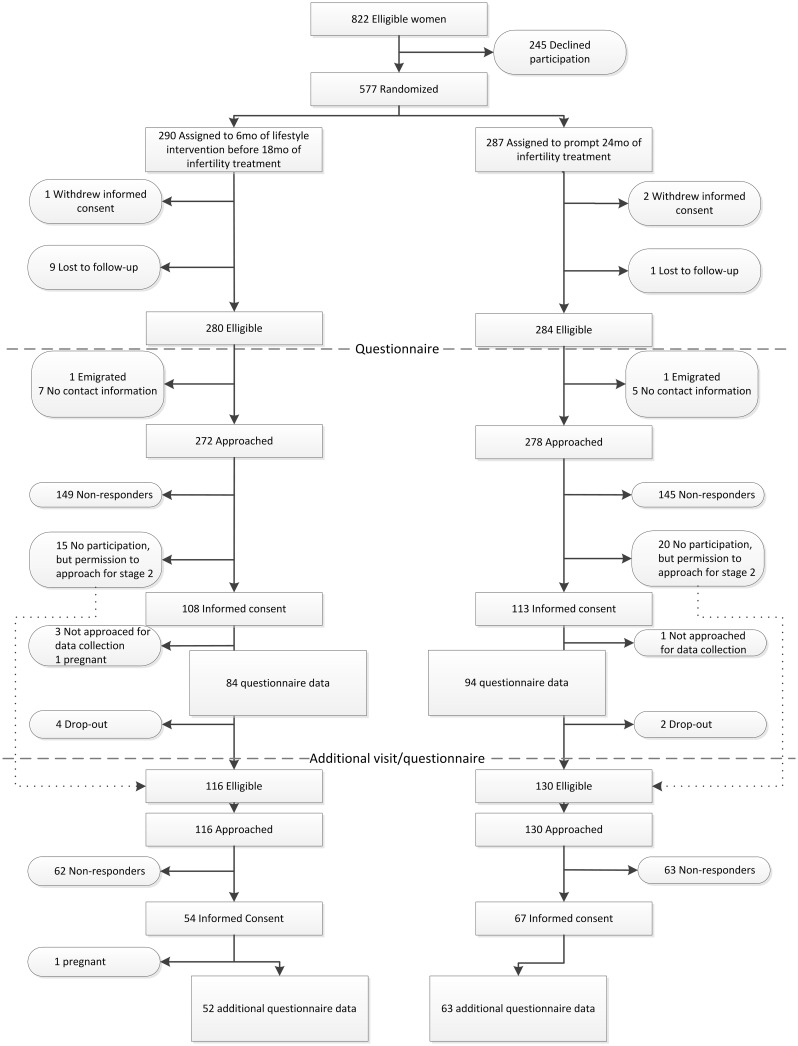
We followed women who participated in the LIFEstyle study. This is a multi-center randomized controlled trial comparing a six-month lifestyle intervention to improve diet and increase physical activity followed by infertility treatment, versus prompt infertility treatment. Participants were 577 women with infertility between 18 and 39 years of age with a body mass index (BMI) ≥ 29 kg/m2. For the current study we measured perceived stress, mood symptoms, sleep quality and QoL in 178 women five years after randomization. T-tests and linear regression models were used to assess differences between the intervention and control groups. Five years after randomization, no differences were observed for perceived stress, mood symptoms, sleep quality and QoL between the intervention (n = 84) and control groups (n = 94). There was selective participation: women who did not participate in the follow-up had lower baseline mental QoL, and benefitted more from the intervention in terms of improved physical QoL during the original LIFEstyle intervention.
We found no evidence that a pre-conception lifestyle intervention improved female well-being five years after randomization.
肥胖是一个全球性的日益严重的问题,与严重的健康风险有关。肥胖不仅会降低身体健康水平,还会对感知压力、情绪症状、睡眠质量和生活质量(QoL)产生负面影响,从而导致进一步的体重增加。我们之前的研究表明,孕前生活方式干预可以在短期内减轻体重和改善身体 QoL。在当前的研究中,我们评估了这种干预措施对肥胖和不孕的女性在随机分组五年后感知压力、情绪症状、睡眠质量和 QoL 的影响。
我们随访了参加 LIFEstyle 研究的女性。这是一项多中心随机对照试验,比较了为期六个月的生活方式干预措施,以改善饮食和增加体力活动,随后进行不孕治疗,与直接进行不孕治疗相比。参与者为 577 名年龄在 18 至 39 岁之间、BMI≥29kg/m2 的不孕女性。为了进行本研究,我们在随机分组五年后测量了 178 名女性的感知压力、情绪症状、睡眠质量和 QoL。使用 t 检验和线性回归模型评估干预组和对照组之间的差异。随机分组五年后,干预组(n=84)和对照组(n=94)之间在感知压力、情绪症状、睡眠质量和 QoL 方面没有差异。存在选择性参与:未参加随访的女性基线心理健康 QoL 较低,并且在原始 LIFEstyle 干预期间从干预中受益更多,身体 QoL 得到改善。
我们没有发现孕前生活方式干预可以在随机分组五年后改善女性的幸福感的证据。