Ren Chao, Ji Yong-Qiang, Liu Hong, Wang Zhe, Wang Jia-Hui, Zhang Cai-Yi, Guan Li-Na, Yin Pei-Yuan
Department of Neurology and Suzhou Clinical Research Center of Neurological Disease, The Second Affiliated Hospital of Soochow University, Suzhou, Jiangsu Province; Department of Neurology, Affiliated Yantai Yuhuangding Hospital of Qingdao University, Yantai, Shandong Province, China.
Department of Nephrology, Affiliated Yantai Yuhuangding Hospital of Qingdao University, Yantai, Shandong Province, China.
Neural Regen Res. 2019 Jul;14(7):1152-1157. doi: 10.4103/1673-5374.251191.
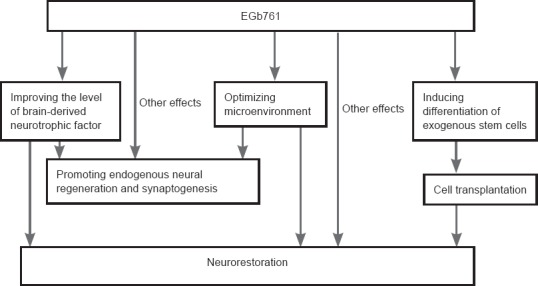
Stem cell transplantation has brought new hope for the treatment of neurological diseases. The key to stem cell therapy lies in inducing the specific differentiation of stem cells into nerve cells. Because the differentiation of stem cells in vitro and in vivo is affected by multiple factors, the final differentiation outcome is strongly associated with the microenvironment in which the stem cells are located. Accordingly, the optimal microenvironment for inducing stem cell differentiation is a hot topic. EGb761 is extracted from the leaves of the Ginkgo biloba tree. It is used worldwide and is becoming one of the focuses of stem cell research. Studies have shown that EGb761 can antagonize oxygen free radicals, stabilize cell membranes, promote neurogenesis and synaptogenesis, increase the level of brain-derived neurotrophic factors, and replicate the environment required during the differentiation of stem cells into nerve cells. This offers the possibility of using EGb761 to induce the differentiation of stem cells, facilitating stem cell transplantation. To provide a comprehensive reference for the future application of EGb761 in stem cell therapy, we reviewed studies investigating the influence of EGb761 on stem cells. These started with the composition and neuropharmacology of EGb761, and eventually led to the finding that EGb761 and some of its important components play important roles in the differentiation of stem cells and the protection of a beneficial microenvironment for stem cell transplantation.
干细胞移植为神经疾病的治疗带来了新希望。干细胞治疗的关键在于诱导干细胞定向分化为神经细胞。由于干细胞在体外和体内的分化受多种因素影响,最终的分化结果与干细胞所处的微环境密切相关。因此,诱导干细胞分化的最佳微环境成为研究热点。银杏叶提取物761(EGb761)是从银杏叶中提取的。它在全球范围内被广泛使用,正成为干细胞研究的重点之一。研究表明,EGb761可对抗氧自由基、稳定细胞膜、促进神经发生和突触形成、提高脑源性神经营养因子水平,并重现干细胞分化为神经细胞过程中所需的环境。这为利用EGb761诱导干细胞分化、推动干细胞移植提供了可能。为了给EGb761在干细胞治疗中的未来应用提供全面参考,我们综述了探究EGb761对干细胞影响的研究。这些研究从EGb761的成分和神经药理学入手,最终发现EGb761及其一些重要成分在干细胞分化以及为干细胞移植保护有益微环境方面发挥着重要作用。