Varkey Mathew, Visscher Dafydd O, van Zuijlen Paul P M, Atala Anthony, Yoo James J
1Wake Forest Institute for Regenerative Medicine, Wake Forest School of Medicine, Medical Center Boulevard, Winston-Salem, NC 27101 USA.
Department of Plastic, Reconstructive and Hand Surgery, Amsterdam University Medical Center, 1081 HV Amsterdam, The Netherlands.
Burns Trauma. 2019 Feb 12;7:4. doi: 10.1186/s41038-019-0142-7. eCollection 2019.
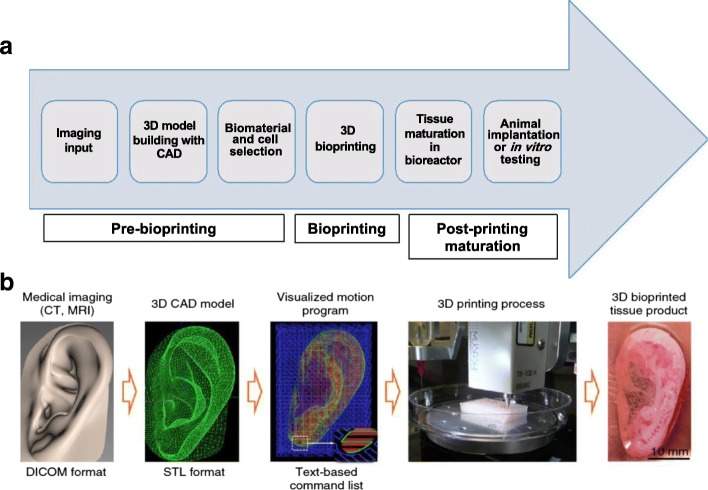
Burns are a significant cause of trauma, and over the years, the focus of patient care has shifted from just survival to facilitation of improved functional outcomes. Typically, burn treatment, especially in the case of extensive burn injuries, involves surgical excision of injured skin and reconstruction of the burn injury with the aid of skin substitutes. Conventional skin substitutes do not contain all skin cell types and do not facilitate recapitulation of native skin physiology. Three-dimensional (3D) bioprinting for reconstruction of burn injuries involves layer-by-layer deposition of cells along with scaffolding materials over the injured areas. Skin bioprinting can be done either in situ or in vitro. Both these approaches are similar except for the site of printing and tissue maturation. There are technological and regulatory challenges that need to be overcome for clinical translation of bioprinted skin for burn reconstruction. However, the use of bioprinting for skin reconstruction following burns is promising; bioprinting will enable accurate placement of cell types and precise and reproducible fabrication of constructs to replace the injured or damaged sites. Overall, 3D bioprinting is a very transformative technology, and its use for wound reconstruction will lead to a paradigm shift in patient outcomes. In this review, we aim to introduce bioprinting, the different stages involved, in vitro and in vivo skin bioprinting, and the various clinical and regulatory challenges in adoption of this technology.
烧伤是创伤的一个重要原因,多年来,患者护理的重点已从单纯的生存转向促进改善功能结局。通常,烧伤治疗,尤其是大面积烧伤的情况,涉及手术切除受伤皮肤并借助皮肤替代物重建烧伤创面。传统的皮肤替代物并不包含所有皮肤细胞类型,也无法促进天然皮肤生理功能的重现。用于烧伤创面重建的三维(3D)生物打印涉及在受伤区域上逐层沉积细胞以及支架材料。皮肤生物打印可以在原位或体外进行。这两种方法除了打印部位和组织成熟度外相似。生物打印皮肤用于烧伤重建的临床转化存在需要克服的技术和监管挑战。然而,将生物打印用于烧伤后的皮肤重建很有前景;生物打印将能够精确放置细胞类型,并精确且可重复地制造构建体以替代受伤或受损部位。总体而言,3D生物打印是一项极具变革性的技术,其用于伤口重建将导致患者结局发生范式转变。在本综述中,我们旨在介绍生物打印、所涉及的不同阶段、体外和体内皮肤生物打印,以及采用该技术时面临的各种临床和监管挑战。