School of Information Engineering, Wuyi University, Jiangmen, China.
Department of Computer Science, Universita' Degli Studi di Milano, Crema, Italy.
Comput Intell Neurosci. 2019 Jan 28;2019:1910624. doi: 10.1155/2019/1910624. eCollection 2019.
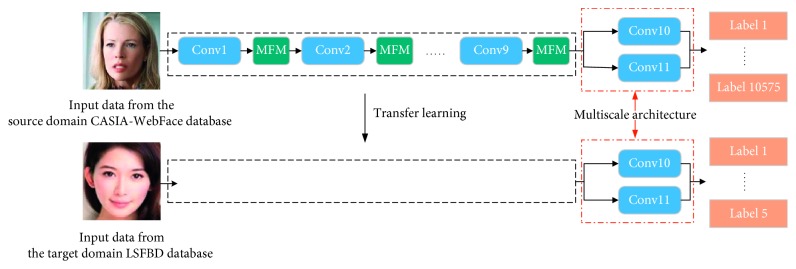
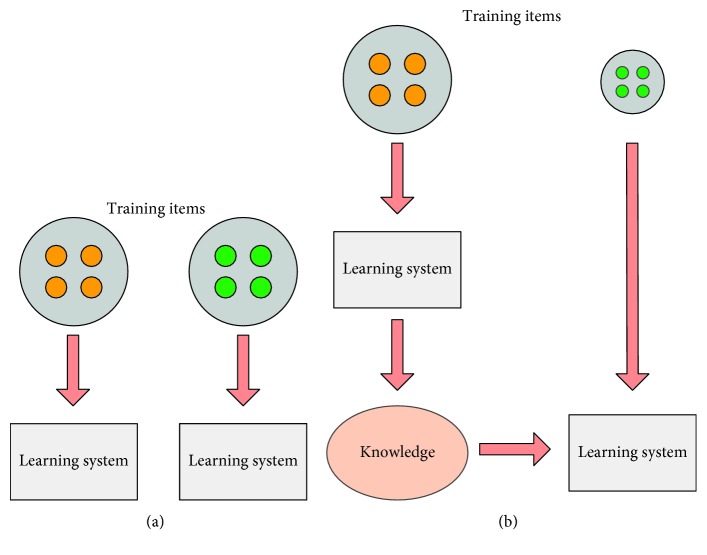
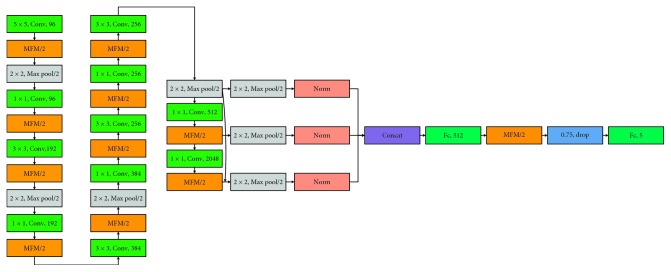
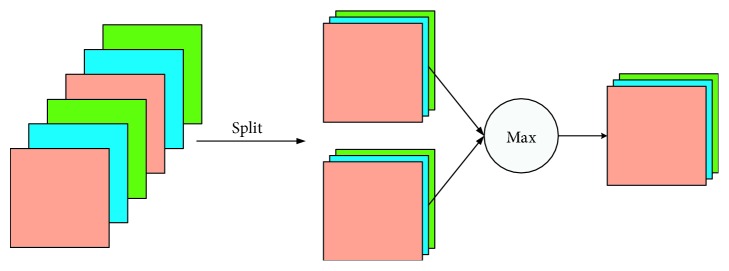
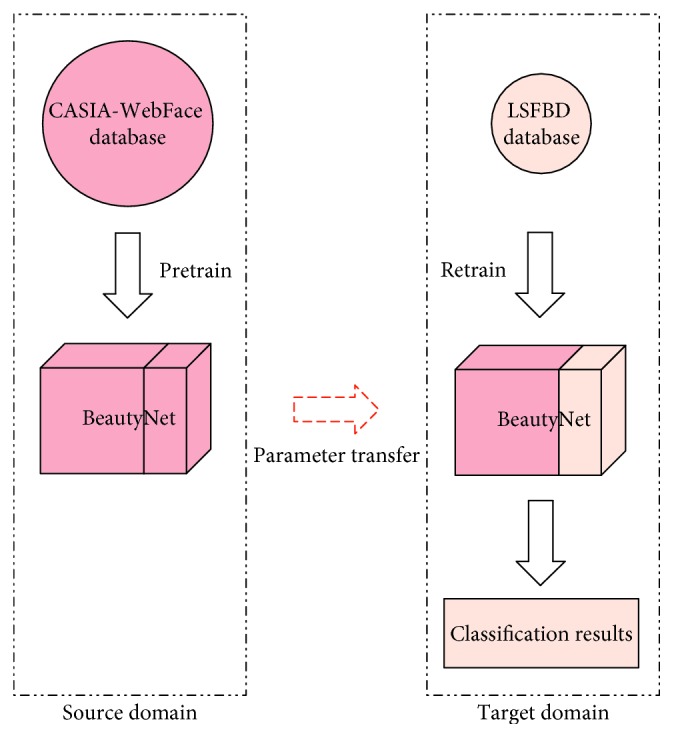
Because of the lack of discriminative face representations and scarcity of labeled training data, facial beauty prediction (FBP), which aims at assessing facial attractiveness automatically, has become a challenging pattern recognition problem. Inspired by recent promising work on fine-grained image classification using the multiscale architecture to extend the diversity of deep features, BeautyNet for unconstrained facial beauty prediction is proposed in this paper. Firstly, a multiscale network is adopted to improve the discriminative of face features. Secondly, to alleviate the computational burden of the multiscale architecture, MFM (max-feature-map) is utilized as an activation function which can not only lighten the network and speed network convergence but also benefit the performance. Finally, transfer learning strategy is introduced here to mitigate the overfitting phenomenon which is caused by the scarcity of labeled facial beauty samples and improves the proposed BeautyNet's performance. Extensive experiments performed on LSFBD demonstrate that the proposed scheme outperforms the state-of-the-art methods, which can achieve 67.48% classification accuracy.
由于缺乏有区分度的人脸表示和稀缺的有标签训练数据,面部美丽预测(FBP),旨在自动评估面部吸引力,已成为一个具有挑战性的模式识别问题。受最近在使用多尺度架构进行细粒度图像分类方面的有希望的工作的启发,本文提出了用于无约束面部美丽预测的 BeautyNet。首先,采用多尺度网络来提高人脸特征的判别能力。其次,为了减轻多尺度架构的计算负担,使用 MFM(最大特征图)作为激活函数,它不仅可以减轻网络并加快网络收敛速度,而且有利于性能。最后,引入迁移学习策略来减轻由于标记的面部美丽样本稀缺而导致的过拟合现象,并提高所提出的 BeautyNet 的性能。在 LSFBD 上进行的广泛实验表明,所提出的方案优于最先进的方法,可以实现 67.48%的分类准确率。