College of Biopharmaceutical and Food Engineering, Shangluo University, Shangluo 726000, China.
Department of Biology, Miami University, Oxford, OH 45056, USA.
Int J Mol Sci. 2019 Feb 22;20(4):958. doi: 10.3390/ijms20040958.
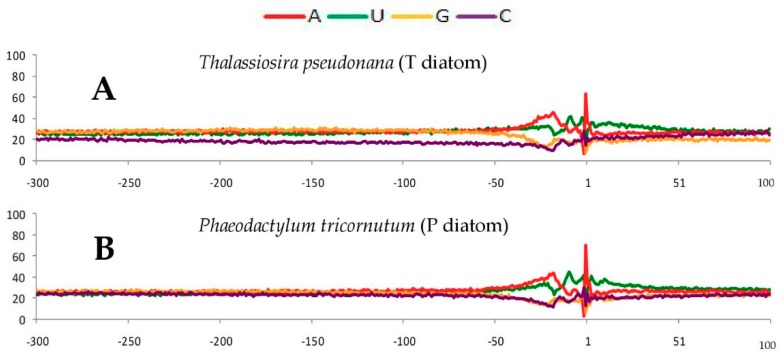
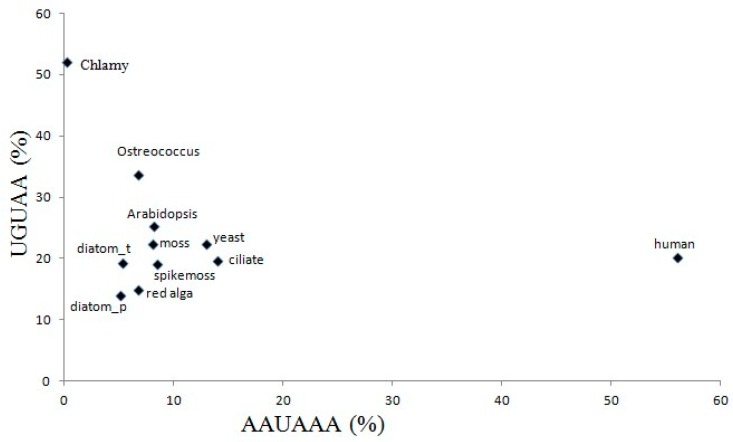
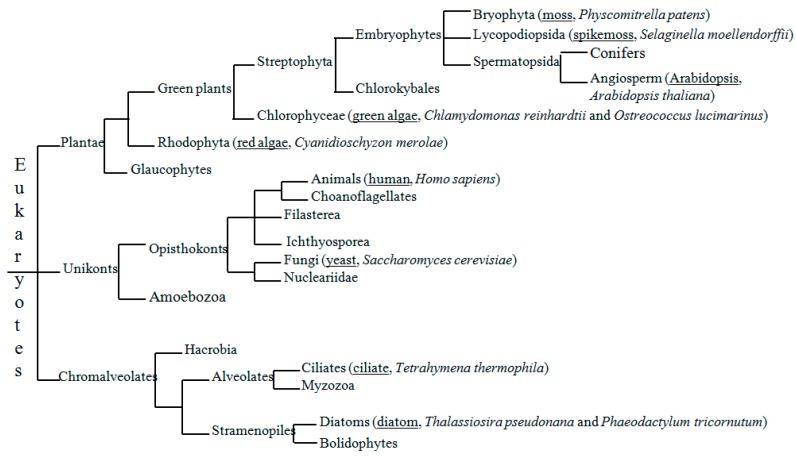
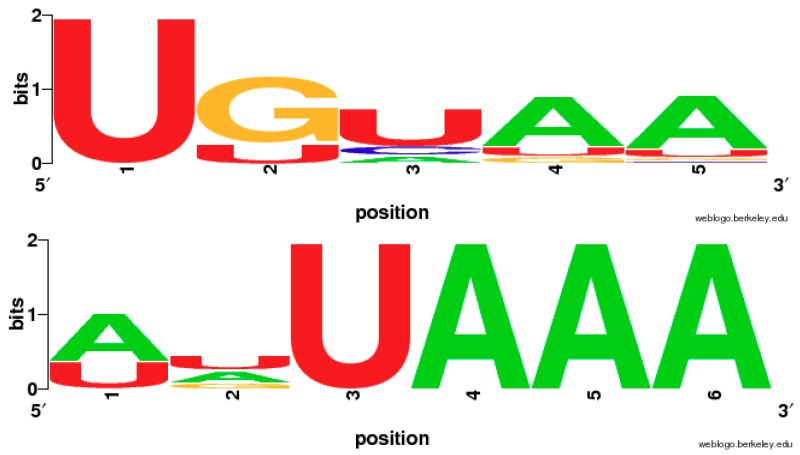
Pre-mRNA cleavage and polyadenylation is an essential step for almost all mRNA in eukaryotes. The -elements around the poly(A) sites, however, are very diverse among different organisms. We characterized the poly(A) signals of seven different species, and compared them with that of four well-studied organisms. We found that ciliates do not show any dominant poly(A) signal; a triplet (UAA) and tetramers (UAAA and GUAA) are dominant in diatoms and red alga, respectively; and green alga uses UGUAA as its poly(A) signal. Spikemoss and moss use conserved AAUAAA signals that are similar to other land plants. Our analysis suggests that the first two bases (NN in NNUAAA) are likely degenerated whereas UAAA appears to be the core motif. Combined with other published results, it is suggested that the highly conserved poly(A) signal AAUAAA may be derived from UAA with an intermediate, putative UAAA, following a pathway of UAA→UAAA→AAUAAA.
前体 mRNA 的切割和多聚腺苷酸化是真核生物中几乎所有 mRNA 的一个必要步骤。然而,多聚(A)位点周围的 - 元件在不同的生物之间差异很大。我们对七种不同物种的多聚(A)信号进行了表征,并将其与四种研究充分的生物进行了比较。我们发现纤毛类动物没有表现出任何优势多聚(A)信号;三核苷酸(UAA)和四核苷酸(UAAA 和 GUAA)分别在硅藻和红藻中占优势;而绿藻使用 UGUAA 作为其多聚(A)信号。石松和苔藓使用与其他陆地植物相似的保守 AAUAAA 信号。我们的分析表明,前两个碱基(NN 在 NNUAAA 中)可能已经退化,而 UAAA 似乎是核心基序。结合其他已发表的结果,表明高度保守的多聚(A)信号 AAUAAA 可能是从 UAA 衍生而来,中间存在一个假定的 UAAA,遵循 UAA→UAAA→AAUAAA 的途径。