Integrative Marine Biology Laboratory (BIOM), CNRS, UMR7232, Sorbonne Université, 66650 Banyuls-sur-Mer, France.
Institute of Earth, Ocean, and Atmospheric Sciences, Rutgers University, New Brunswick, NJ 08901, USA.
Viruses. 2019 Feb 22;11(2):189. doi: 10.3390/v11020189.
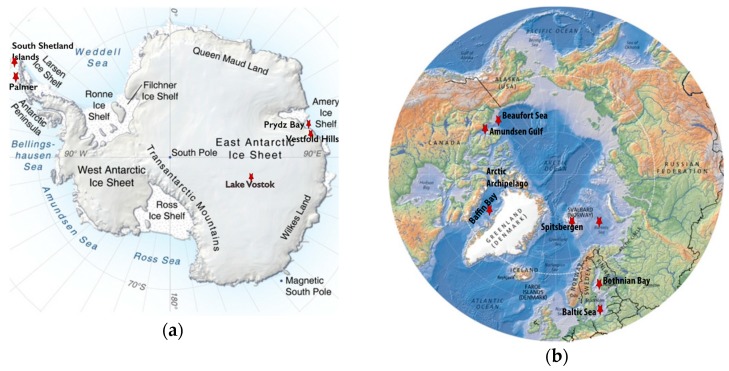
The poles constitute 14% of the Earth's biosphere: The aquatic Arctic surrounded by land in the north, and the frozen Antarctic continent surrounded by the Southern Ocean. In spite of an extremely cold climate in addition to varied topographies, the polar aquatic regions are teeming with microbial life. Even in sub-glacial regions, cellular life has adapted to these extreme environments where perhaps there are traces of early microbes on Earth. As grazing by macrofauna is limited in most of these polar regions, viruses are being recognized for their role as important agents of mortality, thereby influencing the biogeochemical cycling of nutrients that, in turn, impact community dynamics at seasonal and spatial scales. Here, we review the viral diversity in aquatic polar regions that has been discovered in the last decade, most of which has been revealed by advances in genomics-enabled technologies, and we reflect on the vast extent of the still-to-be explored polar microbial diversity and its "enigmatic virosphere".
极地构成了地球生物圈的 14%:北方被陆地环绕的水生北极,以及被南大洋环绕的冰冻南极大陆。尽管极地水生区的气候极其寒冷,地形多样,但仍然充满了微生物生命。即使在冰川下地区,细胞生命也已经适应了这些极端环境,而地球上可能有早期微生物的痕迹。由于在这些极地地区的大部分地区,大型动物的放牧受到限制,病毒被认为是重要的致死因子,从而影响营养物质的生物地球化学循环,进而影响季节性和空间尺度上的群落动态。在这里,我们回顾了过去十年中在水生极地地区发现的病毒多样性,其中大部分是通过基因组学技术的进步揭示的,我们还反思了仍然有待探索的极地微生物多样性及其“神秘的病毒圈”的广阔范围。