Centre for Immunity, Infection and Evolution, Institute for Immunology and Infection Research, School of Biological Sciences, University of Edinburgh, Ashworth Laboratories, West Mains Road, Edinburgh, EH9 3JT, UK.
International Livestock Research Institute, Old Naivasha Road, PO BOX 30709, 00100, Nairobi, Kenya.
Sci Rep. 2019 Feb 27;9(1):2972. doi: 10.1038/s41598-019-39375-z.
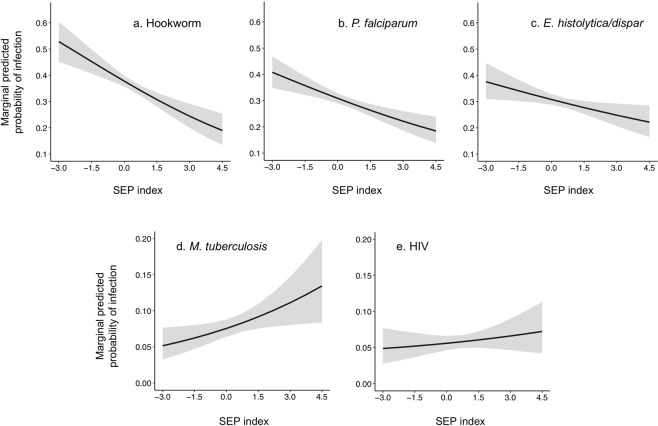
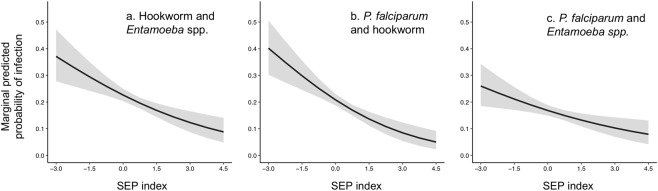
The importance of household socio-economic position (SEP) in shaping individual infectious disease risk is increasingly recognised, particularly in low income settings. However, few studies have measured the extent to which this association is consistent for the range of pathogens that are typically endemic among the rural poor in the tropics. This cross-sectional study assessed the relationship between SEP and human infection within a single community in western Kenya using a set of pathogens with diverse transmission routes. The relationships between household SEP and individual infection with Plasmodium falciparum, hookworm (Ancylostoma duodenale and/or Necator americanus), Entamoeba histolytica/dispar, Mycobacterium tuberculosis, and HIV, and co-infections between hookworm, P. falciparum and E. histolytica/dispar, were assessed using multivariable logistic and multinomial regression. Individuals in households with the lowest SEP were at greatest risk of infection with P. falciparum, hookworm and E. histolytica/dispar, as well as co-infection with each pathogen. Infection with M. tuberculosis, by contrast, was most likely in individuals living in households with the highest SEP. There was no evidence of a relationship between individual HIV infection and household SEP. We demonstrate the existence of a household socio-economic gradient within a rural farming community in Kenya which impacts upon individual infectious disease risk. Structural adjustments that seek to reduce poverty, and therefore the socio-economic inequalities that exist in this community, would be expected to substantially reduce overall infectious disease burden. However, policy makers and researchers should be aware that heterogeneous relationships can exist between household SEP and infection risk for different pathogens in low income settings.
家庭社会经济地位(SEP)在塑造个体传染病风险方面的重要性日益受到认识,尤其是在低收入环境中。然而,很少有研究衡量这种关联在热带农村贫困人口中常见的一系列病原体中具有多大程度的一致性。本横断面研究使用一组具有不同传播途径的病原体,评估了肯尼亚西部一个单一社区中 SEP 与个体感染之间的关系。使用多变量逻辑回归和多项回归评估了家庭 SEP 与个体感染间的关系疟原虫(恶性疟原虫)、钩虫(十二指肠钩口线虫和/或美洲板口线虫)、溶组织内阿米巴(痢疾和迪斯帕拉)、结核分枝杆菌和 HIV 之间的关系,以及钩虫、疟原虫和溶组织内阿米巴之间的合并感染。处于社会经济地位最低的家庭中的个体最有可能感染疟原虫、钩虫和溶组织内阿米巴,以及每个病原体的合并感染。相比之下,生活在社会经济地位最高的家庭中的个体最有可能感染结核分枝杆菌。没有证据表明个体 HIV 感染与家庭 SEP 之间存在关系。我们证明了肯尼亚农村农业社区中存在家庭社会经济梯度,这会影响个体传染病风险。旨在减少贫困的结构调整,以及因此在这个社区中存在的社会经济不平等,有望大大降低整体传染病负担。然而,政策制定者和研究人员应该意识到,在低收入环境中,家庭 SEP 和感染风险之间可能存在不同病原体之间的异质关系。