Toupet Michel, Van Nechel Christian, Hautefort Charlotte, Heuschen Sylvie, Duquesne Ulla, Cassoulet Anne, Bozorg Grayeli Alexis
Otolaryngology Department, Dijon University Hospital, Université Bourgogne-Franche Comté, Dijon, France.
Centre d'Explorations Fonctionnelles Otoneurologiques, Paris, France.
Front Neurol. 2019 Feb 13;10:69. doi: 10.3389/fneur.2019.00069. eCollection 2019.
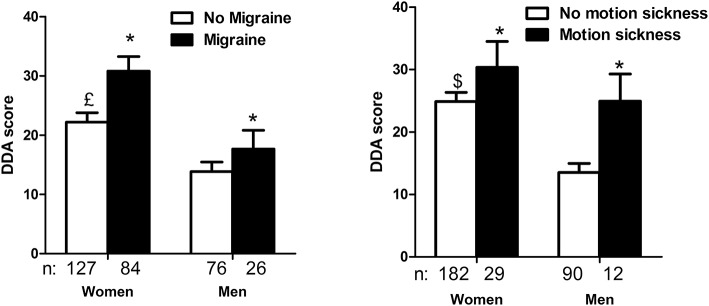
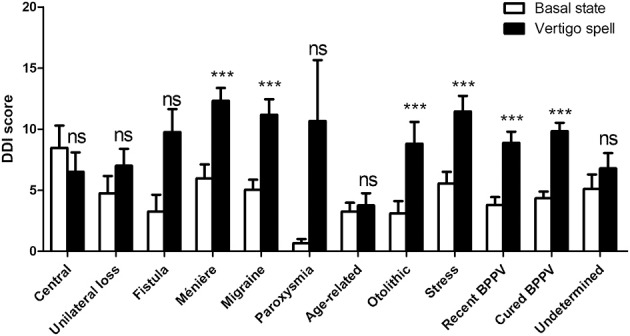
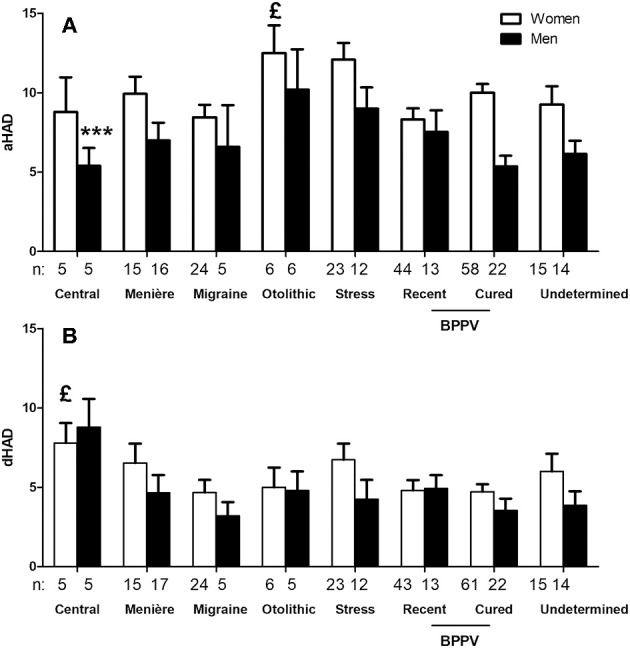
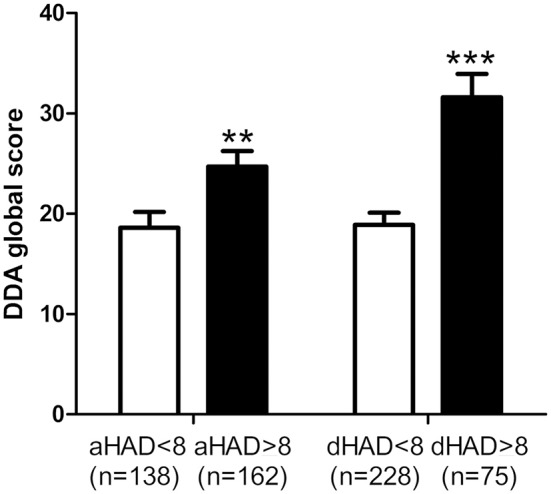
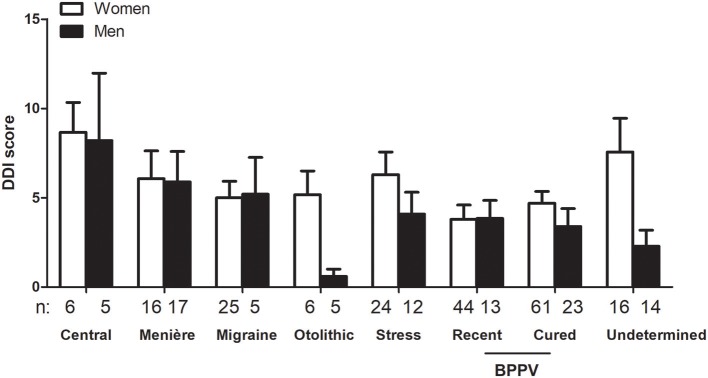
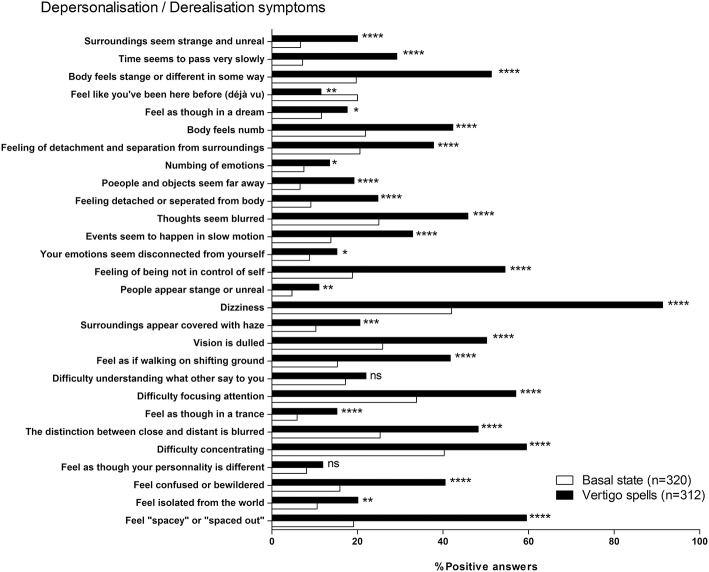
The aim of this study was to investigate the relation between visual and vestibular hypersensitivity, and Depersonalization/Derealization symptoms in patients with chronic dizziness. 319 adult patients with chronic dizziness for more than 3 months (214 females and 105 males, mean age: 58 years, range: 13-90) were included in this prospective cross-sectional study. Patients underwent a complete audio-vestibular workup and 3 auto questionnaires: Hospital Anxiety and Depression (HAD), Depersonalization/Derealization Inventory (DDI), and an in-house questionnaire (Dizziness in Daily Activity, DDA) assessing 9 activities with a score ranging from 0 (no difficulty) to 10 (maximal discomfort) and 11 (avoidance) to detect patients with visual and vestibular hypersensitivity (VVH, a score > 41 corresponding to mean + 1 standard deviation). DDI scores were higher in case of VVH (6.9 ± 6.79, = 55 vs. 4.2 ± 4.81, = 256 without VVH, < 0.001, unpaired test), migraine (6.1 ± 6.40, = 110 vs. 4.0 ± 4.42, = 208no migraine, < 0.001, unpaired test), and motion sickness (6.8 ± 5.93, = 41 vs. 4.4 ± 5.11, = 277 no motion sickness, < 0.01, unpaired test). Women scored DDI higher than men (5.1 ± 5.42, = 213 vs. 3.9 ± 4.91, = 105, respectively, < 0.05, unpaired test). DDI scores were also related to depression and anxiety. DDI score was also higher during spells than during the basal state. During chronic dizziness, Depersonalization/Derealization symptoms seem to be related to anxiety and depression. Moreover, they were prominent in women, in those with visual and vestibular hypersensitivity, migraine, and motion sickness.
本研究旨在探讨慢性头晕患者视觉和前庭超敏反应与人格解体/现实解体症状之间的关系。319例慢性头晕超过3个月的成年患者(214例女性和105例男性,平均年龄:58岁,范围:13 - 90岁)纳入了这项前瞻性横断面研究。患者接受了全面的听-前庭检查以及3份自动问卷:医院焦虑抑郁量表(HAD)、人格解体/现实解体量表(DDI),以及一份内部问卷(日常活动中的头晕,DDA),该问卷评估9项活动,评分范围从0(无困难)到10(最大不适)以及11(避免),以检测视觉和前庭超敏反应患者(VVH,评分>41对应于均值 + 1标准差)。有VVH的患者DDI评分更高(6.9±6.79,n = 55,而无VVH的患者为4.2±4.81,n = 256,P<0.001,非配对检验),偏头痛患者(6.1±6.40,n = 110,而无偏头痛的患者为4.0±4.42,n = 208,P<0.001,非配对检验),以及晕动病患者(6.8±5.93,n = 41,而无晕动病的患者为4.4±5.11,n = 277,P<0.01,非配对检验)。女性的DDI评分高于男性(分别为5.1±5.42,n = 213和3.9±4.91,n = 105,P<0.05,非配对检验)。DDI评分也与抑郁和焦虑有关。发作期间的DDI评分也高于基础状态时。在慢性头晕期间,人格解体/现实解体症状似乎与焦虑和抑郁有关。此外,这些症状在女性、有视觉和前庭超敏反应者、偏头痛患者以及晕动病患者中更为突出。