Universidad Autónoma de Nuevo León, Department of Biochemistry and Molecular Medicine, School of Medicine and University Hospital 'Dr. José E. González', Monterrey, Nuevo León 64460, México.
Institutional Core Laboratories, University of Texas Health Science Center at San Antonio, San Antonio, TX, USA.
Int J Mol Med. 2019 Apr;43(4):1559-1574. doi: 10.3892/ijmm.2019.4112. Epub 2019 Feb 26.
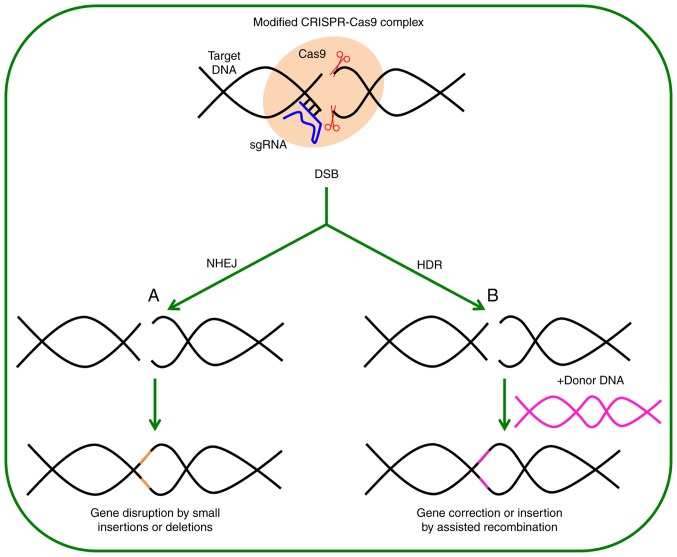
Genome editing reemerged in 2012 with the development of CRISPR/Cas9 technology, which is a genetic manipulation tool derived from the defense system of certain bacteria against viruses and plasmids. This method is easy to apply and has been used in a wide variety of experimental models, including cell lines, laboratory animals, plants, and even in human clinical trials. The CRISPR/Cas9 system consists of directing the Cas9 nuclease to create a site‑directed double‑strand DNA break using a small RNA molecule as a guide. A process that allows a permanent modification of the genomic target sequence can repair the damage caused to DNA. In the present study, the basic principles of the CRISPR/Cas9 system are reviewed, as well as the strategies and modifications of the enzyme Cas9 to eliminate the off‑target cuts, and the different applications of CRISPR/Cas9 as a system for visualization and gene expression activation or suppression. In addition, the review emphasizes on the potential application of this system in the treatment of different diseases, such as pulmonary, gastrointestinal, hematologic, immune system, viral, autoimmune and inflammatory diseases, and cancer.
基因编辑在 2012 年随着 CRISPR/Cas9 技术的发展重新出现,这是一种源自某些细菌防御系统的基因操作工具,用于对抗病毒和质粒。这种方法易于应用,已经在多种实验模型中得到了应用,包括细胞系、实验动物、植物,甚至在人类临床试验中。CRISPR/Cas9 系统由指导 Cas9 核酸酶使用小 RNA 分子作为向导在靶向位置创建双链 DNA 断裂组成。该过程可以永久性地修饰基因组靶序列,修复 DNA 造成的损伤。在本研究中,回顾了 CRISPR/Cas9 系统的基本原理,以及酶 Cas9 的策略和修饰以消除脱靶切割,以及 CRISPR/Cas9 作为可视化和基因表达激活或抑制系统的不同应用。此外,本综述强调了该系统在治疗不同疾病(如肺部、胃肠道、血液系统、免疫系统、病毒、自身免疫和炎症性疾病以及癌症)方面的潜在应用。