Prevention Research Center in St. Louis, Brown School, Washington University in St. Louis, One Brookings Drive, Campus Box 1196, St. Louis, MO, 63130, USA.
Department of Surgery (Division of Public Health Sciences), Washington University School of Medicine, Washington University in St. Louis, St. Louis, MO, 63103, USA.
BMC Public Health. 2019 Feb 28;19(1):246. doi: 10.1186/s12889-019-6566-y.
The human papillomavirus (HPV) vaccine is an underutilized cancer control practice in the United States. Although individual contextual factors are known to impact HPV vaccine coverage rates, the impact of macro-level elements are still unclear. The aim of this analysis was to use HPV vaccination rates to explore the underuse of an evidence-based cancer control intervention and explore broader-level correlates influencing completion rates.
A comprehensive database was developed using individual-level date from the National Immunization Survey (NIS)-Teen (2016) and state-level data collected from publically available sources to analyze HPV vaccine completion. Multi-level logistic models were fit to identify significant correlates. Level-1 (individual) and level-2 (state) correlates were fitted to a random intercept model. Deviance and AIC assessed model fit and sampling weights were applied.
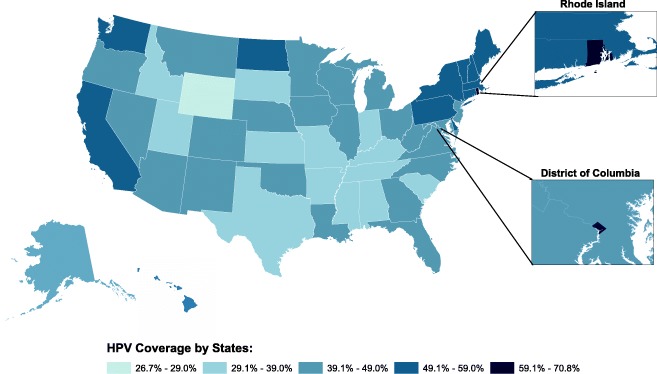
The analysis included 20,495 adolescents from 50 U.S. states and the District of Columbia. Teen age, gender, race/ethnicity, and maternal education were significant individual predictors of HPV completion rates. Significant state-level predictors included sex education policy, religiosity, and HPV vaccine mandate. States with the lowest HPV coverage rates were found to be conservative and highly religious. Little variation in vaccine exemptions and enacted sex and abstinence education polices were observed between states with high and low HPV vaccine coverage suggesting various contextual and situational factors impact HPV vaccine completion rates.
Given that gender, religiosity, political ideology, and education policies are predictors of HPV vaccine completion, the interaction and underlying mechanism of these factors can be used to address the underutilization of the HPV vaccine.
人乳头瘤病毒(HPV)疫苗在美国是一种未充分利用的癌症防控实践。尽管已知个体背景因素会影响 HPV 疫苗接种率,但宏观层面因素的影响仍不清楚。本分析旨在利用 HPV 疫苗接种率来探讨对这一基于证据的癌症防控干预措施的利用不足,并探讨影响完成率的更广泛的层面相关因素。
利用国家免疫调查(NIS)-青少年(2016 年)的个体层面数据和公共来源收集的州层面数据,开发了一个综合数据库,以分析 HPV 疫苗的完成情况。采用多水平逻辑模型确定显著相关因素。一级(个体)和二级(州)相关因素拟合为随机截距模型。通过偏差和 AIC 评估模型拟合度,并应用抽样权重。
分析包括来自美国 50 个州和哥伦比亚特区的 20495 名青少年。青少年的年龄、性别、种族/民族和母亲教育程度是 HPV 完成率的显著个体预测因素。显著的州级预测因素包括性教育政策、宗教信仰和 HPV 疫苗强制接种。HPV 覆盖率最低的州被认为是保守和高度宗教信仰的州。在 HPV 疫苗高覆盖和低覆盖的州之间,疫苗豁免和实施的性和禁欲教育政策差异很小,这表明各种背景和情境因素会影响 HPV 疫苗的完成率。
鉴于性别、宗教信仰、政治意识形态和教育政策是 HPV 疫苗接种完成的预测因素,可以利用这些因素的相互作用和潜在机制来解决 HPV 疫苗的利用不足问题。