Ge Weiwei, Hu Qiaohua, Fang Xiangshao, Liu Juanhua, Xu Jing, Hu Juntao, Liu Xuefen, Ling Qin, Wang Yue, Li He, Gao Ming, Jiang Longyuan, Yang Zhengfei, Tang Wanchun
1The Second Affiliated Hospital of Anhui Medical University, Hefei, China.
2Sun Yat-sen Memorial Hospital, Sun Yat-sen University, 107 Yan Jiang Xi Road, Guangzhou, 510120 China.
J Inflamm (Lond). 2019 Feb 18;16:3. doi: 10.1186/s12950-019-0208-0. eCollection 2019.
Sepsis is a systemic inflammatory response syndrome caused by severe infections. LDK378, a second-generation ALK inhibitor, exhibits a potential anti-inflammatory function against sepsis. Micro- and macro-circulatory dysfunctions are pivotal elements of the pathogenesis of severe sepsis and septic shock. We hypothesized that LDK378 can improve micro- and macro-circulation of septic rats, therefore improving the outcome of survival via blocking the ALK-STING pathway to attenuate inflammatory injuries.
A septic rat model was established by the cecal ligation and puncture (CLP) method. A total of 60 rats were randomized into three groups: a sham group, CLP group, and CLP + LDK378 group ( = 20 in each group). Five rats were randomly selected from each group for the mechanism study; the remaining 15 rats in each group were involved in a survival curve examination. A sidestream dark field video microscope was used to record sublingual microcirculation and mean arterial pressure (MAP) and levels of inflammatory cytokine secretion were examined at 6 h, 30 h, and 54 h after CLP surgery. Expressions of TANK binding kinase 1 (TBK1) and its downstream targets were determined, and histological alterations to the heart, lungs, and kidneys were examined at 54 h after CLP surgery.
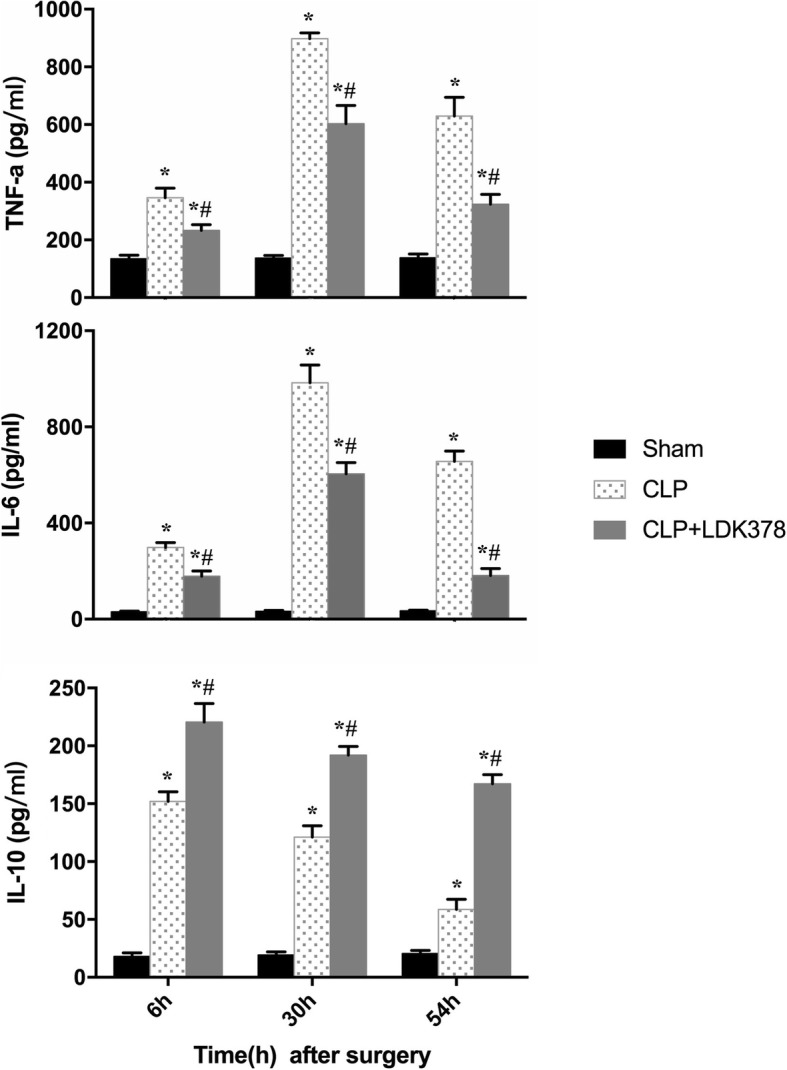
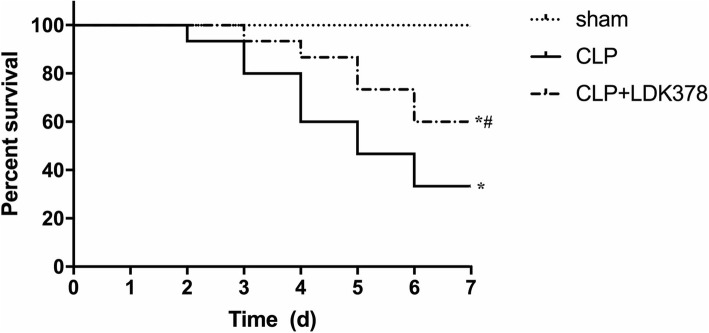
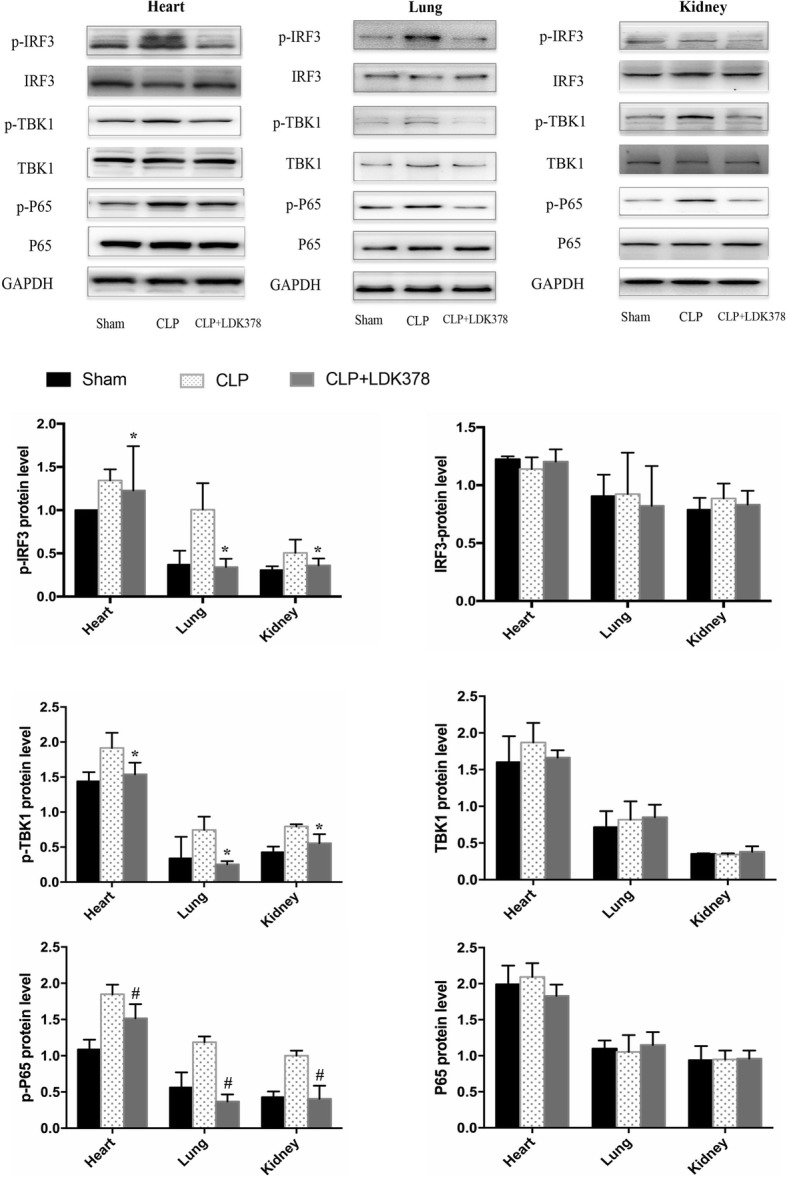
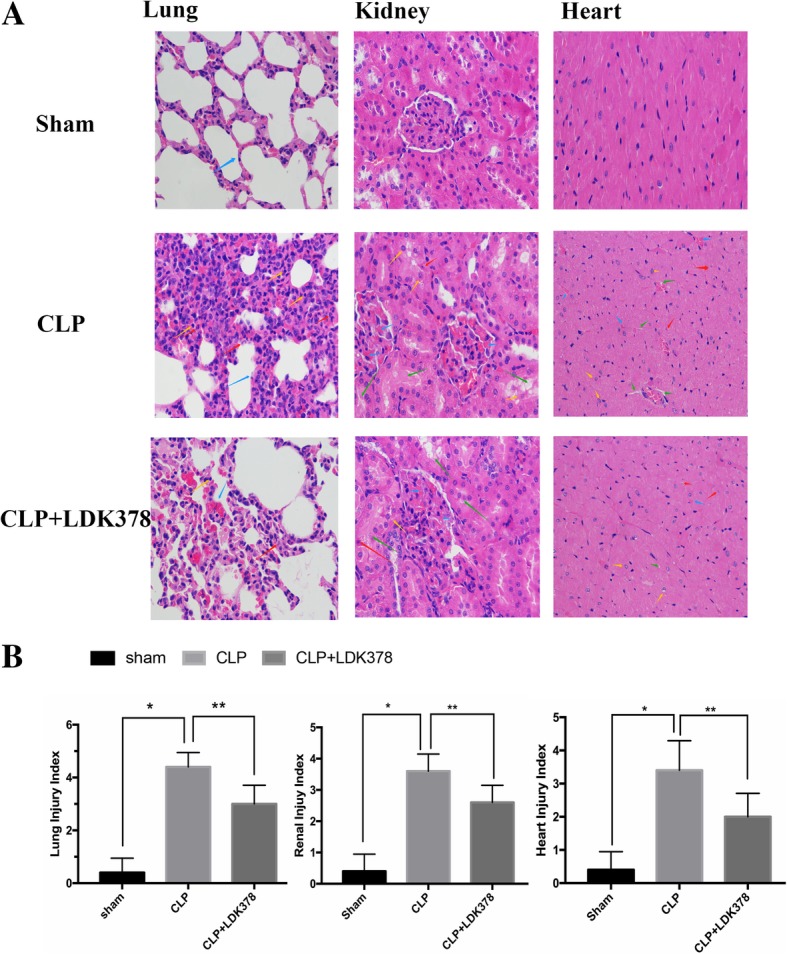
We found the group that received LDK378 treatment showed increased MAP levels compared to the CLP group at 30 h and 54 h. Meanwhile, LDK378 ameliorated the perfused small vessel density and microvascular flow index, decreased the expression of TNF-a and IL-6, and upregulated the expression of IL-10 in comparison with the CLP group. LDK378 injections also downregulated the expression of TBK1 and its downstream targets. Furthermore, LDK378 treatment significantly reduced sepsis-induced organ injuries, therefore improving survival rates.
These findings demonstrate that LDK378 treatment can improve microcirculation and reduce organ injuries in CLP-induced septic rats via the regulation of inflammatory cytokine secretion and the downstream signaling components of the ALK-STING pathway.
脓毒症是由严重感染引起的全身炎症反应综合征。第二代ALK抑制剂LDK378对脓毒症具有潜在的抗炎作用。微循环和大循环功能障碍是严重脓毒症和脓毒性休克发病机制的关键因素。我们推测LDK378可以改善脓毒症大鼠的微循环和大循环,从而通过阻断ALK-STING通路减轻炎症损伤,进而改善生存结局。
采用盲肠结扎穿孔(CLP)法建立脓毒症大鼠模型。将60只大鼠随机分为三组:假手术组、CLP组和CLP+LDK378组(每组20只)。每组随机选取5只大鼠进行机制研究;每组其余15只大鼠进行生存曲线检测。采用侧流暗视野视频显微镜记录舌下微循环和平均动脉压(MAP),并在CLP手术后6小时、30小时和54小时检测炎症细胞因子分泌水平。测定TANK结合激酶1(TBK1)及其下游靶点的表达,并在CLP手术后54小时检查心脏、肺和肾脏的组织学改变。
我们发现,与CLP组相比,接受LDK378治疗的组在30小时和54小时时MAP水平升高。同时,与CLP组相比,LDK378改善了灌注小血管密度和微血管血流指数,降低了TNF-α和IL-6的表达,并上调了IL-10的表达。注射LDK378还下调了TBK1及其下游靶点的表达。此外,LDK378治疗显著减轻了脓毒症诱导的器官损伤,从而提高了生存率。
这些发现表明,LDK378治疗可通过调节炎症细胞因子分泌和ALK-STING通路的下游信号成分,改善CLP诱导的脓毒症大鼠的微循环并减少器官损伤。