Department of Preventive Medicine and Public Health, University of Granada, 18071 Granada, Spain.
Consortium for Biomedical Research in Epidemiology and Public Health (CIBERESP), 28029 Madrid, Spain.
Nutrients. 2019 Feb 28;11(3):523. doi: 10.3390/nu11030523.
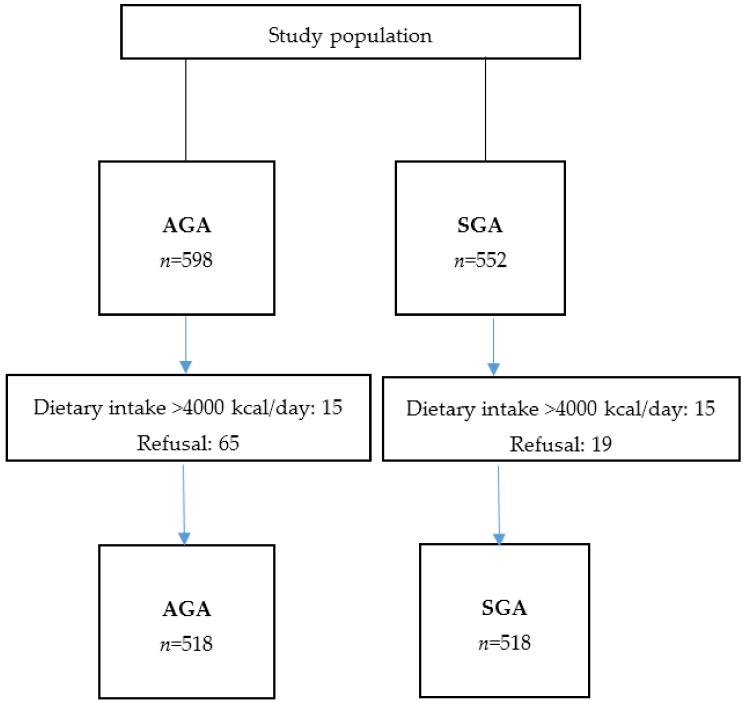
The objective of this study was to assess the relationship between consumption of different types of carbohydrates (CHO) during pregnancy and the risk of having a small for gestational age (SGA) newborn. A retrospective matched case⁻control design was carried out with a total of 518 mother-offspring pairs. A total of 137 validated items were included in the food frequency questionnaire (FFQ). Conditional logistic regression models were used to calculate crude odds ratios (cORs) and adjusted odds ratios (aORs) with 95% confidence intervals (CIs). Having more than 75 g/day of brown bread showed an inverse association with SGA (aOR = 0.64, CI 0.43⁻0.96). In contrast, an intake of industrial sweets more than once a day (aOR = 2.70, CI 1.42⁻5.13), or even 2⁻6 times a week (aOR = 1.84, CI 1.20⁻2.82), increased the odds of having a SGA newborn. During pregnancy, the higher the increase of wholegrain cereal and bread, the lower the possibility of having a SGA newborn, but the opposite occurred with refined sugar products-just consuming industrial bakery products or pastries twice a week increased the odds of having an SGA infant. Case⁻control studies cannot verify causality and only show associations, which may reflect residual confusion due to the presence of unknown factors. It is possible that a high consumption of sugary foods is a marker of a generally poor lifestyle.
本研究旨在评估妊娠期间不同类型碳水化合物(CHO)的摄入量与胎儿生长受限(SGA)新生儿风险之间的关系。采用回顾性病例对照设计,共纳入了 518 对母婴。食物频率问卷(FFQ)共包括 137 个经过验证的项目。采用条件逻辑回归模型计算粗比值比(cOR)和调整比值比(aOR)及其 95%置信区间(CI)。每天食用超过 75 克的黑面包与 SGA 呈负相关(aOR=0.64,95%CI:0.43-0.96)。相反,每天食用工业糖果超过一次(aOR=2.70,95%CI:1.42-5.13),甚至每周食用 2-6 次(aOR=1.84,95%CI:1.20-2.82),都会增加 SGA 新生儿的发生几率。在妊娠期间,全谷物谷物和面包的摄入量增加,SGA 新生儿的可能性越低,但精制糖产品的情况则相反——每周仅食用两次工业烘焙产品或糕点就会增加 SGA 婴儿的发生几率。病例对照研究不能验证因果关系,只能显示相关性,这可能反映了由于存在未知因素而导致的残留混淆。高糖食品的摄入可能是不良生活方式的一个标志。