Wellcome Centre for Integrative Neuroimaging, FMRIB, Nuffield Department of Clinical Neurosciences, University of Oxford, Oxford, United Kingdom.
Erwin L. Hahn Institute for Magnetic Resonance Imaging, University of Duisburg-Essen, Essen, Germany.
Magn Reson Med. 2019 Jul;82(1):107-125. doi: 10.1002/mrm.27699. Epub 2019 Mar 1.
Image acceleration provides multiple benefits to diffusion MRI, with in-plane acceleration reducing distortion and slice-wise acceleration increasing the number of directions that can be acquired in a given scan time. However, as acceleration factors increase, the reconstruction problem becomes ill-conditioned, particularly when using both in-plane acceleration and simultaneous multislice imaging. In this work, we develop a novel reconstruction method for in vivo MRI acquisition that provides acceleration beyond what conventional techniques can achieve.
We propose to constrain the reconstruction in the spatial (k) domain by incorporating information from the angular (q) domain. This approach exploits smoothness of the signal in q-space using Gaussian processes, as has previously been exploited in post-reconstruction analysis. We demonstrate in-plane undersampling exceeding the theoretical parallel imaging limits, and simultaneous multislice combined with in-plane undersampling at a total factor of 12. This reconstruction is cast within a Bayesian framework that incorporates estimation of smoothness hyper-parameters, with no need for manual tuning.
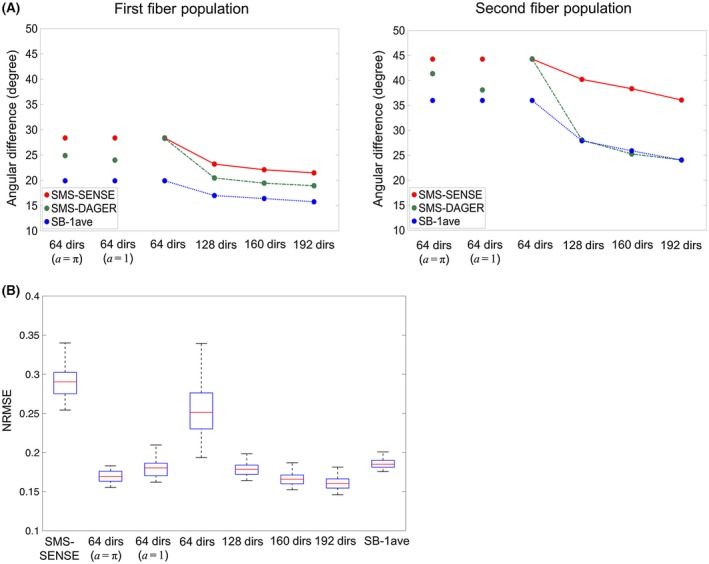
Simulations and in vivo results demonstrate superior performance of the proposed method compared with conventional parallel imaging methods. These improvements are achieved without loss of spatial or angular resolution and require only a minor modification to standard pulse sequences.
The proposed method provides improvements over existing methods for diffusion acceleration, particularly for high simultaneous multislice acceleration with in-plane undersampling.
图像加速为扩散 MRI 提供了多种益处,平面内加速可减少失真,而切片式加速可增加在给定扫描时间内可采集的方向数量。然而,随着加速因子的增加,重建问题变得病态,尤其是在同时使用平面内加速和同时多层成像时。在这项工作中,我们开发了一种新的活体 MRI 采集重建方法,该方法提供了传统技术无法实现的加速。
我们建议通过从角(q)域中引入信息来约束空间(k)域中的重建。这种方法利用高斯过程在 q 空间中信号的平滑性,这在以前的后重建分析中已经得到了利用。我们证明了平面内欠采样超过了理论并行成像限制,同时在总因子为 12 的情况下实现了同时多层成像与平面内欠采样的结合。这种重建是在贝叶斯框架内进行的,其中包括对平滑度超参数的估计,而无需手动调整。
模拟和体内结果表明,与传统的并行成像方法相比,所提出的方法具有更好的性能。这些改进是在不损失空间或角分辨率的情况下实现的,并且仅需要对标准脉冲序列进行微小修改。
与现有的扩散加速方法相比,所提出的方法提供了改进,特别是在具有平面内欠采样的高同时多层加速方面。