School of Nursing, University of Pittsburgh, Pittsburgh, PA, United States of America.
Department of Psychiatry and Clinical and Translational Science, University of Pittsburgh School of Medicine, Pittsburgh, PA, United States of America.
Contemp Clin Trials. 2019 Apr;79:73-79. doi: 10.1016/j.cct.2019.02.011. Epub 2019 Feb 27.
Chronic insomnia is associated with poor asthma control. Cognitive-behavioral treatment for insomnia (CBT-I) is an efficacious and durable treatment for comorbid insomnia in medical and psychiatric disorders. However, the efficacy and potential accompanying mechanisms of CBT-I have not been examined in asthma. The purpose of this study is to test the efficacy of a CBT-I intervention on sleep and asthma control in adults with insomnia and asthma. We will also explore airway inflammation (i.e., exhaled nitric oxide, blood eosinophils) as a potential biological mechanism linking improvements in sleep with improvements in asthma control.
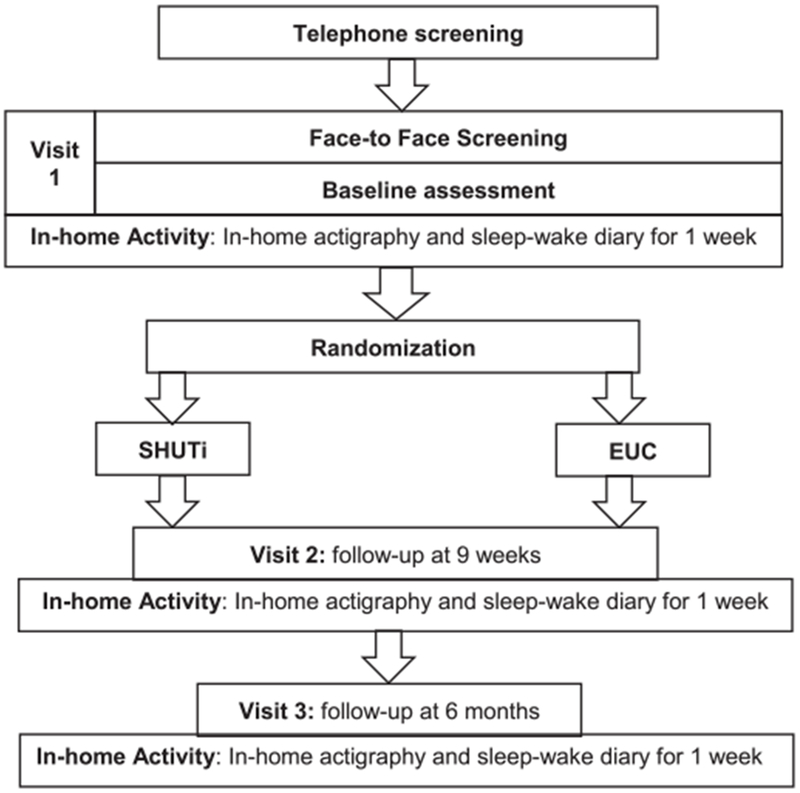
The study is a single center, parallel group, randomized controlled trial. Two hundred and ten adults with insomnia and asthma that is not well-controlled will be randomized to either a 9-week Internet-based CBT-I program (Sleep Healthy Using the Internet (SHUTi)) or an enhanced usual care condition which utilizes an online educational video about insomnia. The primary sleep outcome is insomnia severity measured by the Insomnia Severity Index. Secondary sleep outcomes are sleep quality and wrist actigraph-recorded sleep parameters. Asthma control will be assessed by the Asthma Control Test, Asthma Quality of Life Questionnaire, pulmonary function testing, and self-report of asthma exacerbations and asthma-related healthcare utilization. Treatment outcomes will be measured at baseline, 9 weeks, and 6 months.
This trial has the potential to identify a novel strategy for improving asthma control. Findings may advocate for the inclusion of treatment of comorbid insomnia into current asthma management practice guidelines.
慢性失眠与哮喘控制不佳有关。认知行为疗法治疗失眠(CBT-I)是一种有效的、持久的治疗方法,适用于医学和精神疾病中的共病失眠。然而,CBT-I 的疗效及其潜在的伴随机制尚未在哮喘中得到检验。本研究旨在测试 CBT-I 干预对患有失眠和哮喘的成年人的睡眠和哮喘控制的疗效。我们还将探讨气道炎症(即呼出的一氧化氮、血液嗜酸性粒细胞)作为将睡眠改善与哮喘控制改善联系起来的潜在生物学机制。
该研究是一项单中心、平行组、随机对照试验。210 名失眠且哮喘控制不佳的成年人将被随机分配到 9 周的基于互联网的 CBT-I 方案(使用互联网保持健康睡眠(SHUTi))或增强的常规护理条件,后者利用关于失眠的在线教育视频。主要睡眠结局是通过失眠严重程度指数(Insomnia Severity Index)测量的失眠严重程度。次要睡眠结局是睡眠质量和腕部活动记录仪记录的睡眠参数。哮喘控制将通过哮喘控制测试、哮喘生活质量问卷、肺功能测试以及哮喘加重和与哮喘相关的医疗保健利用情况的自我报告来评估。治疗结果将在基线、9 周和 6 个月时进行测量。
该试验有可能确定改善哮喘控制的新策略。研究结果可能主张将共病失眠的治疗纳入当前的哮喘管理实践指南。