Universidad Autónoma de Sinaloa, Centro de Investigación y Docencia en Ciencias de la Salud, Otolaryngology Department, Culiacán, Mexico.
Universidad Autónoma de Sinaloa, Centro de Investigación y Docencia en Ciencias de la Salud, Otolaryngology Department, Culiacán, Mexico.
Braz J Otorhinolaryngol. 2020 May-Jun;86(3):300-307. doi: 10.1016/j.bjorl.2018.12.007. Epub 2019 Feb 18.
Otomycosis, an infection of the ear canal by fungi, is prevalent in hot and humid weather. Nevertheless, there is not sufficient evidence for the effectiveness of different topical antifungal treatments. Tolnaftate, is a topical antifungal agent described to be effective in the treatment of otomycosis. Currently there are not sufficient studies that prove its efficacy.
To compare the efficacy of clotrimazole and tolnaftate administration in the treatment of otomycosis.
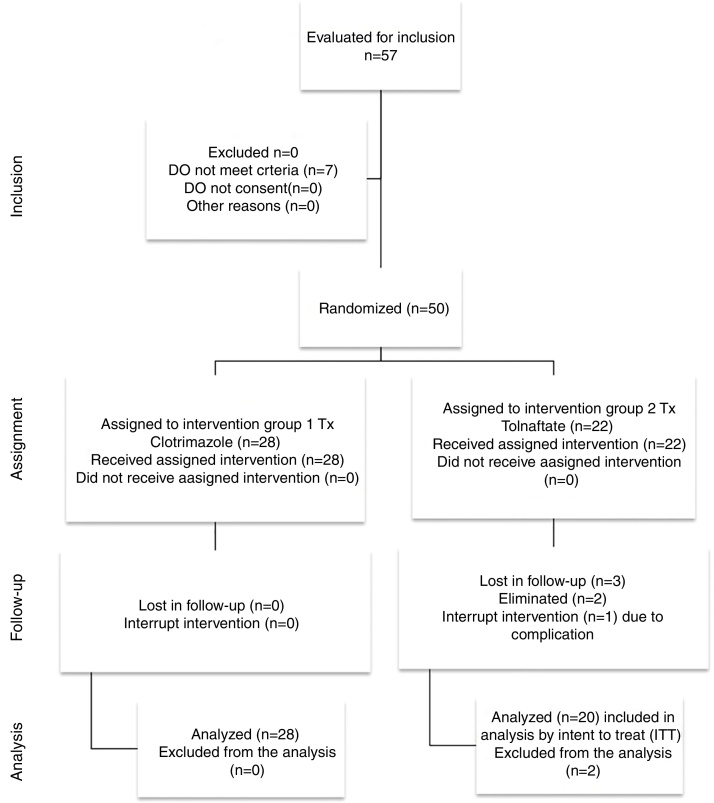
A controlled, randomized and open clinical trial included patients diagnosed with fungal external otitis who were treated with topical antifungals, randomized into two treatment groups: (1) clotrimazole cream; (2) tolnaftate solution. They were microscopically evaluated at one and two weeks of treatment to determine resolution of disease. Recurrence and complications were recorded. Demographic and clinical variables were collected and analyzed. Follow-up and final outcomes (absence of infection) were compared between groups.
Forty eight patients were included, 28 in the clotrimazole group and 20 in the tolnaftate group. Spring was the weather most commonly associated with otomycosis, while otic manipulation was the risk factor more common in both groups. Predominant symptoms were itching and otic fullness. Aspergillus niger organism was isolated most frequently. Treatment with clotrimazole resulted in 75% resolution vs 45% resolution with treatment with tolnaftate at one week of treatment (p=0.007). The Tolnaftate treatment group demonstrated higher recurrence rates and treatment failures, 20% and 15% respectively.
Clotrimazole cream treatment is more effective than tolnaftate for uncomplicated otomycosis. More studies are needed to corroborate our results.
耳真菌病是一种由真菌引起的耳道感染,在炎热潮湿的天气中很常见。然而,目前尚无足够的证据证明不同局部抗真菌治疗的有效性。托萘酯是一种局部抗真菌药物,据报道可有效治疗耳真菌病。目前,还没有足够的研究证明其疗效。
比较克霉唑和托萘酯治疗耳真菌病的疗效。
一项对照、随机、开放性临床试验纳入了诊断为真菌性外耳道炎的患者,他们接受了局部抗真菌药物治疗,随机分为两组:(1)克霉唑乳膏;(2)托萘酯溶液。在治疗后一周和两周进行显微镜评估,以确定疾病的缓解情况。记录复发和并发症。收集并分析人口统计学和临床变量。比较两组之间的随访和最终结局(无感染)。
共纳入 48 例患者,克霉唑组 28 例,托萘酯组 20 例。春季是耳真菌病最常见的发病季节,而耳内操作是两组共同的常见危险因素。主要症状是瘙痒和耳闷。最常分离到的真菌是黑曲霉。克霉唑治疗一周后,75%的患者缓解,而托萘酯治疗的缓解率为 45%(p=0.007)。托萘酯治疗组的复发率和治疗失败率分别为 20%和 15%,高于克霉唑组。
克霉唑乳膏治疗单纯性耳真菌病比托萘酯更有效。需要进一步的研究来证实我们的结果。