Newborn Research Centre, The Royal Women's Hospital, Melbourne, Victoria, Australia.
Department of Obstetrics and Gynaecology, The University of Melbourne, Melbourne, Victoria, Australia.
BMJ Open. 2019 Mar 1;9(2):e026265. doi: 10.1136/bmjopen-2018-026265.
Bronchopulmonary dysplasia (BPD), an important sequela of preterm birth, is associated with long-term abnormalities of lung function and adverse neurodevelopmental outcomes. Inflammation, inhibition of secondary septation and vascular maldevelopment play key roles in the pathogenesis of BPD. Human amnion epithelial cells (hAECs), stem-like cells, derived from placental tissues are able to modulate the inflammatory milieu and, in preclinical studies of BPD-like injury, restore lung architecture and function. Allogeneic hAECs may present a new preventative and reparative therapy for BPD.
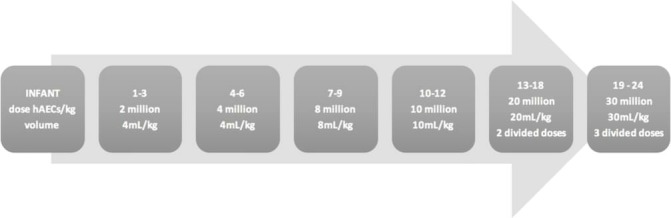
In this two centre, phase I cell dose escalation study we will evaluate the safety of intravenous hAEC infusions in preterm infants at high risk of severe BPD. Twenty-four infants born at less than 29 weeks' gestation will each receive intravenous hAECs beginning day 14 of life. We will escalate the dose of cells contained in a single intravenous hAEC infusion in increments from 2 million cells/kg to 10 million cells/kg. Further dose escalation will be achieved with repeat infusions given at 5 day intervals to a maximum total dose of 30 million cells/kg (three infusions). Safety is the primary outcome. Infants will be followed-up until 2 years corrected age. Additional outcome measures include a description of infants' cytokine profile following hAEC infusion, respiratory outcomes including BPD and pulmonary hypertension and other neonatal morbidities including neurodevelopmental assessment at 2 years.
This study was approved on the June12th, 2018 by the Human Research Ethics Committee of Monash Health and Monash University. Recruitment commenced in August 2018 and is expected to take 18 months. Accordingly, follow-up will be completed mid-2022. The findings of this study will be disseminated via peer-reviewed journals and at conferences.
5, 21 May 2018.
ACTRN12618000920291; Pre-results.
支气管肺发育不良(BPD)是早产儿的重要后遗症,与肺功能的长期异常和不良的神经发育结果有关。炎症、抑制次级间隔形成和血管发育不良在 BPD 的发病机制中发挥关键作用。人羊膜上皮细胞(hAECs)是一种来源于胎盘组织的干细胞样细胞,能够调节炎症环境,并在 BPD 样损伤的临床前研究中恢复肺结构和功能。同种异体 hAECs 可能为 BPD 提供一种新的预防和修复治疗方法。
在这项两中心、I 期细胞剂量递增研究中,我们将评估静脉内 hAEC 输注在有发生严重 BPD 风险的早产儿中的安全性。24 名胎龄小于 29 周的婴儿出生后,每天接受静脉内 hAEC 输注。我们将以 200 万细胞/kg 为增量递增单次静脉内 hAEC 输注中细胞的剂量,递增至 1000 万细胞/kg。在 5 天的间隔内重复输注,达到 3000 万细胞/kg(3 次输注)的最大总剂量,将进一步增加剂量。安全性是主要终点。婴儿将随访至校正年龄 2 岁。其他结局指标包括 hAEC 输注后婴儿细胞因子谱的描述、呼吸结局,包括 BPD 和肺动脉高压,以及其他新生儿并发症,包括 2 岁时的神经发育评估。
这项研究于 2018 年 6 月 12 日获得莫纳什健康和莫纳什大学人类研究伦理委员会的批准。招募工作于 2018 年 8 月开始,预计需要 18 个月。因此,随访将于 2022 年年中完成。这项研究的结果将通过同行评议的期刊和会议进行传播。
5,2018 年 5 月 21 日。
ACTRN12618000920291;预结果。