Thompson Beti, Barrington Wendy E, Briant Katherine J, Kupay Erin, Carosso Elizabeth, Gonzalez Nora E, Gonzalez Virginia J
Fred Hutchinson Cancer Research Center, 1100 Fairview Avenue North, M3-B232, Seattle, WA, 98109, USA.
Department of Psychosocial & Community Health, University of Washington School of Nursing, 1959 NE Pacific St., Box 359263, Seattle, WA, 98195, USA.
Cancer Causes Control. 2019 Apr;30(4):375-384. doi: 10.1007/s10552-019-01150-w. Epub 2019 Mar 4.
The purpose of this study was to assess effects of three different educational intervention arms on knowledge of and intention to receive Pap testing and HPV co-testing.
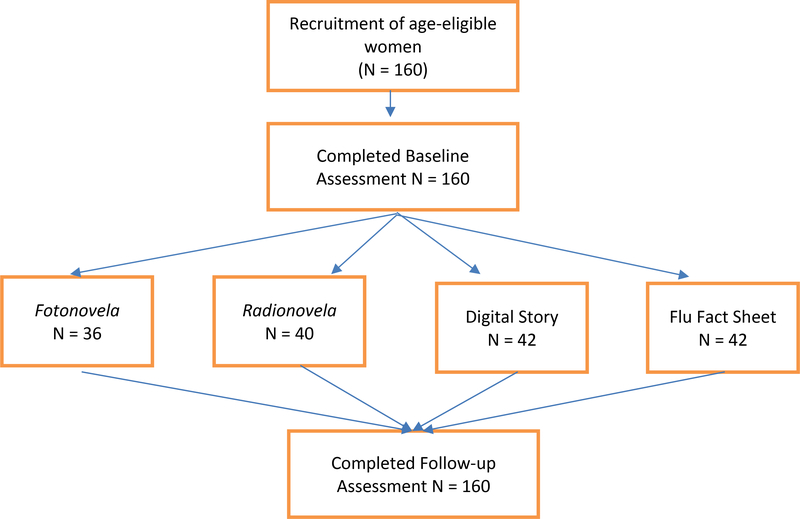
Three active educational intervention arms were developed: a fotonovela, a radionovela, and a digital story. A pilot randomized controlled trial of 160 Latinas was conducted to assess the effectiveness of the intervention arms in increasing knowledge of cervical cancer and HPV and intention to be screened for cervical cancer compared to an attention control group (flu vaccination).
Women in all three treatment arms significantly increased knowledge about cervical cancer compared to control arm (p = 0.02). Knowledge about cervical cancer screening also increased in the active arms compared to control (p = 0.0003). Knowledge of HPV risk also increased relative to the control (p = 0.0001). There were no significant differences between the intervention arms in increased knowledge of cervical cancer or cervical cancer screening (p = 0.57 and 0.16, respectively).
This study supported the use of small media interventions in narrative education form as effective in increasing knowledge and intention to be screened for cervical cancer. The three culturally relevant interventions, built on qualitative data, were all successful in increasing knowledge.
本研究的目的是评估三种不同教育干预方式对巴氏试验和人乳头瘤病毒联合检测知识及接受意愿的影响。
开发了三种积极的教育干预方式:图文小说、广播剧和数字故事。开展了一项针对160名拉丁裔女性的试点随机对照试验,以评估与注意力控制组(流感疫苗接种)相比,干预方式在增加宫颈癌和人乳头瘤病毒知识以及宫颈癌筛查意愿方面的有效性。
与对照组相比,所有三个治疗组的女性对宫颈癌的了解均显著增加(p = 0.02)。与对照组相比,积极干预组对宫颈癌筛查的了解也有所增加(p = 0.0003)。与对照组相比,人乳头瘤病毒风险知识也有所增加(p = 0.0001)。在宫颈癌或宫颈癌筛查知识增加方面,各干预组之间无显著差异(分别为p = 0.57和0.16)。
本研究支持使用叙事教育形式的小型媒体干预来有效增加宫颈癌筛查知识和意愿。基于定性数据的三种与文化相关的干预措施在增加知识方面均取得成功。