Cheng Shengming, Shen Bin, Yuan Wei, Zhou Xiaobo, Liu Qingyun, Kong Mengya, Shi Yibing, Yang Pengyuan, Feng Wei, Li Fuyou
Institutes of Biomedical Sciences & Department of Chemistry & State Key Laboratory of Molecular Engineering of Polymers, Fudan University, 220 Handan Road, Shanghai 200433, P. R. China.
ACS Cent Sci. 2019 Feb 27;5(2):299-307. doi: 10.1021/acscentsci.8b00763. Epub 2019 Jan 14.
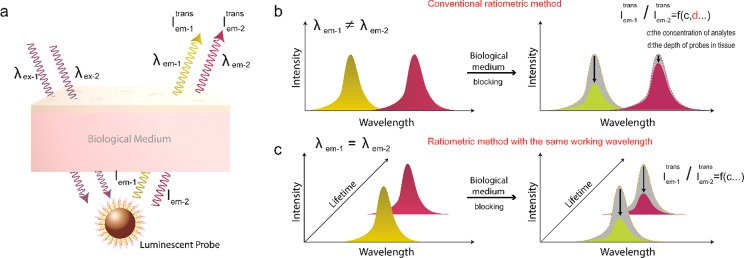
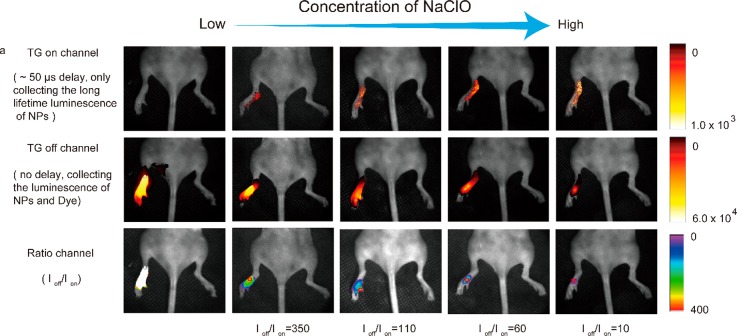
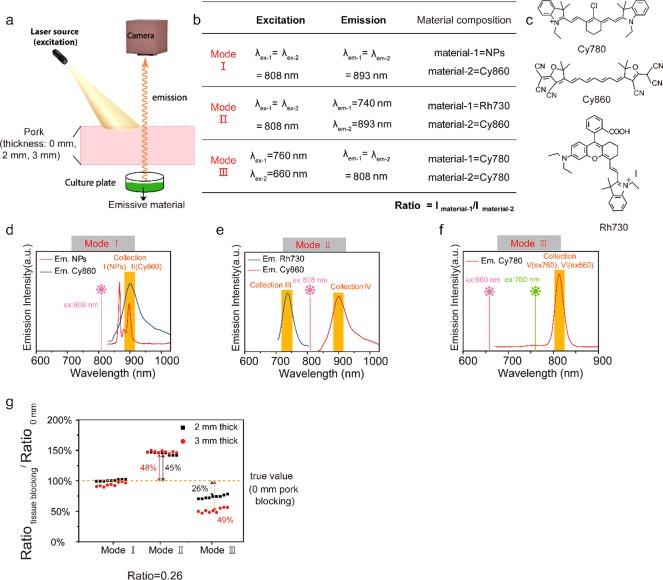
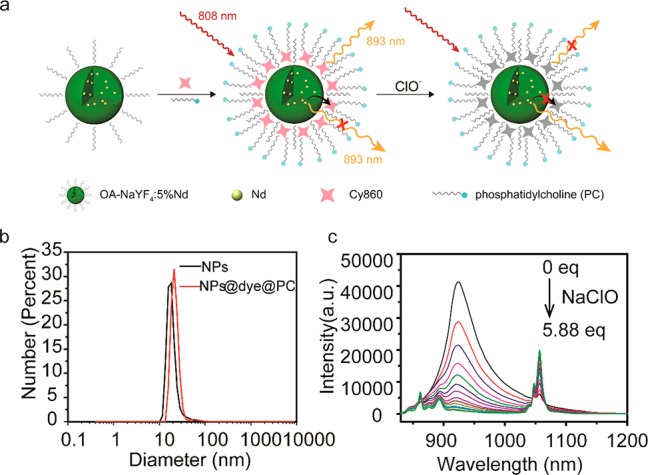
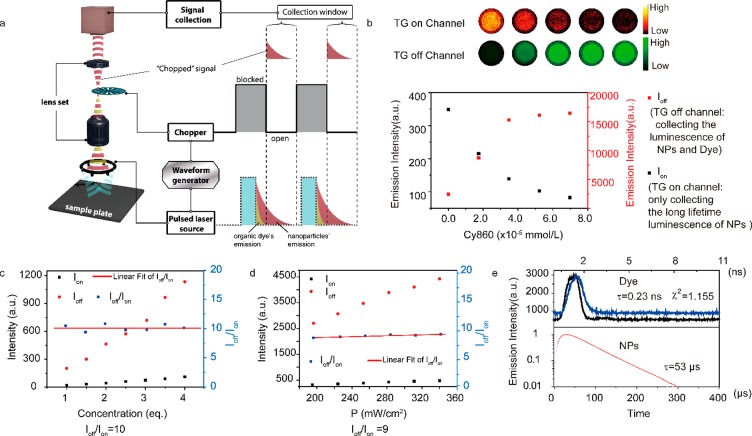
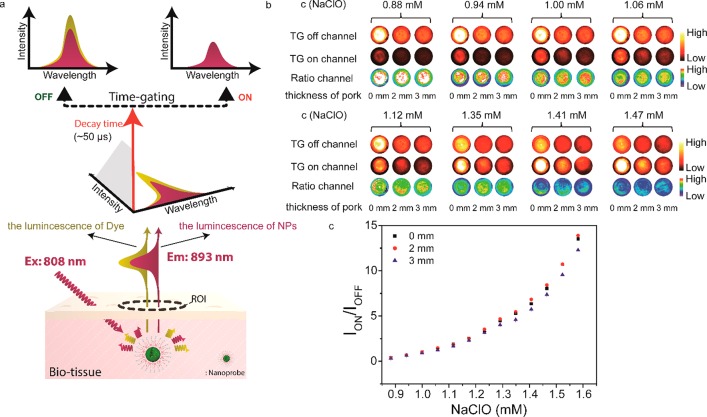
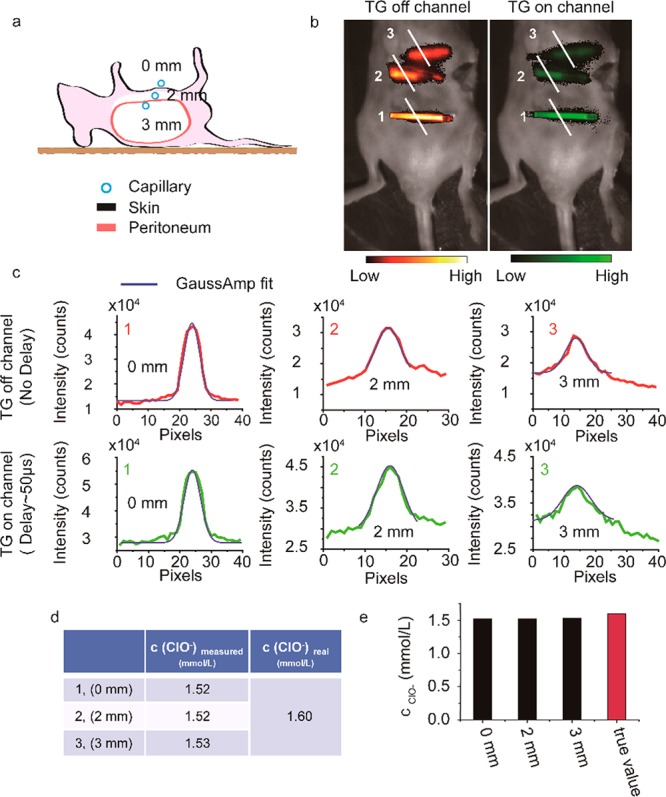
Luminescence imaging, exhibiting noninvasive, sensitive, rapid, and versatile properties, plays an important role in biomedical applications. It is usually unsuitable for direct biodetection, because the detected luminescence intensity can be influenced by various factors such as the luminescent substance concentration, the depth of the luminescent substance in the organism, etc. Ratiometric imaging may eliminate the interference due to the luminescent substance concentration on the working signal. However, the conventional ratiometric imaging mode has a limited capacity for signal acquisition and fidelity due to the highly variable and wavelength-dependent scattering and absorption process in biotissue. In this work, we demonstrate a general imaging mode in which two signals with the same working wavelength are used to perform ratiometric sensing ignoring the depth of the luminescent substance in the organism. Dual-channel decoding is achieved by time-gated imaging technology, in which the signals from lanthanide ions and fluorescent dyes are distinguished by their different luminescent lifetimes. The ratiometric signal is proven to be nonsensitive to the detection depth and excitation power densities; thus, we could utilize the working curve measured to determine the amount of target substance (hypochlorous acid) .
发光成像具有非侵入性、灵敏、快速和多功能的特性,在生物医学应用中发挥着重要作用。它通常不适合直接进行生物检测,因为检测到的发光强度会受到多种因素的影响,如发光物质浓度、发光物质在生物体内的深度等。比率成像可以消除发光物质浓度对工作信号的干扰。然而,由于生物组织中高度可变且依赖波长的散射和吸收过程,传统的比率成像模式在信号采集和保真度方面能力有限。在这项工作中,我们展示了一种通用的成像模式,其中使用具有相同工作波长的两个信号进行比率传感,而忽略发光物质在生物体内的深度。通过时间门控成像技术实现双通道解码,其中来自镧系离子和荧光染料的信号通过它们不同的发光寿命来区分。已证明比率信号对检测深度和激发功率密度不敏感;因此,我们可以利用测量的工作曲线来确定目标物质(次氯酸)的量。