Department of Psychology and Human Development, Vanderbilt University, Nashville, TN, USA.
Neurology Department, Neuroscape, University of California San Francisco, San Francisco, CA, USA.
Sci Data. 2019 Mar 5;6:190040. doi: 10.1038/sdata.2019.40.
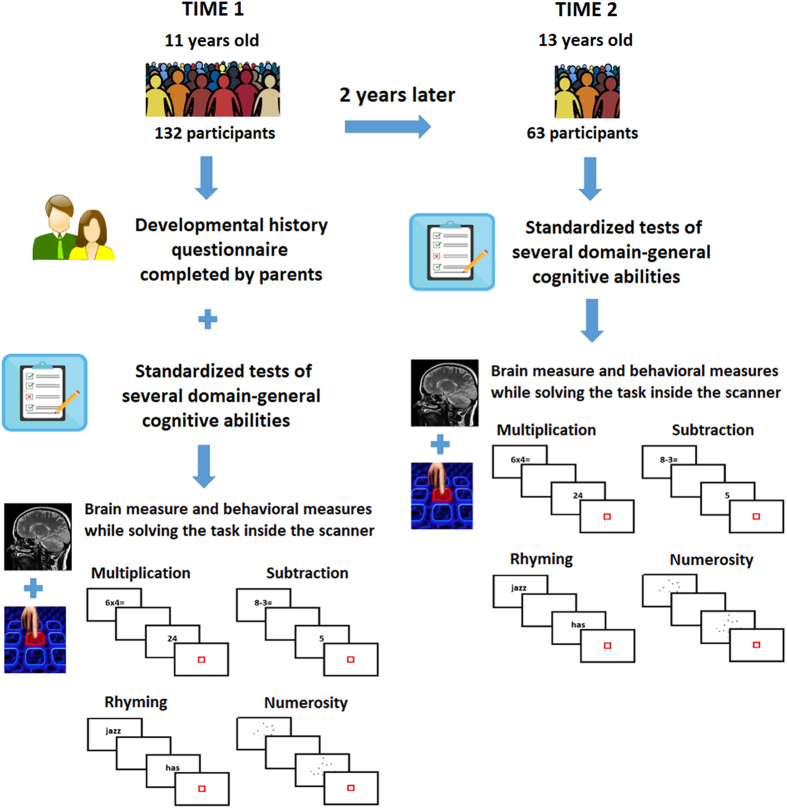
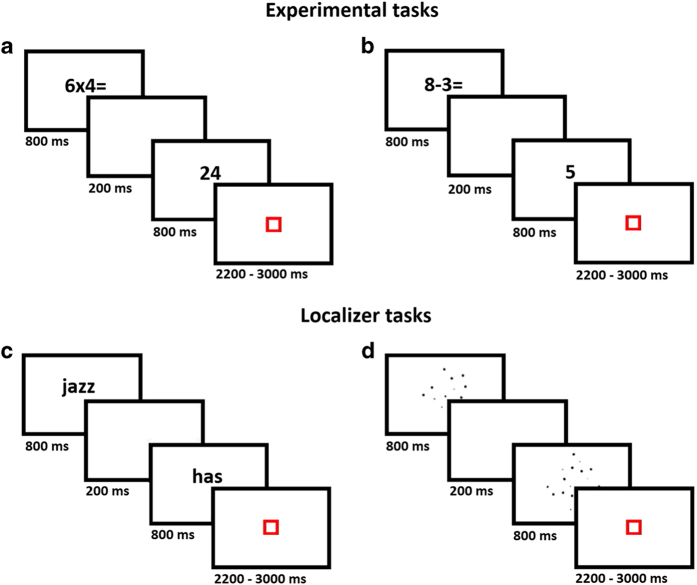
We describe functional and structural data acquired using a 3T scanner in a sample of 132 typically developing children, who were scanned when they were approximately 11 years old (i.e. Time 1). Sixty-three of them were scanned again approximately 2 years later (i.e. Time 2). Children performed four tasks inside the scanner: two arithmetic tasks and two localizer tasks. The arithmetic tasks were a single-digit multiplication and a single-digit subtraction task. The localizer tasks, a written rhyming judgment task and a numerosity judgment task, were used to independently identify verbal and quantity brain areas, respectively. Additionally, we provide data on behavioral performance on the tasks inside the scanner, participants' scores on standardized tests, including reading and math skill, and a developmental history questionnaire completed by parents. This dataset could be useful to answer questions regarding the neural bases of the development of math in children and its relation to individual differences in skill. The data, entitled "Brain Correlates of Math Development", are freely available from OpenNeuro (https://openneuro.org).
我们描述了在 132 名正常发育儿童的样本中使用 3T 扫描仪获得的功能和结构数据,这些儿童在大约 11 岁时(即时间 1)进行了扫描。其中 63 人在大约 2 年后(即时间 2)再次进行了扫描。儿童在扫描仪内进行了四项任务:两项算术任务和两项定位器任务。算术任务是一位数乘法和一位数减法任务。定位器任务,书面押韵判断任务和数量判断任务,分别用于独立识别语言和数量大脑区域。此外,我们还提供了有关扫描仪内任务的行为表现、参与者在包括阅读和数学技能在内的标准化测试中的得分,以及由父母完成的发展历史问卷的数据。该数据集可用于回答有关儿童数学发展的神经基础及其与技能个体差异的关系的问题。该数据集名为“大脑与数学发展的相关性”,可在 OpenNeuro(https://openneuro.org)上免费获取。