Tokyo Metropolitan Research Institute for Environmental Protection 1-7-5, Sinsuna, Koto-ku, Tokyo, 136-0075, Japan.
Graduate School of Frontier Sciences, The University of Tokyo, 5-1-5 Kashiwanoha, Kashiwa, Chiba, 277-8563, Japan.
Sci Rep. 2019 Mar 5;9(1):3573. doi: 10.1038/s41598-019-40012-y.
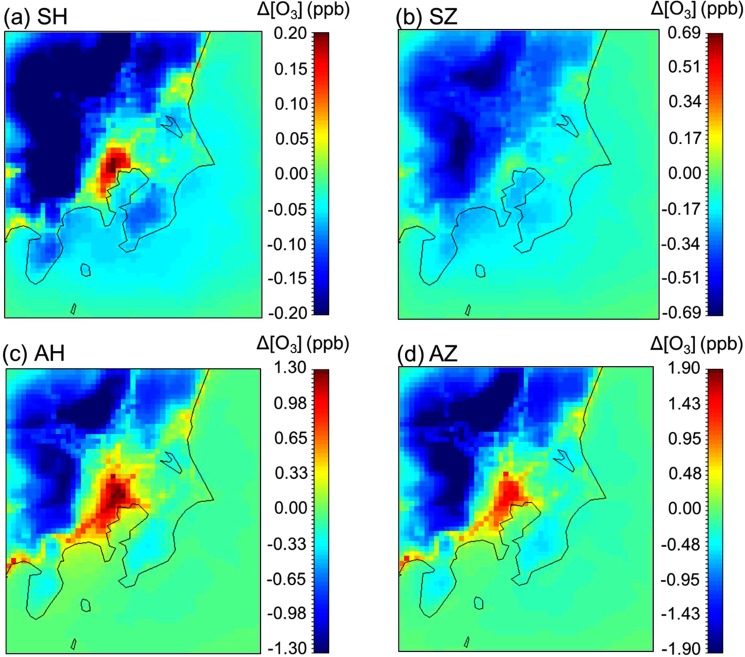
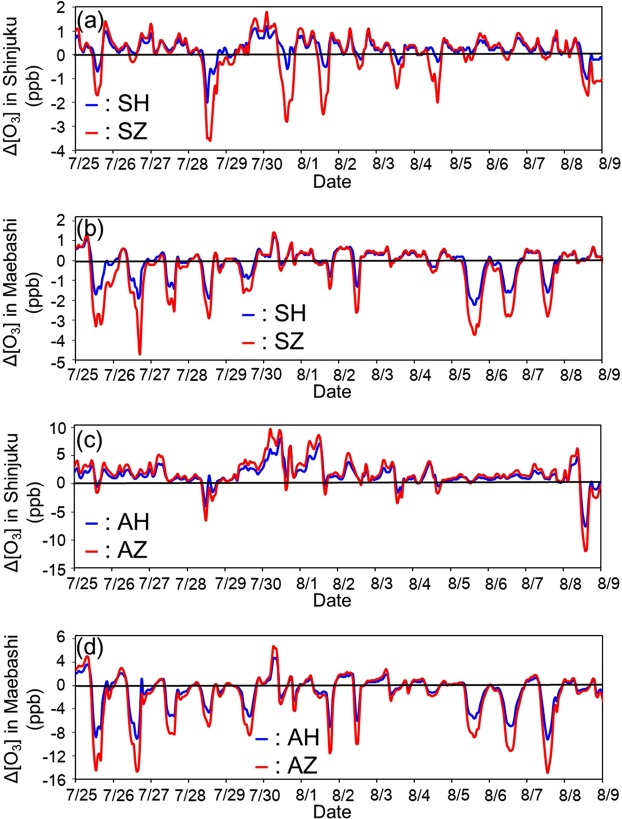
The plans to introduce next-generation hybrid and zero-emission vehicles in the market are now enacted by governments in many countries to manage both global warming and air pollution problems. There are only a few studies evaluating the effects of the next-generation vehicles on the changes in concentrations of ozone generated by the photochemical reactions between volatile organic compounds and nitrogen oxides (NO). To evaluate these changes, we performed chemical transport modeling in the Kanto region, Japan in the summer of 2013. The results show that if the vehicles are substituted by hybrid vehicles, average ozone concentrations increase in urban areas and decrease in suburban areas due to NO titration. Substitution with zero-emission passenger vehicles decreases the concentrations in both urban and suburban areas. Substitution with both hybrid and zero-emission passenger and heavy-duty vehicles highly increases the concentrations in urban areas. Using the model results, we also discuss the effect of ozone concentration changes on premature mortality of humans in summer. The results suggest that, in some cases the introduction of next-generation vehicles might exasperate ozone concentrations, even leading to 5 to 10 times higher premature mortality during the summer compared to that of influenza and heat stroke in Japan.
许多国家的政府现在都制定了在市场上推出新一代混合动力和零排放车辆的计划,以应对全球变暖和空气污染问题。然而,目前仅有少数研究评估了下一代车辆对挥发性有机化合物和氮氧化物(NO)之间光化学反应生成的臭氧浓度变化的影响。为了评估这些变化,我们在 2013 年夏季于日本关东地区进行了化学输送建模。结果表明,如果用混合动力车辆替代现有车辆,由于氮氧化物滴定作用,城市地区的臭氧平均浓度会增加,而郊区地区则会降低。用零排放乘用车替代则会降低城市和郊区地区的臭氧浓度。用混合动力和零排放乘用车及重型车辆替代则会大大增加城市地区的臭氧浓度。利用模型结果,我们还讨论了臭氧浓度变化对夏季人类过早死亡的影响。结果表明,在某些情况下,引入下一代车辆可能会加剧臭氧浓度,甚至导致夏季过早死亡率比日本的流感和中暑高出 5 到 10 倍。