Kelly Rachel S, Boulin Adrianna, Laranjo Nancy, Lee-Sarwar Kathleen, Chu Su H, Yadama Aishwarya P, Carey Vincent, Litonjua Augusto A, Lasky-Su Jessica, Weiss Scott T
Channing Division of Network Medicine, Department of Medicine, Brigham and Women's Hospital and Harvard Medical School, Boston, MA 02115, USA.
The Fenway Institute, Fenway Health, Boston, MA 02215, USA.
Metabolites. 2019 Mar 5;9(3):42. doi: 10.3390/metabo9030042.
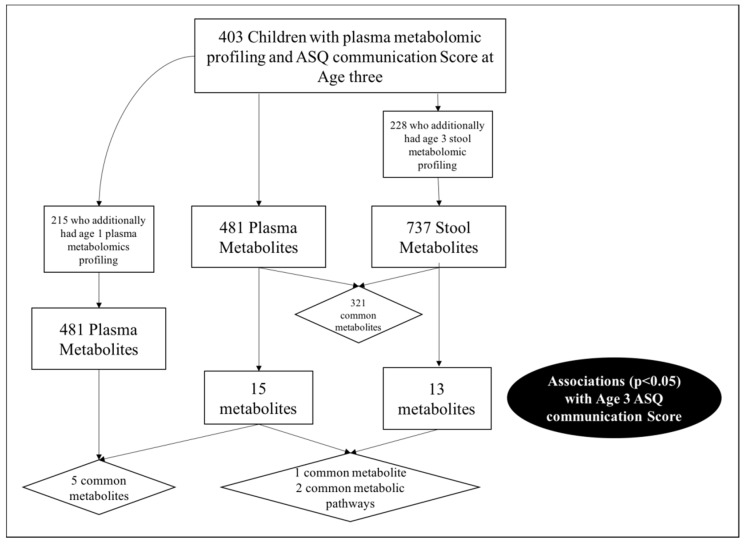
We hypothesized metabolomic profiling could be utilized to identify children who scored poorly on the communication component of the Ages and Stages Questionnaire (ASQ); which assesses development in childhood, and to provide candidate biomarkers for autism spectrum disorders (ASD). In a population of three-year-old children, 15 plasma metabolites, were significantly ( < 0.05) different between children who were categorized as having communication skills that were "on schedule" ( = 365 (90.6%)) as compared to those "requiring further monitoring/evaluation" ( = 38 (9.4%)) according to multivariable regression models. Five of these metabolites, including three endocannabinoids, were also dysregulated at age one ( = 204 "on schedule", = 24 "further monitoring/evaluation") in the same children. Stool metabolomic profiling identified 11 significant metabolites. Both the plasma and stool results implicated a role for tryptophan and tyrosine metabolism; in particular, higher levels of N-formylanthranilic acid were associated with an improved communication score in both biosample types. A model based on the significant plasma metabolites demonstrated high sensitivity (88.9%) and specificity (84.5%) for the prediction of autism by age 8. These results provide evidence that ASQ communication score and metabolomic profiling of plasma and/or stool may provide alternative approaches for early diagnosis of ASD, as well as insights into the pathobiology of these conditions.
我们假设代谢组学分析可用于识别在《年龄与阶段问卷》(ASQ)的沟通部分得分较低的儿童;该问卷用于评估儿童发育情况,并为自闭症谱系障碍(ASD)提供候选生物标志物。在一群三岁儿童中,根据多变量回归模型,与那些被归类为沟通技能“正常”(n = 365,占90.6%)的儿童相比,那些“需要进一步监测/评估”(n = 38,占9.4%)的儿童之间有15种血浆代谢物存在显著差异(P < 0.05)。其中五种代谢物,包括三种内源性大麻素,在这些儿童一岁时(n = 204“正常”,n = 24“进一步监测/评估”)也出现了失调。粪便代谢组学分析确定了11种显著的代谢物。血浆和粪便检测结果均表明色氨酸和酪氨酸代谢发挥了作用;特别是,在两种生物样本类型中,较高水平的N - 甲酰邻氨基苯甲酸与改善的沟通得分相关。基于显著血浆代谢物的模型对8岁时自闭症的预测显示出高敏感性(88.9%)和特异性(84.5%)。这些结果提供了证据,表明ASQ沟通得分以及血浆和/或粪便的代谢组学分析可能为ASD的早期诊断提供替代方法,以及对这些病症病理生物学的见解。