Chair of Biological Imaging, TranslaTUM, Technische Universität München, Munich, 81675, Germany.
Institute of Biological and Medical Imaging, Helmholtz Zentrum München, Neuherberg, 85764, Germany.
Nat Commun. 2019 Mar 7;10(1):1114. doi: 10.1038/s41467-019-09034-y.
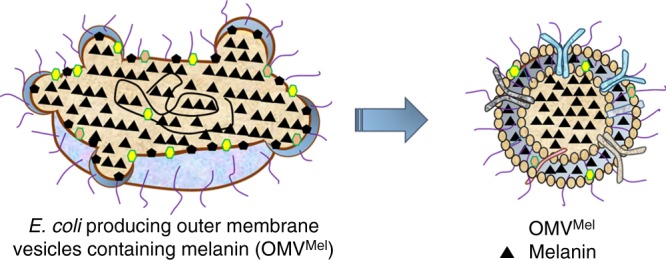
Advances in genetic engineering have enabled the use of bacterial outer membrane vesicles (OMVs) to deliver vaccines, drugs and immunotherapy agents, as a strategy to circumvent biocompatibility and large-scale production issues associated with synthetic nanomaterials. We investigate bioengineered OMVs for contrast enhancement in optoacoustic (photoacoustic) imaging. We produce OMVs encapsulating biopolymer-melanin (OMV) using a bacterial strain expressing a tyrosinase transgene. Our results show that upon near-infrared light irradiation, OMV generates strong optoacoustic signals appropriate for imaging applications. In addition, we show that OMV builds up intense heat from the absorbed laser energy and mediates photothermal effects both in vitro and in vivo. Using multispectral optoacoustic tomography, we noninvasively monitor the spatio-temporal, tumour-associated OMV distribution in vivo. This work points to the use of bioengineered vesicles as potent alternatives to synthetic particles more commonly employed for optoacoustic imaging, with the potential to enable both image enhancement and photothermal applications.
基因工程的进步使得可以使用细菌外膜囊泡(OMV)来递送疫苗、药物和免疫治疗剂,作为一种策略来规避与合成纳米材料相关的生物相容性和大规模生产问题。我们研究了生物工程化的 OMV 用于光声(超声)成像的对比增强。我们使用表达酪氨酸酶转基因的细菌菌株生产包封生物聚合物黑色素的 OMV(OMV)。我们的结果表明,近红外光照射下,OMV 产生适用于成像应用的强光声信号。此外,我们还表明,OMV 从吸收的激光能量中产生强烈的热量,并在体外和体内介导光热效应。使用多光谱光声断层扫描,我们可以非侵入性地监测体内肿瘤相关 OMV 分布的时空变化。这项工作表明,生物工程囊泡可作为更常用于光声成像的合成颗粒的有力替代品,具有增强图像和光热应用的潜力。