Klein Kristina, Sonnabend Michael S, Frank Lisa, Leibiger Karolin, Franz-Wachtel Mirita, Macek Boris, Trunk Thomas, Leo Jack C, Autenrieth Ingo B, Schütz Monika, Bohn Erwin
Interfakultäres Institut für Mikrobiologie und Infektionsmedizin Tübingen (IMIT), Institut für Medizinische Mikrobiologie und Hygiene, Universität Tübingen, Tübingen, Germany.
Proteome Center Tübingen, Universität Tübingen, Tübingen, Germany.
Front Microbiol. 2019 Feb 21;10:100. doi: 10.3389/fmicb.2019.00100. eCollection 2019.
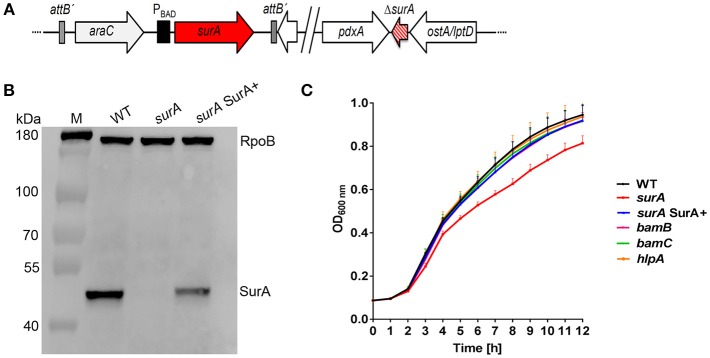
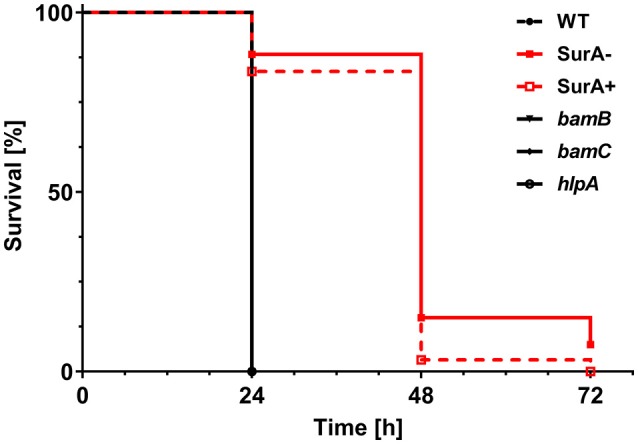
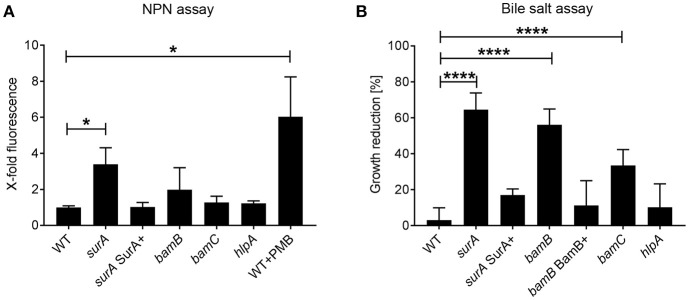
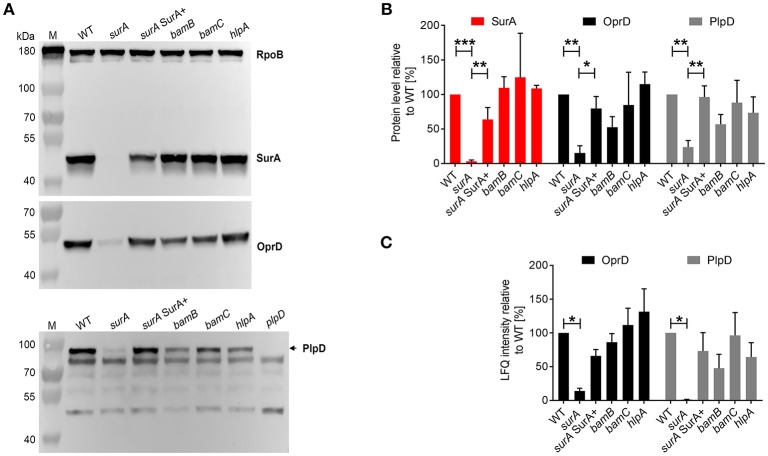
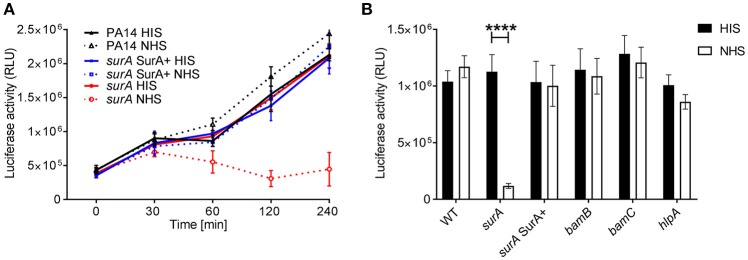
is one of the main causative agents of nosocomial infections and the spread of multidrug-resistant strains is rising. Therefore, novel strategies for therapy are urgently required. The outer membrane composition of Gram-negative pathogens and especially of restricts the efficacy of antibiotic entry into the cell and determines virulence. For efficient outer membrane protein biogenesis, the β-barrel assembly machinery (BAM) complex in the outer membrane and periplasmic chaperones like Skp and SurA are crucial. Previous studies indicated that the importance of individual proteins involved in outer membrane protein biogenesis may vary between different Gram-negative species. In addition, since multidrug-resistant strains pose a serious global threat, the interference with both virulence and antibiotic resistance by disturbing outer membrane protein biogenesis might be a new strategy to cope with this challenge. Therefore, deletion mutants of the non-essential BAM complex components and , of the homolog as well as a conditional mutant of were investigated. The most profound effects for both traits were associated with reduced levels of SurA, characterized by increased membrane permeability, enhanced sensitivity to antibiotic treatment and attenuation of virulence in a infection model. Strikingly, the depletion of SurA in a multidrug-resistant clinical bloodstream isolate re-sensitized the strain to antibiotic treatment. From our data we conclude that SurA of serves as a promising target for developing a drug that shows antiinfective activity and re-sensitizes multidrug-resistant strains to antibiotics.
是医院感染的主要病原体之一,多重耐药菌株的传播正在增加。因此,迫切需要新的治疗策略。革兰氏阴性病原体的外膜组成,尤其是 的外膜组成,限制了抗生素进入细胞的效力并决定了毒力。对于有效的外膜蛋白生物合成,外膜中的β-桶组装机器(BAM)复合物以及诸如Skp和SurA之类的周质伴侣至关重要。先前的研究表明,参与外膜蛋白生物合成的单个蛋白质的重要性在不同的革兰氏阴性物种之间可能有所不同。此外,由于多重耐药菌株构成了严重的全球威胁,通过干扰外膜蛋白生物合成来干扰毒力和抗生素抗性可能是应对这一挑战的新策略。因此,研究了非必需BAM复合物成分 和 的缺失突变体、 同源物的缺失突变体以及 的条件突变体。这两个性状最显著的影响都与SurA水平降低有关,其特征是膜通透性增加、对抗生素治疗的敏感性增强以及在 感染模型中毒力减弱。令人惊讶的是,多重耐药临床血流分离株中SurA的耗尽使该菌株重新对抗生素治疗敏感。从我们的数据中我们得出结论, 的SurA是开发一种具有抗感染活性并使多重耐药菌株重新对抗生素敏感的药物的有希望的靶点。