Su Yi, Flores Shaney, Wang Guoqiao, Hornbeck Russ C, Speidel Benjamin, Joseph-Mathurin Nelly, Vlassenko Andrei G, Gordon Brian A, Koeppe Robert A, Klunk William E, Jack Clifford R, Farlow Martin R, Salloway Stephen, Snider Barbara J, Berman Sarah B, Roberson Erik D, Brosch Jared, Jimenez-Velazques Ivonne, van Dyck Christopher H, Galasko Douglas, Yuan Shauna H, Jayadev Suman, Honig Lawrence S, Gauthier Serge, Hsiung Ging-Yuek R, Masellis Mario, Brooks William S, Fulham Michael, Clarnette Roger, Masters Colin L, Wallon David, Hannequin Didier, Dubois Bruno, Pariente Jeremie, Sanchez-Valle Raquel, Mummery Catherine, Ringman John M, Bottlaender Michel, Klein Gregory, Milosavljevic-Ristic Smiljana, McDade Eric, Xiong Chengjie, Morris John C, Bateman Randall J, Benzinger Tammie L S
Banner Alzheimer's Institute, Phoenix, AZ, USA.
Department of Radiology, Washington University School of Medicine, Saint Louis, MO, USA.
Alzheimers Dement (Amst). 2019 Feb 22;11:180-190. doi: 10.1016/j.dadm.2018.12.008. eCollection 2019 Dec.
Quantitative measurement of brain amyloid burden is important for both research and clinical purposes. However, the existence of multiple imaging tracers presents challenges to the interpretation of such measurements. This study presents a direct comparison of Pittsburgh compound B-based and florbetapir-based amyloid imaging in the same participants from two independent cohorts using a crossover design.
Pittsburgh compound B and florbetapir amyloid PET imaging data from three different cohorts were analyzed using previously established pipelines to obtain global amyloid burden measurements. These measurements were converted to the Centiloid scale to allow fair comparison between the two tracers. The mean and inter-individual variability of the two tracers were compared using multivariate linear models both cross-sectionally and longitudinally.
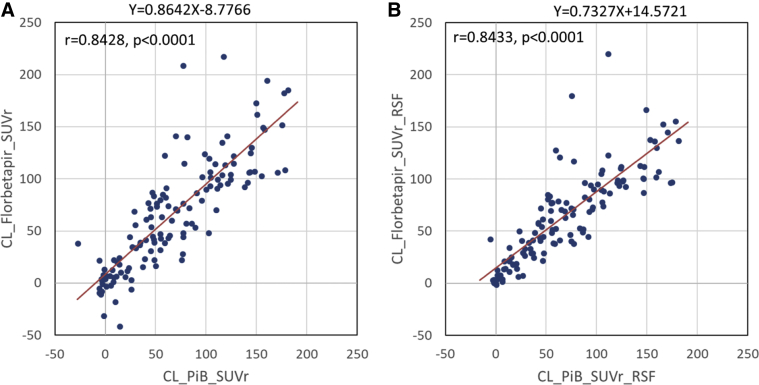
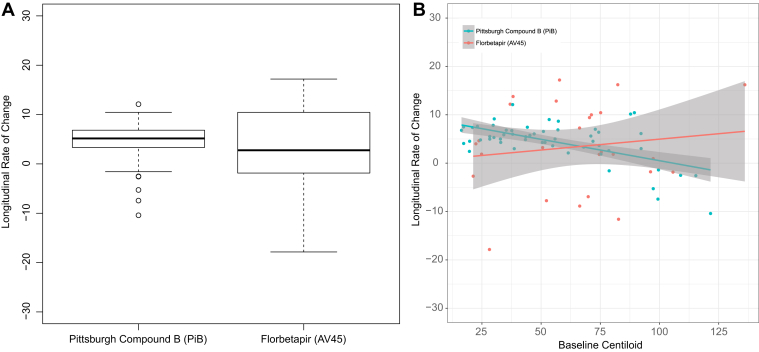
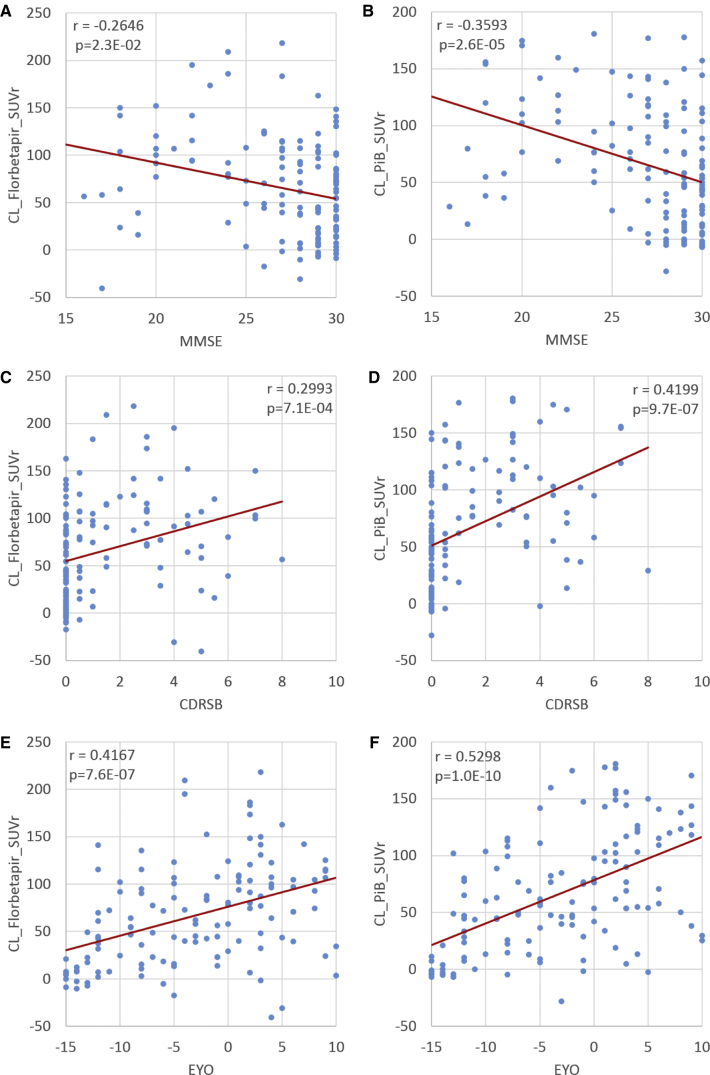
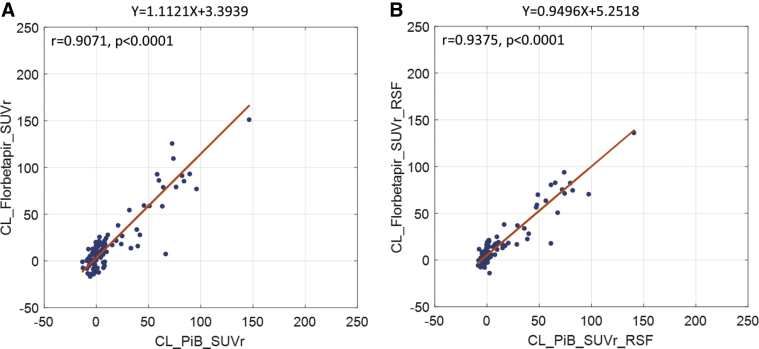
Global amyloid burden measured using the two tracers were strongly correlated in both cohorts. However, higher variability was observed when florbetapir was used as the imaging tracer. The variability may be partially caused by white matter signal as partial volume correction reduces the variability and improves the correlations between the two tracers. Amyloid burden measured using both tracers was found to be in association with clinical and psychometric measurements. Longitudinal comparison of the two tracers was also performed in similar but separate cohorts whose baseline amyloid load was considered elevated (i.e., amyloid positive). No significant difference was detected in the average annualized rate of change measurements made with these two tracers.
Although the amyloid burden measurements were quite similar using these two tracers as expected, difference was observable even after conversion into the Centiloid scale. Further investigation is warranted to identify optimal strategies to harmonize amyloid imaging data acquired using different tracers.
脑淀粉样蛋白负荷的定量测量对于研究和临床目的都很重要。然而,多种成像示踪剂的存在给此类测量结果的解读带来了挑战。本研究采用交叉设计,对来自两个独立队列的同一组参与者进行基于匹兹堡化合物B和基于氟比他派的淀粉样蛋白成像的直接比较。
使用先前建立的流程分析来自三个不同队列的匹兹堡化合物B和氟比他派淀粉样蛋白PET成像数据,以获得全局淀粉样蛋白负荷测量值。这些测量值被转换为百分等级量表,以便在两种示踪剂之间进行公平比较。使用多变量线性模型对两种示踪剂的均值和个体间变异性进行横断面和纵向比较。
在两个队列中,使用两种示踪剂测量的全局淀粉样蛋白负荷都高度相关。然而,当使用氟比他派作为成像示踪剂时,观察到更高的变异性。这种变异性可能部分由白质信号引起,因为部分容积校正降低了变异性并改善了两种示踪剂之间的相关性。发现使用两种示踪剂测量的淀粉样蛋白负荷与临床和心理测量结果相关。还在基线淀粉样蛋白负荷被认为升高(即淀粉样蛋白阳性)的相似但独立的队列中对两种示踪剂进行了纵向比较。在使用这两种示踪剂进行的平均年化变化率测量中未检测到显著差异。
尽管正如预期的那样,使用这两种示踪剂测量的淀粉样蛋白负荷非常相似,但即使转换为百分等级量表后仍可观察到差异。有必要进行进一步研究,以确定协调使用不同示踪剂获取的淀粉样蛋白成像数据(的)最佳策略。