Pharmaceutical Health Services Research, University of Maryland School of Pharmacy, Baltimore.
JAMA Netw Open. 2019 Mar 1;2(3):e190338. doi: 10.1001/jamanetworkopen.2019.0338.
Inadequate treatment of opioid use disorder (OUD) in pregnant women increases the risk of life-threatening consequences on maternal and fetal outcomes. Untreated OUD during pregnancy is associated with higher rates of adverse outcomes among newborns.
To examine the variation in the prevalence of OUD and the use of medication-assisted treatment among commercially insured pregnant women according to region and state legislature.
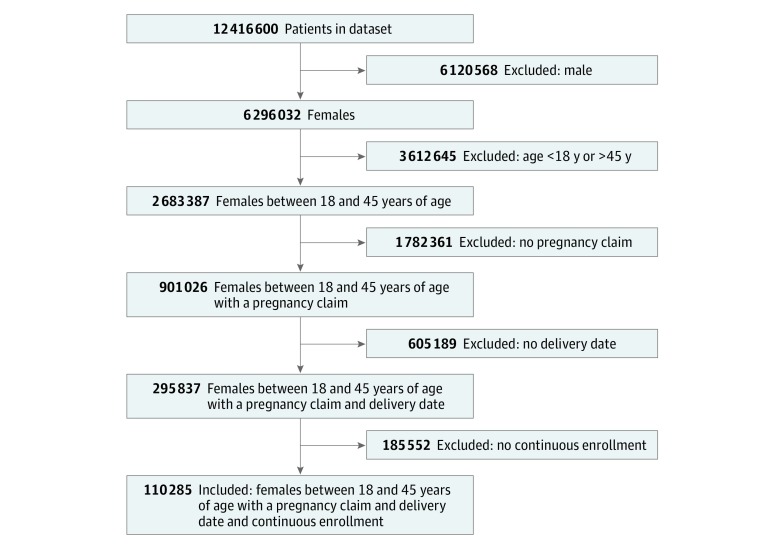
DESIGN, SETTING, AND PARTICIPANTS: Cohort study in which the patient cohort used was derived from a 10% random sample of enrollees within the IQVIA PharMetrics Plus adjudicated claims and enrollment database from 2007 to 2015. The database consists of a 10% random sample of private health insurance recipients in the United States and contains claims and enrollment data that are representative of the commercially insured US population. The cohort comprised women (n = 110 285) between 18 and 45 years of age with a code indicating a delivery and continuous insurance enrollment 9 months before and 12 months after delivery. Data analysis was performed from December 2017 to May 2018.
Based on their state of residence, the women were classified into 4 different regions: South, Midwest, West, and Northeast. Those residing in states with statutes that imposed civil or criminal penalties for OUD diagnosis during pregnancy were placed in a separate population from those residing in states without these statutes.
Diagnosis of OUD in the 9 months before delivery and the receipt of medication-assisted treatment in the 9 months before or 12 months after delivery.
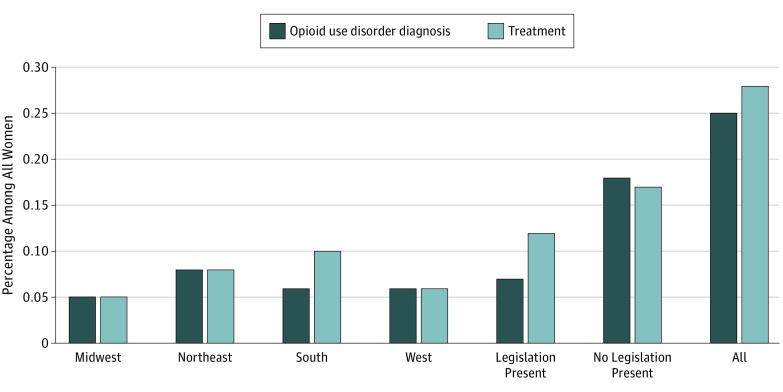
The 110 285 pregnant women included in the analysis had a mean (SD) age of 30.26 (5.59) years, with most (67 771 [61.5%]) falling within the 26- to 35-year age range. Of this cohort, 277 women (0.25%) had a diagnosis of OUD and 312 (0.28%) received treatment. Among the 277 women with OUD, 127 (45.9%) received treatment. The prevalence of an OUD diagnosis and receipt of treatment within regions was statistically significant (OUD diagnosis by region: Midwest, 0.05%; North, 0.09%; South, 0.06%; West, 0.06%; χ23 = 45.1148 [P < .001]; OUD treatment by region: Midwest, 0.05%; North, 0.08%; South, 0.10%; West, 0.05%; χ23 = 26.5654 [P < .001]). The prevalence of OUD diagnosis was also statistically significant when comparing women residing in states with statutes with those in states without statutes (OUD diagnosis by criminal statutes: criminalization, 0.07%; no criminalization, 0.18%; χ21 = 14.6456 [P < .001]; OUD treatment by criminal statutes: criminalization, 0.12%; no criminalization, 0.17%; χ21 = 0.0895); the receipt of treatment was not statistically significant (P = .76).
These results appeared to show significant variations in the patterns of OUD diagnosis and receipt of medication-assisted treatment among pregnant women, suggesting the need to further explore the source of these variations.
在孕妇中治疗阿片类药物使用障碍(OUD)不足会增加对母婴结局产生危及生命后果的风险。在怀孕期间未经治疗的 OUD 与新生儿不良结局的发生率较高有关。
根据地区和州立法,研究商业保险孕妇中 OUD 的患病率和药物辅助治疗的使用情况的变化。
设计、设置和参与者:这项队列研究的患者队列来自 2007 年至 2015 年 IQVIA PharMetrics Plus 裁定索赔和登记数据库中 10%的随机样本。该数据库由美国私人医疗保险接受者的 10%随机样本组成,包含了索赔和登记数据,这些数据代表了商业保险的美国人群。该队列包括 110285 名年龄在 18 至 45 岁之间的女性,她们的分娩代码和 9 个月前和分娩后 12 个月的连续保险登记。数据分析于 2017 年 12 月至 2018 年 5 月进行。
根据她们的居住州,这些女性被分为四个不同的地区:南部、中西部、西部和东北部。那些居住在对 OUD 诊断施加民事或刑事处罚的州的居民与居住在没有这些法规的州的居民分开统计。
分娩前 9 个月的 OUD 诊断和分娩前 9 个月或分娩后 12 个月接受药物辅助治疗的情况。
在分析中纳入的 110285 名孕妇的平均(SD)年龄为 30.26(5.59)岁,其中大多数(67771[61.5%])年龄在 26 至 35 岁之间。在这一队列中,有 277 名女性(0.25%)被诊断为 OUD,312 名(0.28%)接受了治疗。在 277 名患有 OUD 的女性中,有 127 名(45.9%)接受了治疗。各地区 OUD 诊断和治疗的患病率存在统计学差异(OUD 诊断的地区差异:中西部,0.05%;北部,0.09%;南部,0.06%;西部,0.06%;χ23=45.1148[P<0.001];OUD 治疗的地区差异:中西部,0.05%;北部,0.08%;南部,0.10%;西部,0.05%;χ23=26.5654[P<0.001])。与没有法规的州相比,居住在有法规的州的女性的 OUD 诊断率也存在统计学差异(OUD 诊断的刑事法规差异:刑事化,0.07%;非刑事化,0.18%;χ21=14.6456[P<0.001];OUD 治疗的刑事法规差异:刑事化,0.12%;非刑事化,0.17%;χ21=0.0895);但治疗的接受率没有统计学意义(P=0.76)。
这些结果似乎表明,孕妇中 OUD 诊断和药物辅助治疗的模式存在显著差异,这表明需要进一步探讨这些差异的来源。