Xu Guodong, Li Chun, Parsiola Anne L, Li Jiyu, McCarter Kimberly D, Shi Runhua, Mayhan William G, Sun Hong
Department of Cellular Biology & Anatomy, Louisiana State University Health Sciences Center-Shreveport, Shreveport, LA, United States.
Department of Neurology, Hebei General Hospital, Shijiazhuang, China.
Front Cell Neurosci. 2019 Feb 12;13:6. doi: 10.3389/fncel.2019.00006. eCollection 2019.
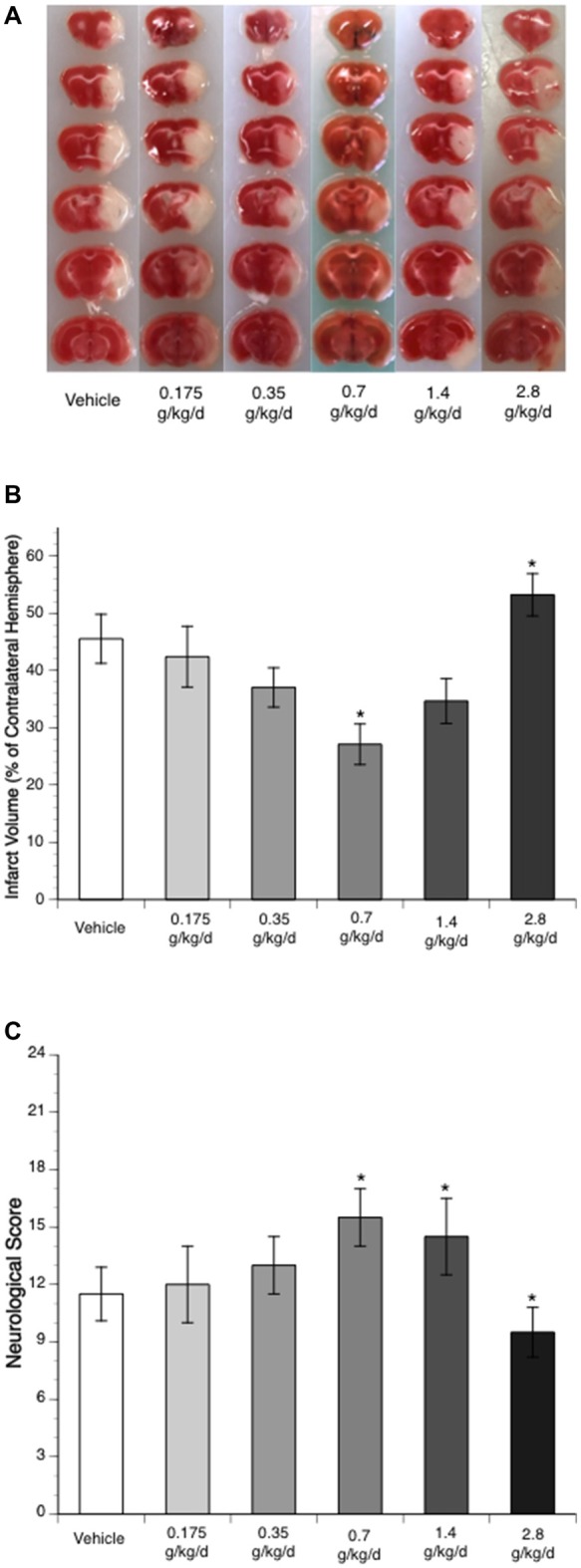
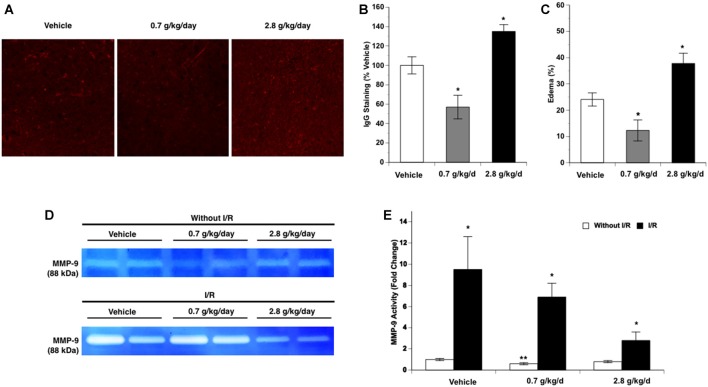
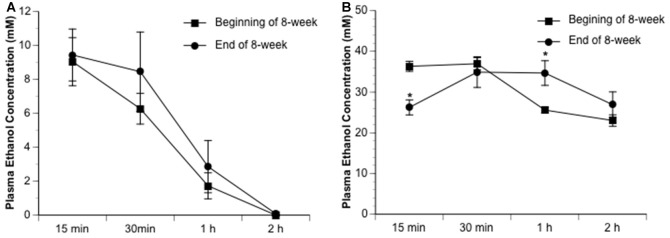
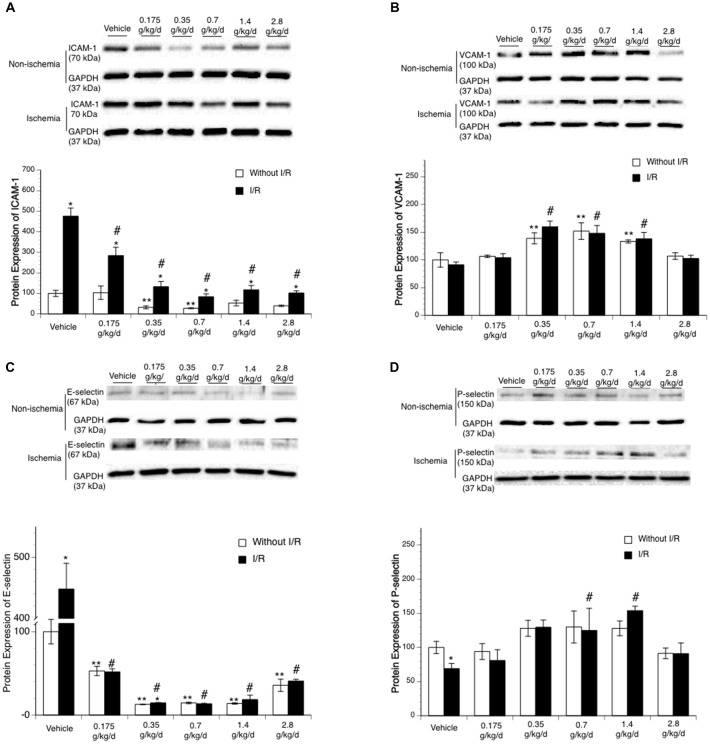
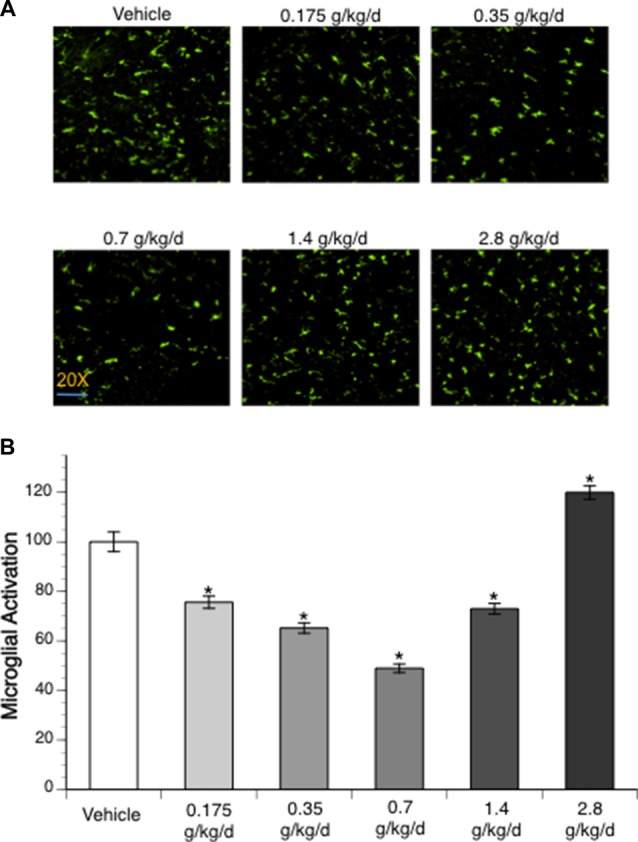
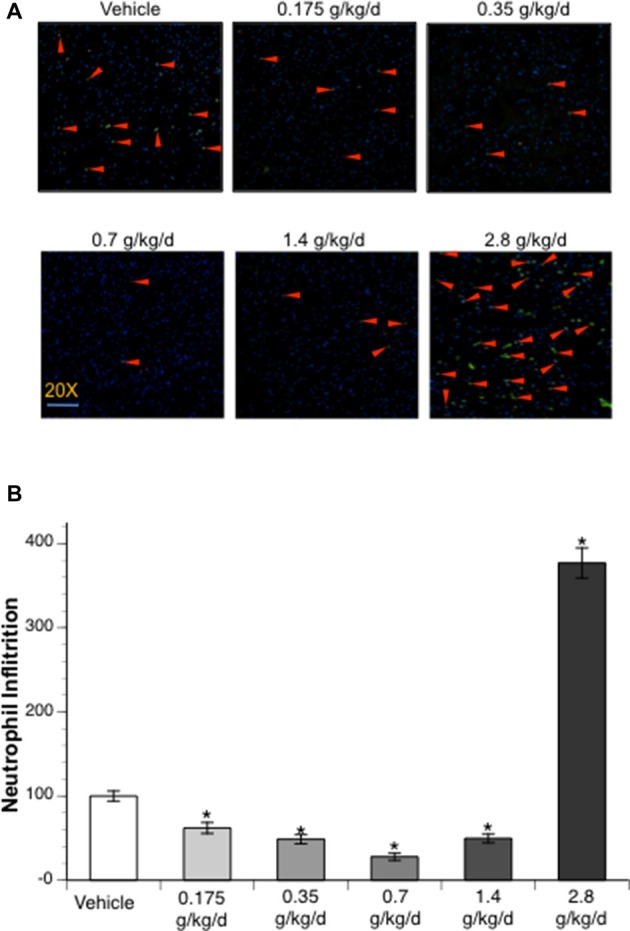
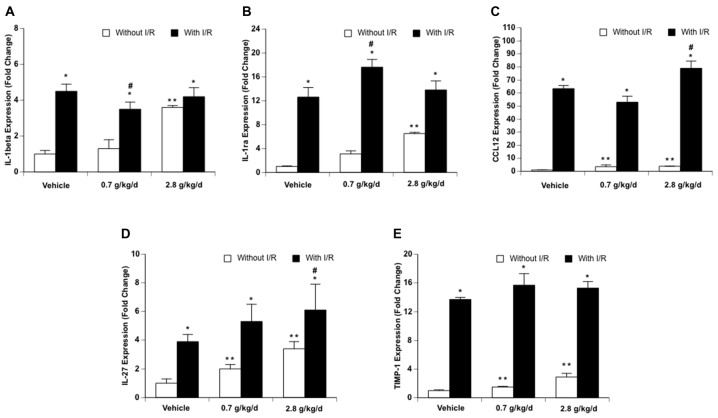
Chronic ethanol consumption dose-dependently affects both incidence and prognosis of ischemic stroke. Our goal was to determine whether the influence of chronic ethanol consumption on ischemic stroke is related to an altered inflammatory profile in the brain. Male C57BL/6J mice were divided into six groups and gavage fed with 0.175, 0.35, 0.7, 1.4, 2.8 g/kg/day ethanol or volume-matched water once a day for 8 weeks. Adhesion molecules, microglial activation, neutrophil infiltration, pro- and anti-inflammatory cytokines/chemokines, blood-brain barrier (BBB) permeability, and matrix metallopeptidases (MMPs) in the cerebral cortex before and following a 90-min unilateral middle cerebral artery occlusion (MCAO)/24-h reperfusion were evaluated. Brain ischemia/reperfusion (I/R) injury was significantly reduced in 0.7 g/kg/day ethanol group (peak blood ethanol concentration: 9 mM) and worsened in 2.8 g/kg/day ethanol group (peak blood ethanol concentration: 37 mM). Baseline E-selectin was downregulated in all ethanol groups, whereas baseline intercellular adhesion molecule-1 (ICAM-1) was only downregulated in 0.35 and 0.7 g/kg/day ethanol groups. Interestingly, baseline vascular cell adhesion molecule-1 (VCAM-1) was upregulated in 0.35, 0.7, and 1.4 g/kg/day ethanol groups. Post-ischemic upregulation of ICAM-1 and E-selectin were suppressed in all ethanol groups. Post-ischemic neutrophil infiltration and microglial activation were significantly less in the low-moderate (0.175-1.4 g/kg/day) ethanol groups but greater in the 2.8 g/kg/day ethanol group compared to the vehicle group. At basal conditions, ethanol increased one pro- and two anti-inflammatory cytokines/chemokines at the 0.7 g/kg/day dose, and 13 pro- and eight anti-inflammatory cytokines/chemokines at the 2.8 g/kg/day dose. After ischemia, 0.7 g/kg/day ethanol suppressed post-ischemic pro-inflammatory cytokines/chemokines and enhanced post-ischemic anti-inflammatory cytokines/chemokines. Moreover, 0.7 g/kg/day ethanol significantly reduced baseline MMP-9 activity and alleviated post-ischemic BBB breakdown. On the other hand, 2.8 g/kg/day ethanol worsened post-ischemic BBB breakdown. Our findings suggest that low-moderate ethanol consumption may prevent ischemic stroke and reduce brain I/R injury by suppressing inflammation, whereas heavy alcohol consumption may induce ischemic stroke and worsen brain I/R injury by aggravating inflammation.
长期摄入乙醇对缺血性中风的发病率和预后均有剂量依赖性影响。我们的目标是确定长期摄入乙醇对缺血性中风的影响是否与大脑中炎症特征的改变有关。将雄性C57BL/6J小鼠分为六组,每天一次灌胃给予0.175、0.35、0.7、1.4、2.8 g/kg/天的乙醇或等体积的水,持续8周。在90分钟单侧大脑中动脉闭塞(MCAO)/24小时再灌注前后,评估大脑皮层中的黏附分子、小胶质细胞活化、中性粒细胞浸润、促炎和抗炎细胞因子/趋化因子、血脑屏障(BBB)通透性以及基质金属蛋白酶(MMPs)。0.7 g/kg/天乙醇组(血乙醇峰值浓度:9 mM)的脑缺血/再灌注(I/R)损伤明显减轻,而2.8 g/kg/天乙醇组(血乙醇峰值浓度:37 mM)的损伤加重。所有乙醇组的基线E-选择素均下调,而基线细胞间黏附分子-1(ICAM-1)仅在0.35和0.7 g/kg/天乙醇组中下调。有趣的是,0.35、0.7和1.4 g/kg/天乙醇组的基线血管细胞黏附分子-1(VCAM-1)上调。所有乙醇组缺血后ICAM-1和E-选择素的上调均受到抑制。与溶剂组相比,低-中度(0.175-1.4 g/kg/天)乙醇组缺血后中性粒细胞浸润和小胶质细胞活化明显减少,而2.8 g/kg/天乙醇组则增加。在基础状态下,0.7 g/kg/天剂量的乙醇增加了一种促炎和两种抗炎细胞因子/趋化因子,2.8 g/kg/天剂量的乙醇增加了13种促炎和8种抗炎细胞因子/趋化因子。缺血后,0.7 g/kg/天乙醇抑制了缺血后促炎细胞因子/趋化因子并增强了缺血后抗炎细胞因子/趋化因子。此外,0.7 g/kg/天乙醇显著降低了基线MMP-9活性并减轻了缺血后血脑屏障的破坏。另一方面,2.8 g/kg/天乙醇加重了缺血后血脑屏障的破坏。我们的研究结果表明,低-中度乙醇摄入可能通过抑制炎症预防缺血性中风并减轻脑I/R损伤,而大量饮酒可能通过加重炎症诱发缺血性中风并加重脑I/R损伤。