Elkouris Maximilianos, Kouroupi Georgia, Vourvoukelis Alexios, Papagiannakis Nikolaos, Kaltezioti Valeria, Matsas Rebecca, Stefanis Leonidas, Xilouri Maria, Politis Panagiotis K
Center for Basic Research, Biomedical Research Foundation of the Academy of Athens, Athens, Greece.
Laboratory of Cellular and Molecular Neurobiology, Hellenic Pasteur Institute Athens, Greece.
Front Cell Neurosci. 2019 Feb 22;13:58. doi: 10.3389/fncel.2019.00058. eCollection 2019.
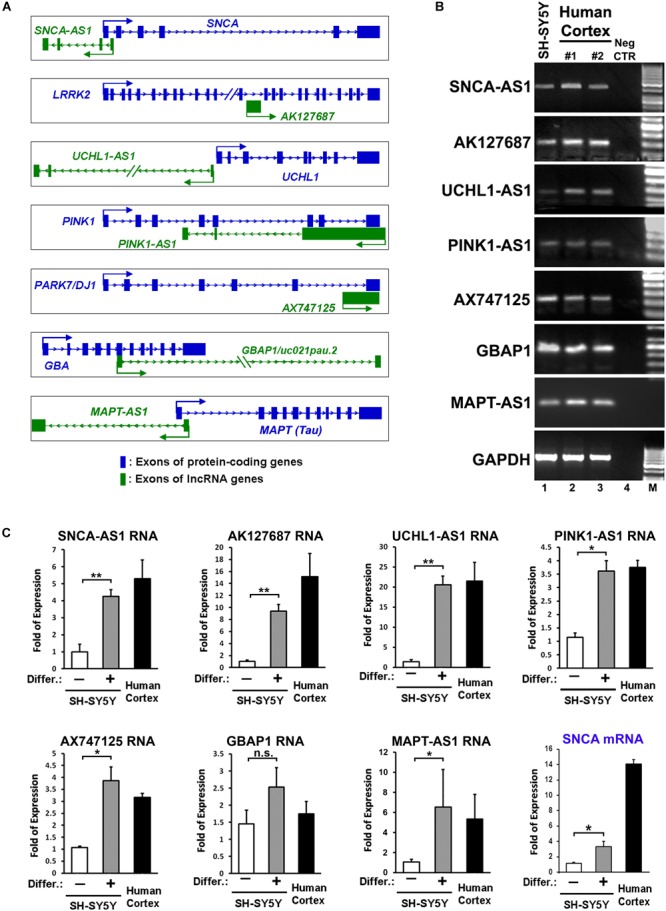
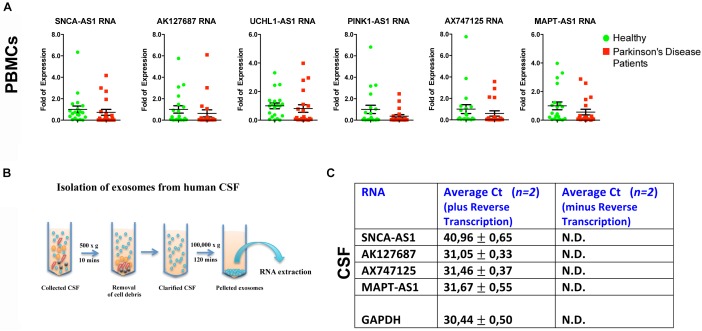
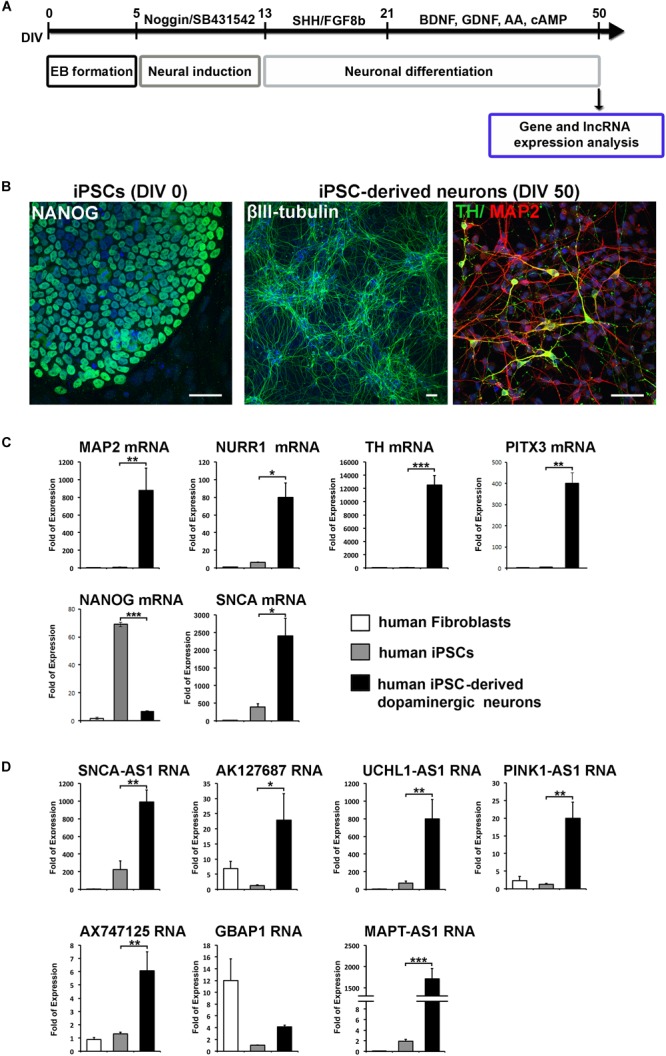
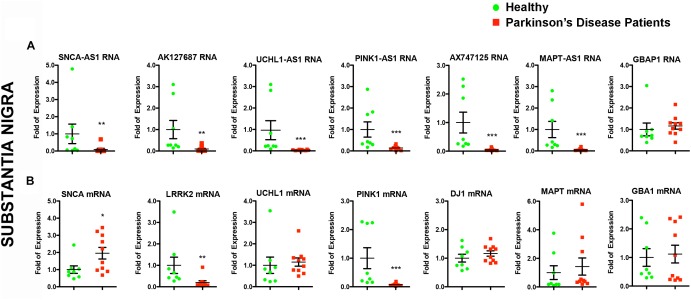
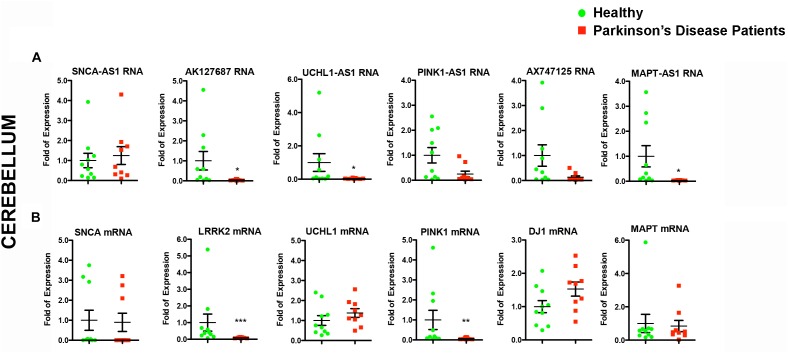
Transcriptome analysis has identified a plethora of long non-coding RNAs (lncRNAs) expressed in the human brain and associated with neurological diseases. However, whether lncRNAs expression levels correlate with Parkinson's disease (PD) pathogenesis remains unknown. Herein, we show that a number of lncRNA genes encompassing transcriptional units in close proximity to PD-linked protein-coding genes, including , , , , , and , are expressed in human dopaminergic cells and post-mortem material, such as cortex, and cerebellum. Interestingly, these lncRNAs are upregulated during neuronal differentiation of SH-SY5Y cells and of dopaminergic neurons generated from human fibroblast-derived induced pluripotent stem cells. Importantly, six lncRNAs are found under-expressed in the nigra and three in the cerebellum of PD patients compared to controls. Simultaneously, mRNA levels are increased in the nigra, while and mRNA levels are decreased both in the nigra and the cerebellum of PD subjects compared to controls, indicating a possible correlation between the expression profile of the respective lncRNAs with their adjacent coding genes. Interestingly, all dysregulated lncRNAs are also detected in human peripheral blood mononuclear cells and four of them in exosomes derived from human cerebrospinal fluid, providing initial evidence for their potential use as diagnostic tools for PD. Our data raise the intriguing possibility that these lncRNAs may be involved in disease pathogenesis by regulating their neighboring PD-associated genes and may thus represent novel targets for the diagnosis and/or treatment of PD or related diseases.
转录组分析已鉴定出大量在人类大脑中表达且与神经疾病相关的长链非编码RNA(lncRNA)。然而,lncRNA的表达水平是否与帕金森病(PD)的发病机制相关仍不清楚。在此,我们表明,一些包含与PD相关的蛋白质编码基因紧密相邻的转录单元的lncRNA基因,包括[具体基因名称未给出],在人类多巴胺能细胞和死后组织(如皮质、[具体组织名称未给出]和小脑)中表达。有趣的是,这些lncRNA在SH-SY5Y细胞以及从人成纤维细胞衍生的诱导多能干细胞产生的多巴胺能神经元的神经元分化过程中上调。重要的是,与对照组相比,在PD患者的黑质中发现6种lncRNA表达下调,在小脑中发现3种lncRNA表达下调。同时,与对照组相比,PD患者黑质中的[具体mRNA名称未给出]mRNA水平升高,而黑质和小脑中的[具体mRNA名称未给出]和[具体mRNA名称未给出]mRNA水平降低,表明相应lncRNA的表达谱与其相邻编码基因之间可能存在相关性。有趣的是,在人类外周血单核细胞中也检测到所有失调的lncRNA,其中4种在源自人类脑脊液的外泌体中也被检测到,这为它们作为PD诊断工具的潜在用途提供了初步证据。我们的数据提出了一个有趣的可能性,即这些lncRNA可能通过调节其邻近的PD相关基因参与疾病发病机制,因此可能代表PD或相关疾病诊断和/或治疗的新靶点。