Dragomir Mihnea, Chen Baoqing, Calin George A
Department of Experimental Therapeutics, The University of Texas MD Anderson Cancer Center, Houston, TX, USA.
Research Center for Functional Genomics, Biomedicine and Translational Medicine, Iuliu Hatieganu University of Medicine and Pharmacy, Cluj-Napoca, Romania.
Transl Cancer Res. 2018 Mar;7(Suppl 2):S243-S252. doi: 10.21037/tcr.2017.10.46.
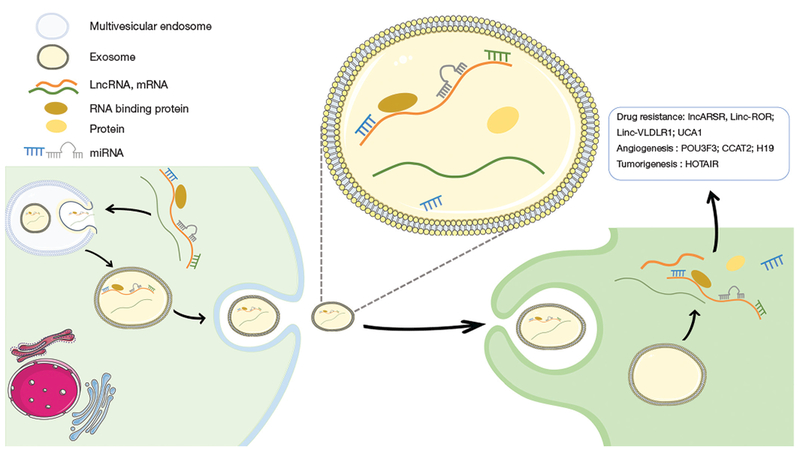
Neoplastic cells use various intercellular communication mechanisms in order to adapt to the local microenvironment, manipulate the immune system, and facilitate metastasis. Exosomes release is a new mechanism of cell-to-cell communication. These nanovesicles enclose various types of molecules including lipids, proteins, DNA, messenger RNA (mRNA) and non-coding RNAs [microRNA and long non-coding RNA (lncRNA)]. lncRNAs are over 200 nt long transcripts, that exhibit no coding potential, but are crucial regulators of physiological processes and are deregulated in cancer. In this review, we will discuss the role of exosomal lncRNAs in cancer, which is an incipient research field that could bring new insights to the vast domain of intercellular communication. Exosomal lncRNAs seem to be promising biomarkers for any type of cancer. The exact role of exosomal lncRNAs is not fully revealed. Several studies show that cancer derived exosomal lncRNAs are functional and can transmit to neighboring cells different phenotypic patterns, like drug resistance and increased angiogenesis. We further discuss the mechanistic function of exosomal lncRNAs, and hypothesize that the crowded exosomal content can be a suitable place of RNA species crosstalk. Finally, we assume that lncRNAs could be a loading vehicle for miRNAs, mRNAs and other complex molecules into the exosome but future studies are required to confirm these hypotheses.
肿瘤细胞利用各种细胞间通讯机制来适应局部微环境、操纵免疫系统并促进转移。外泌体释放是一种细胞间通讯的新机制。这些纳米囊泡包裹着各种类型的分子,包括脂质、蛋白质、DNA、信使核糖核酸(mRNA)和非编码RNA[微小RNA和长链非编码RNA(lncRNA)]。lncRNAs是长度超过200个核苷酸的转录本,不具有编码潜力,但却是生理过程的关键调节因子,且在癌症中失调。在本综述中,我们将讨论外泌体lncRNAs在癌症中的作用,这是一个新兴的研究领域,可能会为细胞间通讯的广阔领域带来新的见解。外泌体lncRNAs似乎有望成为任何类型癌症的生物标志物。外泌体lncRNAs的确切作用尚未完全揭示。多项研究表明,癌症来源的外泌体lncRNAs具有功能,可将不同的表型模式传递给邻近细胞,如耐药性和血管生成增加。我们进一步讨论外泌体lncRNAs的机制功能,并推测拥挤的外泌体内容物可能是RNA种类相互作用的合适场所。最后,我们假设lncRNAs可能是将微小RNA、mRNA和其他复杂分子装载到外泌体中的载体,但未来还需要研究来证实这些假设。