1 Orthodontic Division, Multidisciplinary Department of Medical-Surgical and Dental Specialties, University of Campania "Luigi Vanvitelli", Via Luigi De Crecchio 6, 80138, Naples, Italy.
Department of Periodontics, School of Dentistry, Virginia Commonwealth University, Richmond, VA, USA.
Prog Orthod. 2019 Mar 11;20(1):10. doi: 10.1186/s40510-019-0263-3.
To evaluate differences between orthodontists and general dentists in experience with clear aligners (CA), patients' demand and perception, types of patients, and malocclusion treated with CA and to compare the two groups of clinicians not using CA in their practice.
A Web-based survey was developed and sent to the 129 members of the European Aligner Society and randomly to 200 doctors of dental surgery by e-mail. They responded on demographics and to one of two different parts for clinicians using CA or not using CA. Statistical analysis was performed with SAS EGv.6.1.
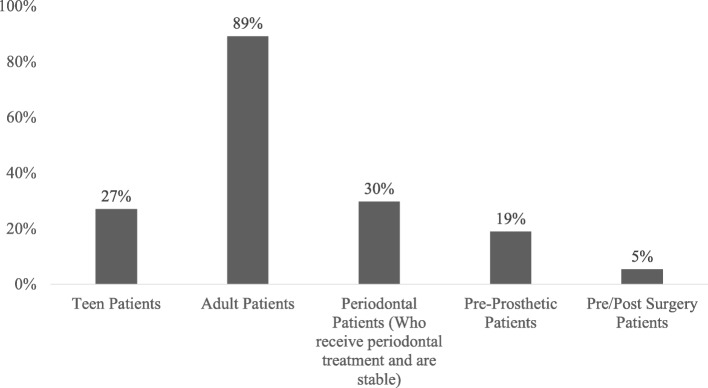
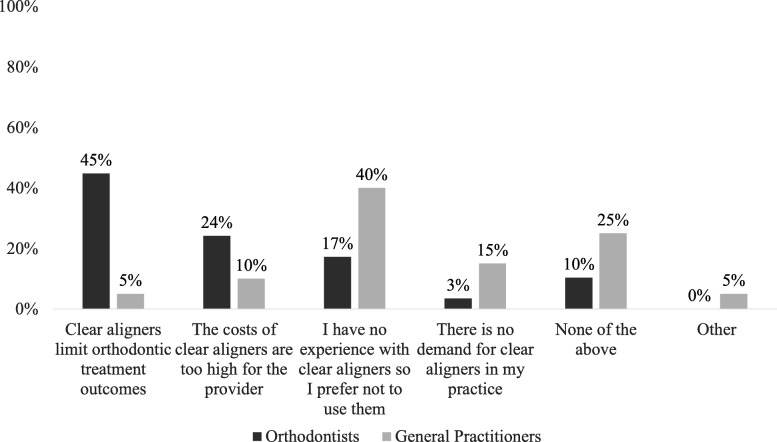
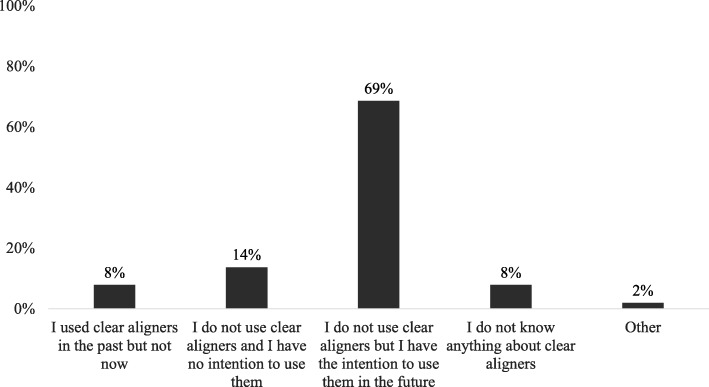
The response rate was 74%. Among the total of respondents, the majority reported utilizing CA in their practice with a greater percentage of orthodontists (P = 0.0040). Overall, orthodontists learned more about CA during academic seminars comparing to general dentists, and they treated more class I with crowding (P = 0.0002) and with open bite (P = 0.0462). The majority of patients treated with CA were female and adults with a full-time employment, and the patients' knowledge about CA treatment was mainly provided by information from external media advertising. For respondents not using CA, orthodontists were more likely to report that CA limit treatment outcomes, whereas general practitioners were reported not having enough experience to use them.
There were some significant differences between orthodontists and general dentists mainly in experience and case selection for clinicians using CA as well as in the reasons provided for not using CA in their practice.
评估正畸医生和普通牙医在使用透明矫正器(CA)方面的经验、患者的需求和认知、患者类型以及使用 CA 治疗的错颌畸形方面的差异,并比较两组在实践中不使用 CA 的临床医生。
开发了一个基于网络的调查,并通过电子邮件发送给欧洲矫正协会的 129 名成员和随机的 200 名口腔外科学医生。他们对人口统计学数据和使用 CA 或不使用 CA 的临床医生的两个不同部分之一进行了回复。使用 SAS EGv.6.1 进行了统计分析。
回复率为 74%。在总受访者中,大多数报告在他们的实践中使用 CA,正畸医生的比例更高(P=0.0040)。总的来说,正畸医生在学术研讨会上比普通牙医更多地了解 CA,他们治疗更多的 I 类拥挤(P=0.0002)和开颌(P=0.0462)。接受 CA 治疗的大多数患者是女性和全职工作的成年人,患者对 CA 治疗的了解主要来自外部媒体广告的信息。对于不使用 CA 的受访者,正畸医生更有可能报告 CA 限制治疗效果,而普通牙医则报告缺乏使用 CA 的经验。
正畸医生和普通牙医之间存在一些显著差异,主要体现在使用 CA 的临床医生的经验和病例选择方面,以及在实践中不使用 CA 的原因方面。