Frontier Science Center for Synthetic Biology and Key Laboratory of Systems Bioengineering (Ministry of Education), Tianjin University, Tianjin, 300072, China.
Collaborative Innovation Center of Chemical Science and Engineering (Tianjin), School of Chemical Engineering and Technology, Tianjin University, Tianjin, 300072, China.
Microb Cell Fact. 2019 Mar 11;18(1):52. doi: 10.1186/s12934-019-1102-4.
Strains with increased alkali tolerance have a broad application in industrial, especially for bioremediation, biodegradation, biocontrol and production of bio-based chemicals. A novel synthetic chromosome recombination and modification by LoxP-mediated evolution (SCRaMbLE) system has been introduced in the synthetic yeast genome (Sc 2.0), which enables generation of a yeast library with massive structural variations and potentially drives phenotypic evolution. The structural variations including deletion, inversion and duplication have been detected within synthetic yeast chromosomes.
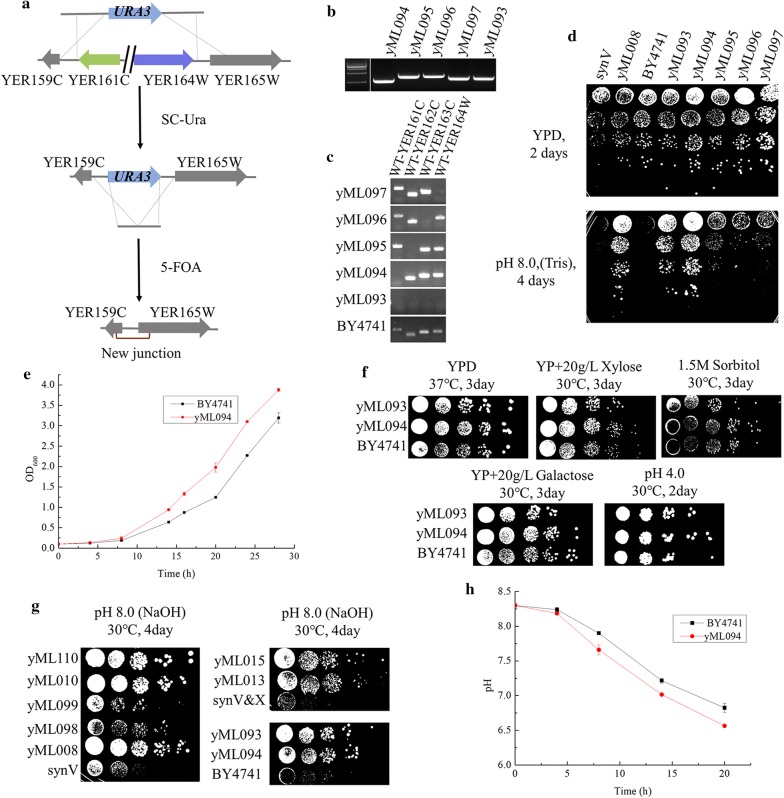
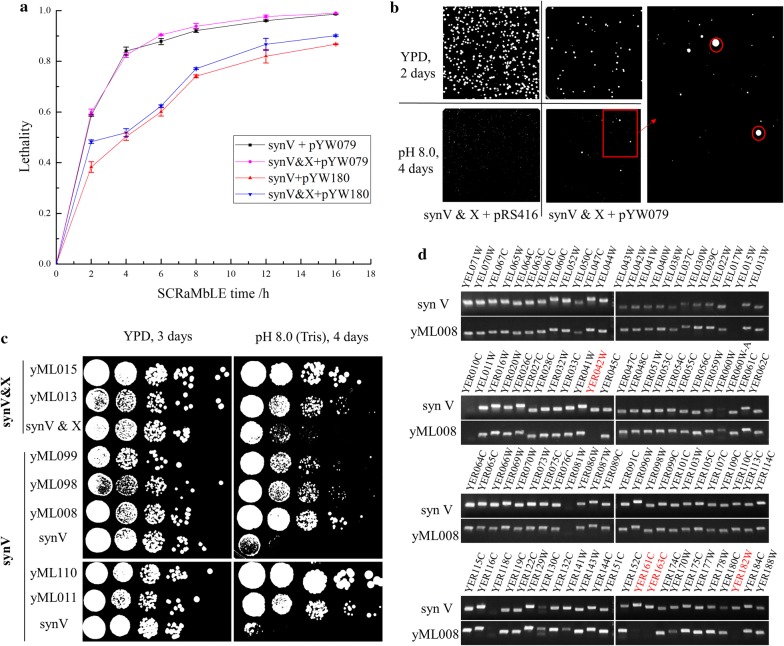
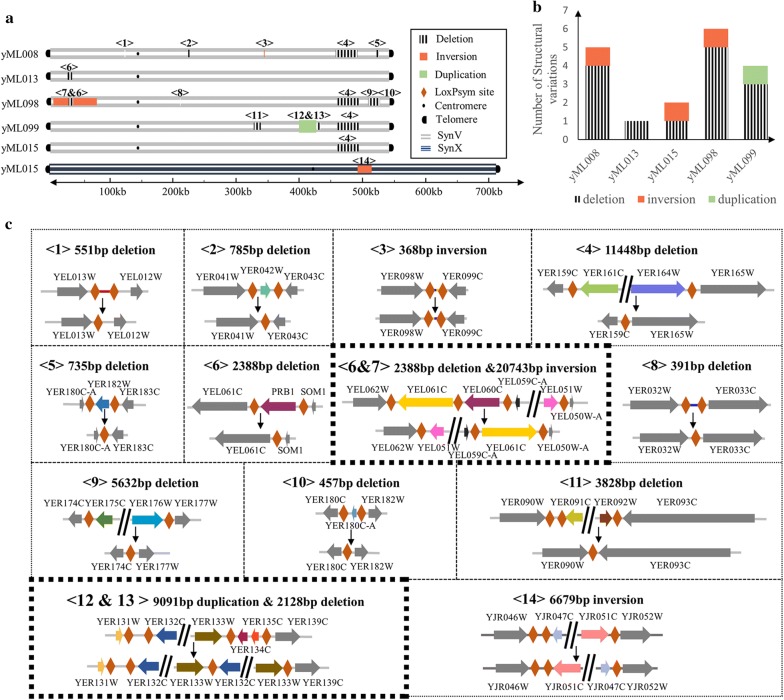
Haploid yeast strains harboring either one (synV) or two (synV and synX) synthetic chromosomes were subjected to SCRaMbLE. Seven of evolved strains with increased alkali tolerance at pH 8.0 were generated through multiple independent SCRaMbLE experiments. Various of structural variations were detected in evolved yeast strains by PCRTag analysis and whole genome sequencing including two complex structural variations. One possessed an inversion of 20,743 base pairs within which YEL060C (PRB1) was deleted simultaneously, while another contained a duplication region of 9091 base pairs in length with a deletion aside. Moreover, a common deletion region with length of 11,448 base pairs was mapped in four of the alkali-tolerant strains. We further validated that the deletion of YER161C (SPT2) within the deleted region could increase alkali tolerance in Saccharomyces cerevisiae.
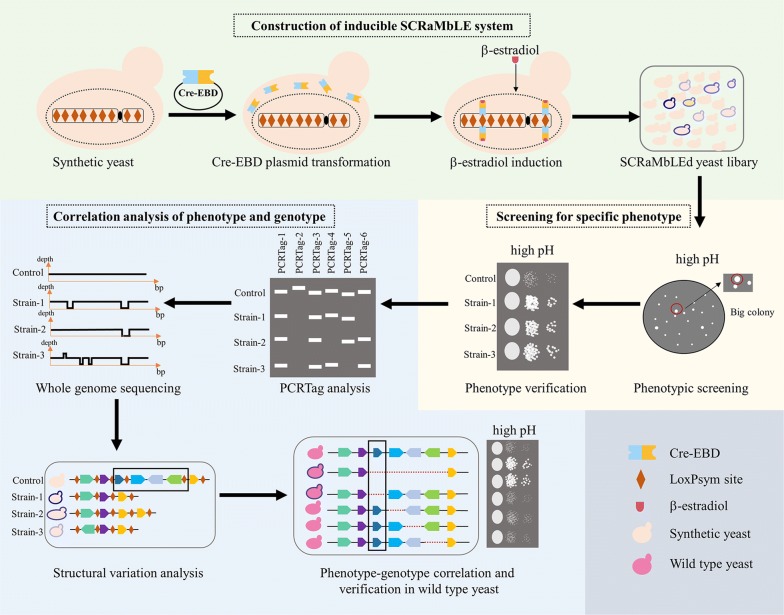
SCRaMbLE system provides a simple and efficient way to generate evolved yeast strains with enhanced alkali tolerance. Deletion of YER161C (SPT2) mapped by SCRaMbLE can improve alkali tolerance in S. cerevisiae. This study enriches our understanding of alkali tolerance in yeast and provides a standard workflow for the application of SCRaMbLE system to generate various phenotypes that may be interesting for industry and extend understanding of phenotype-genotype relationship.
具有耐碱能力增强的菌株在工业中具有广泛的应用,特别是在生物修复、生物降解、生物防治和生产生物基化学品方面。一种新型的通过 LoxP 介导的进化的合成染色体重组和修饰(SCRaMbLE)系统已被引入合成酵母基因组(Sc 2.0),该系统能够产生具有大量结构变异的酵母文库,并可能驱动表型进化。已经在合成酵母染色体中检测到包括缺失、倒位和重复在内的结构变异。
含有一个(synV)或两个(synV 和 synX)合成染色体的单倍体酵母菌株被进行了 SCRaMbLE。通过多次独立的 SCRaMbLE 实验,产生了 7 株耐碱能力增强的进化菌株,在 pH 8.0 下生长。通过 PCRTag 分析和全基因组测序,在进化酵母菌株中检测到各种结构变异,包括两种复杂的结构变异。一种在其中同时缺失了 YEL060C(PRB1)的 20743 个碱基对的倒位,另一种包含一个 9091 个碱基对长度的重复区域,并在旁边缺失了一个碱基对。此外,在其中的四个耐碱菌株中还映射到了一个共同的缺失区域,长度为 11448 个碱基对。我们进一步验证了缺失删除区域内的 YER161C(SPT2)可以提高酿酒酵母的耐碱能力。
SCRaMbLE 系统为生成具有增强耐碱能力的进化酵母菌株提供了一种简单有效的方法。通过 SCRaMbLE 映射到的 YER161C(SPT2)的缺失可以提高酿酒酵母的耐碱能力。本研究丰富了我们对酵母耐碱能力的理解,为 SCRaMbLE 系统在生成可能对工业有意义的各种表型以及扩展表型-基因型关系的理解方面的应用提供了一个标准工作流程。