T. Denny Sanford School of Social and Family Dynamics, Arizona State University, USA.
Department of Sociology and Population Research Center, University of Texas at Austin, USA.
Soc Sci Res. 2019 Mar;79:101-114. doi: 10.1016/j.ssresearch.2019.02.006. Epub 2019 Feb 15.
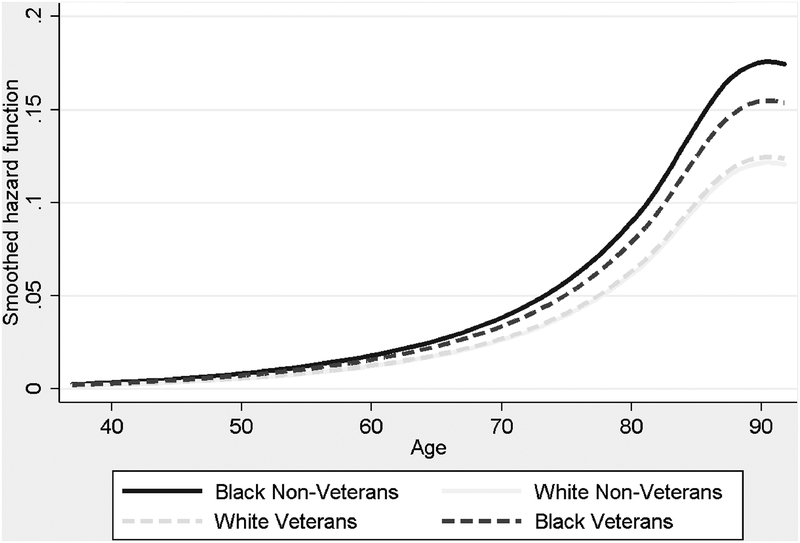
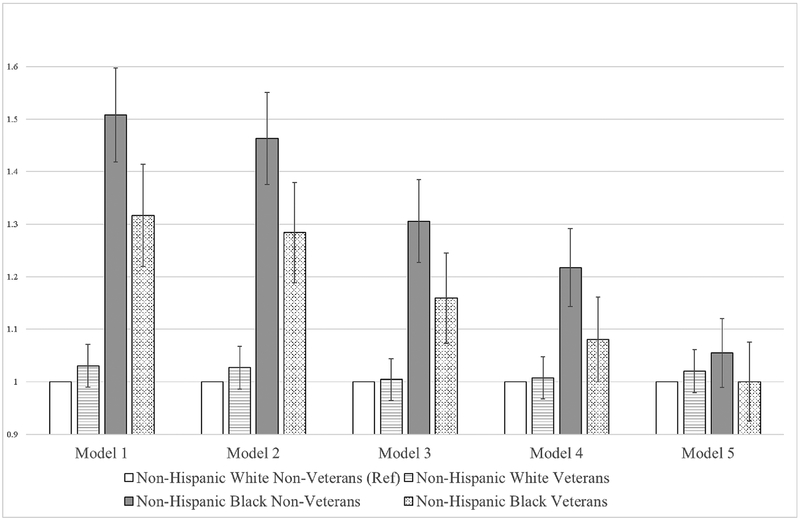
U.S. military veterans are a large and racially heterogeneous population. There are reasons to expect that racial disparities in mortality among veterans are smaller than those for non-veterans. For example, blacks are favorably selected into the military, receive relatively equitable treatment within the military, and after service accrue higher socioeconomic status and receive health and other benefits after service. Using the 1997-2009 National Health Interview Survey (N = 99,063) with Linked Mortality Files through the end of 2011 (13,691 deaths), we fit Cox proportional hazard models to estimate whether racial disparities in the risk of death are smaller for veterans than for non-veterans. We find that black/white disparities in mortality are smaller for veterans than for non-veterans, and that this is explained by the elevated socioeconomic resources of black veterans relative to black non-veterans. Leveraging birth cohort differences in military periods, we document that the smaller disparities are concentrated among All-Volunteer era veterans.
美国退伍军人是一个规模庞大且种族多样化的群体。有理由认为,退伍军人与非退伍军人之间的死亡率种族差异较小。例如,黑人在军队中受到优待,在军队中受到相对公平的待遇,在服役后获得更高的社会经济地位,并在服役后获得健康和其他福利。利用 1997-2009 年全国健康访谈调查(N=99063)和通过 2011 年底的死亡关联记录(13691 例死亡),我们使用 Cox 比例风险模型来估计退伍军人与非退伍军人之间的死亡风险种族差异是否较小。我们发现,退伍军人与非退伍军人之间的黑/白死亡率差异较小,而这一差异是由于黑退伍军人相对于黑非退伍军人拥有更高的社会经济资源。通过利用军事时期的出生队列差异,我们记录到退伍军人中较小的差异主要集中在全志愿兵役时代的退伍军人中。