National Laboratory of Solid State Microstructures, School of Physics, and Collaborative Innovation Center of Advanced Microstructures, Nanjing University, 210093, Nanjing, China.
College of Engineering and Applied Sciences, Nanjing University, 210093, Nanjing, China.
Nat Commun. 2019 Mar 11;10(1):1163. doi: 10.1038/s41467-019-09112-1.
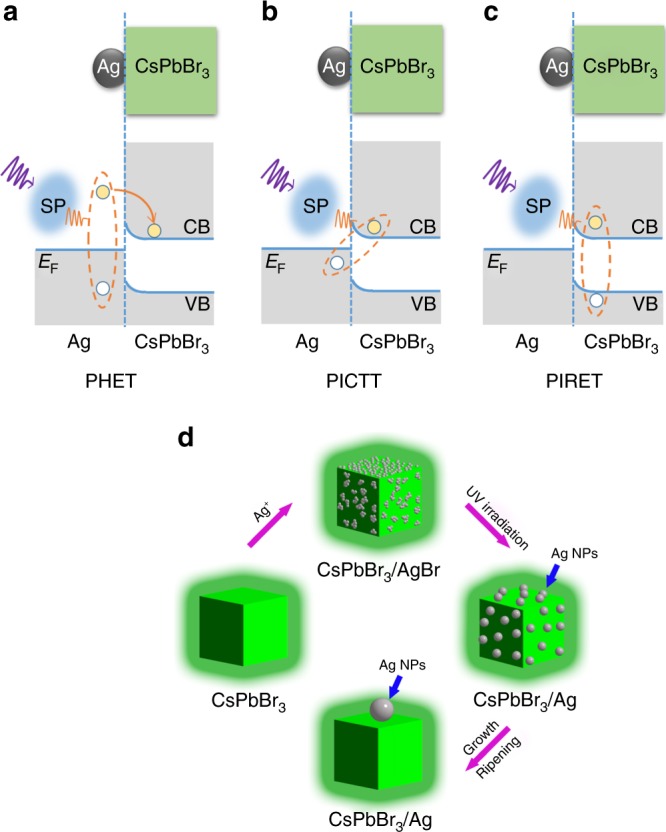
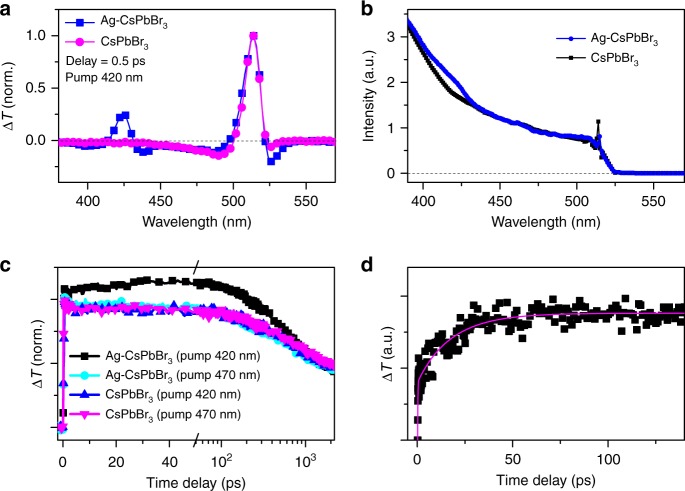
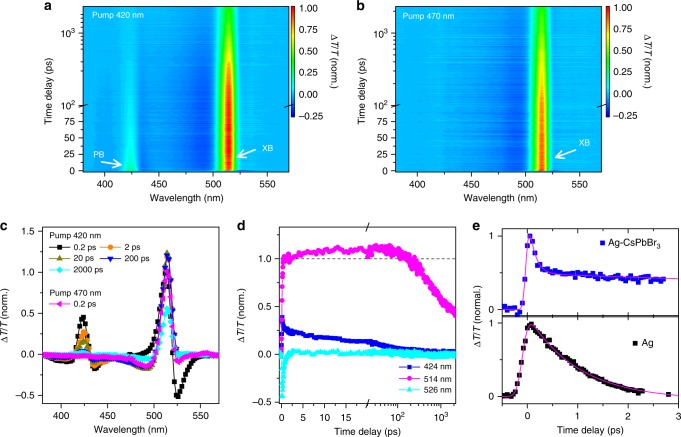
Hybrid metal/semiconductor nano-heterostructures with strong exciton-plasmon coupling have been proposed for applications in hot carrier optoelectronic devices. However, the performance of devices based on this concept has been limited by the poor efficiency of plasmon-hot electron conversion at the metal/semiconductor interface. Here, we report that the efficiency of interfacial hot excitation transfer can be substantially improved in hybrid metal semiconductor nano-heterostructures consisting of perovskite semiconductors. In Ag-CsPbBr nanocrystals, both the plasmon-induced hot electron and the resonant energy transfer processes can occur on a time scale of less than 100 fs with quantum efficiencies of 50 ± 18% and 15 ± 5%, respectively. The markedly high efficiency of hot electron transfer observed here can be ascribed to the increased metal/semiconductor coupling compared with those in conventional systems. These findings suggest that hybrid architectures of metal and perovskite semiconductors may be excellent candidates to achieve highly efficient plasmon-induced hot carrier devices.
具有强激子-等离子体耦合的混合金属/半导体纳米异质结构被提出用于热载流子光电设备中。然而,基于这一概念的器件的性能受到金属/半导体界面上等离子体-热电子转换效率差的限制。在这里,我们报告说,在由钙钛矿半导体组成的混合金属半导体纳米异质结构中,界面热激发转移的效率可以得到显著提高。在 Ag-CsPbBr 纳米晶体中,等离子体诱导的热电子和共振能量转移过程都可以在 100 fs 以内发生,量子效率分别为 50±18%和 15±5%。这里观察到的热电子转移的明显高效率可以归因于与传统系统相比金属/半导体耦合的增加。这些发现表明,金属和钙钛矿半导体的混合结构可能是实现高效等离子体诱导热载流子器件的优秀候选者。