Ingerslev Kasper, Høgdall Estrid, Skovrider-Ruminski Wojciech, Schnack Tine Henrichsen, Lidang Marianne, Høgdall Claus, Blaakaer Jan
1Department of Gynecology, Odense University Hospital, Sdr. Boulevard 29, 5000 Odense C, Denmark.
2Department of Pathology, Herlev Hospital, Herlev Ringvej 75, 2730 Herlev, Denmark.
Infect Agent Cancer. 2019 Feb 26;14:7. doi: 10.1186/s13027-019-0223-z. eCollection 2019.
The underlying cause of epithelial ovarian cancer (EOC) is unknown. It has been theorized that infectious agents could contribute to ovarian tumorigenesis.
To investigate the potential role of oncogenic viral infection in EOC, we examined the prevalence of Epstein-Barr Virus (EBV) DNA and cytomegalovirus (CMV) DNA in EOC tissue samples.
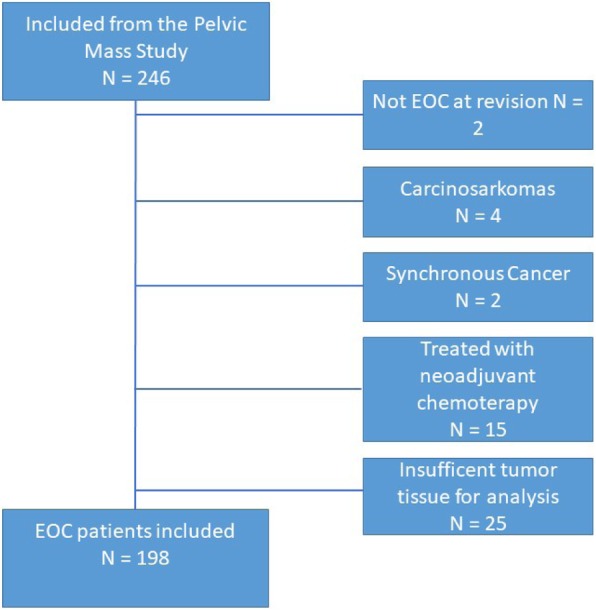
Formalin-fixed, paraffin-imbedded (FFPE) tumor tissue samples from 198 patients included in the Danish Pelvic Mass Study were studied: 163 with serous adenocarcinomas, 15 with endometrioid adenocarcinomas, 11 with mucinous adenocarcinomas, and nine with clear-cell carcinomas. For controls in the EBV analysis, we used 176 tissue samples from patients diagnosed with benign mucinous cystadenomas. EBV and CMV genotyping was performed by real-time polymerase chain reaction with CMV and EBV CE-IVD approved kits. In-situ hybridization (ISH) was performed on the EBV positive samples.
Sufficient DNA material was obtained in 191 and 174 tissue samples from cases and controls, respectively. Ten of 191 case samples (5.2%) and one of 174 control samples (0.5%) were positive for EBV DNA ( value = 0.011). CMV DNA was detected in only one case sample (0.5%). ISH confirmed that three of the samples were of stromal origin, while the remaining seven tested negative for EBV.
This study is the first to demonstrate a higher prevalence of EBV DNA in tissue samples from patients with EOC than in a benign control group. However, the cellular origin of seven of the samples could not be determined by ISH analysis. Our study did not support an association between CMV and EOC.
上皮性卵巢癌(EOC)的潜在病因尚不清楚。有理论认为,感染因子可能与卵巢肿瘤发生有关。
为了研究致癌病毒感染在EOC中的潜在作用,我们检测了EOC组织样本中爱泼斯坦-巴尔病毒(EBV)DNA和巨细胞病毒(CMV)DNA的流行情况。
对丹麦盆腔肿块研究中纳入的198例患者的福尔马林固定、石蜡包埋(FFPE)肿瘤组织样本进行研究:163例为浆液性腺癌,15例为子宫内膜样腺癌,11例为黏液性腺癌,9例为透明细胞癌。在EBV分析中,我们使用了176例被诊断为良性黏液性囊腺瘤患者的组织样本作为对照。采用经CMV和EBV CE-IVD批准的试剂盒,通过实时聚合酶链反应进行EBV和CMV基因分型。对EBV阳性样本进行原位杂交(ISH)。
分别从病例组和对照组的191例和174例组织样本中获得了足够的DNA材料。191例病例样本中有10例(5.2%)EBV DNA呈阳性,174例对照样本中有1例(0.5%)呈阳性(P值=0.011)。仅在1例病例样本中检测到CMV DNA(0.5%)。ISH证实其中3个样本来源于基质,其余7个样本EBV检测为阴性。
本研究首次表明,EOC患者组织样本中EBV DNA的流行率高于良性对照组。然而,ISH分析无法确定其中7个样本的细胞来源。我们的研究不支持CMV与EOC之间存在关联。