
行人在极度拥挤场景下的轨迹预测。
Pedestrian Trajectory Prediction in Extremely Crowded Scenarios.
机构信息
Center for Spatial Information Science, the University of Tokyo, Kashiwa 277-8568, Japan.
Earth Observation Data Integration and Fusion Research Initiative, the University of Tokyo, Tokyo 153-8505, Japan.
出版信息
Sensors (Basel). 2019 Mar 11;19(5):1223. doi: 10.3390/s19051223.
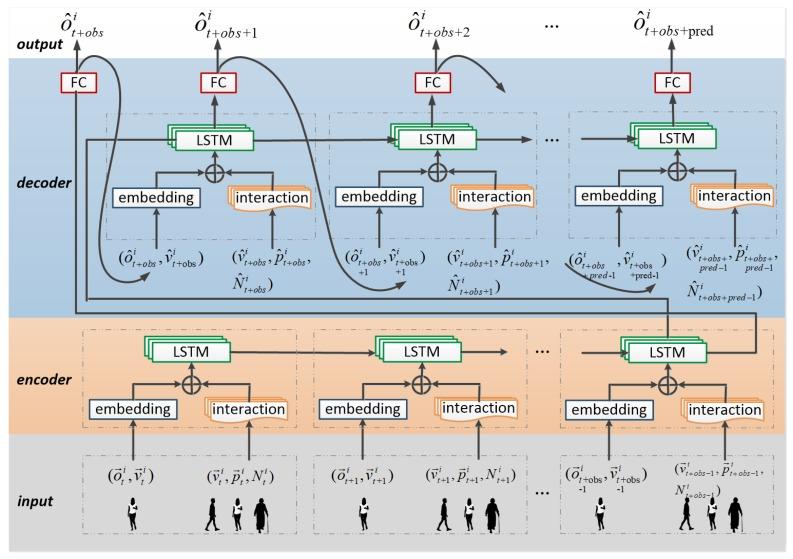
Pedestrian trajectory prediction under crowded circumstances is a challenging problem owing to human interaction and the complexity of the trajectory pattern. Various methods have been proposed for solving this problem, ranging from traditional Bayesian analysis to Social Force model and deep learning methods. However, most existing models heavily depend on specific scenarios because the trajectory model is constructed in absolute coordinates even though the motion trajectory as well as human interaction are in relative motion. In this study, a novel trajectory prediction model is proposed to capture the relative motion of pedestrians in extremely crowded scenarios. Trajectory sequences and human interaction are first represented with relative motion and then integrated to our model to predict pedestrians' trajectories. The proposed model is based on Long Short Term Memory (LSTM) structure and consists of an encoder and a decoder which are trained by truncated back propagation. In addition, an anisotropic neighborhood setting is proposed instead of traditional neighborhood analysis. The proposed approach is validated using trajectory data acquired at an extremely crowded train station in Tokyo, Japan. The trajectory prediction experiments demonstrated that the proposed method outperforms existing methods and is stable for predictions of varying length even when the model is trained with a controlled short trajectory sequence.
行人在拥挤环境下的轨迹预测是一个具有挑战性的问题,这主要是因为人类的相互作用和轨迹模式的复杂性。已经提出了各种方法来解决这个问题,从传统的贝叶斯分析到社会力模型和深度学习方法。然而,由于轨迹模型是在绝对坐标中构建的,即使运动轨迹和人类相互作用是相对运动,大多数现有的模型仍然严重依赖于特定的场景。在这项研究中,提出了一种新的轨迹预测模型来捕捉极其拥挤场景下行人的相对运动。轨迹序列和人类相互作用首先用相对运动表示,然后将其集成到我们的模型中以预测行人的轨迹。所提出的模型基于长短期记忆(LSTM)结构,由编码器和解码器组成,它们通过截断反向传播进行训练。此外,提出了一种各向异性邻域设置,而不是传统的邻域分析。使用在日本东京一个极其拥挤的火车站获得的轨迹数据验证了所提出的方法。轨迹预测实验表明,所提出的方法优于现有方法,并且即使在使用受控短轨迹序列进行训练时,对于不同长度的预测也具有稳定性。




 Zotero 插件