Department of Chemistry, Stanford University, Stanford, CA, 94305, USA.
Departments of Biology and Chemistry, Washington University in St. Louis, St. Louis, MO, 63130, USA.
Nat Commun. 2019 Mar 12;10(1):1172. doi: 10.1038/s41467-019-09084-2.
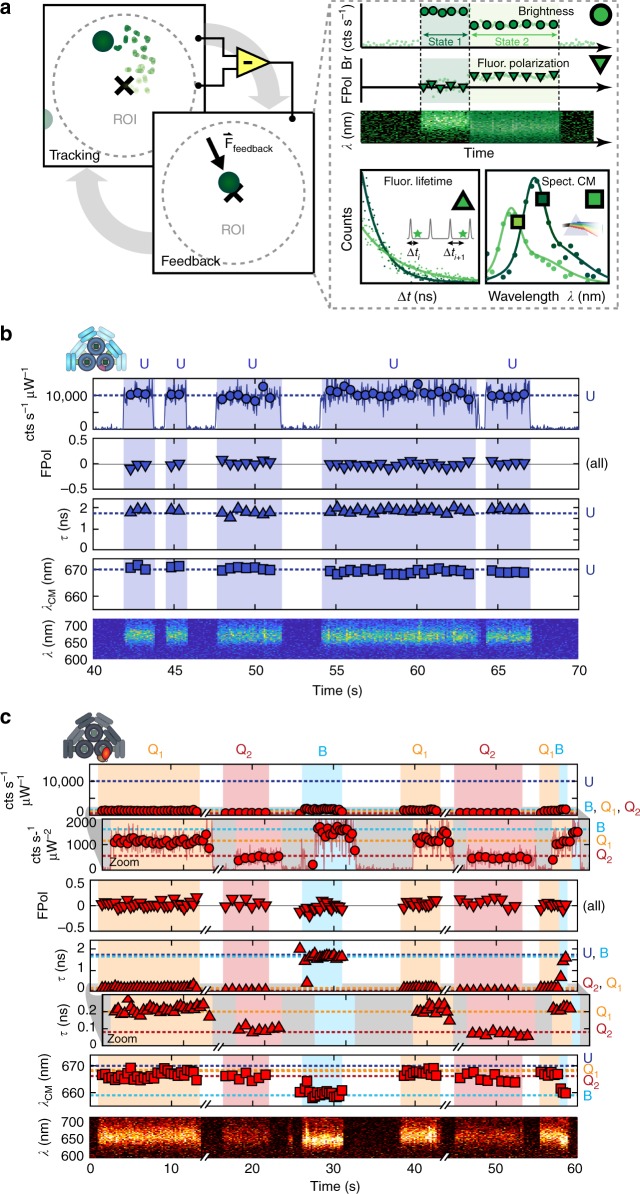
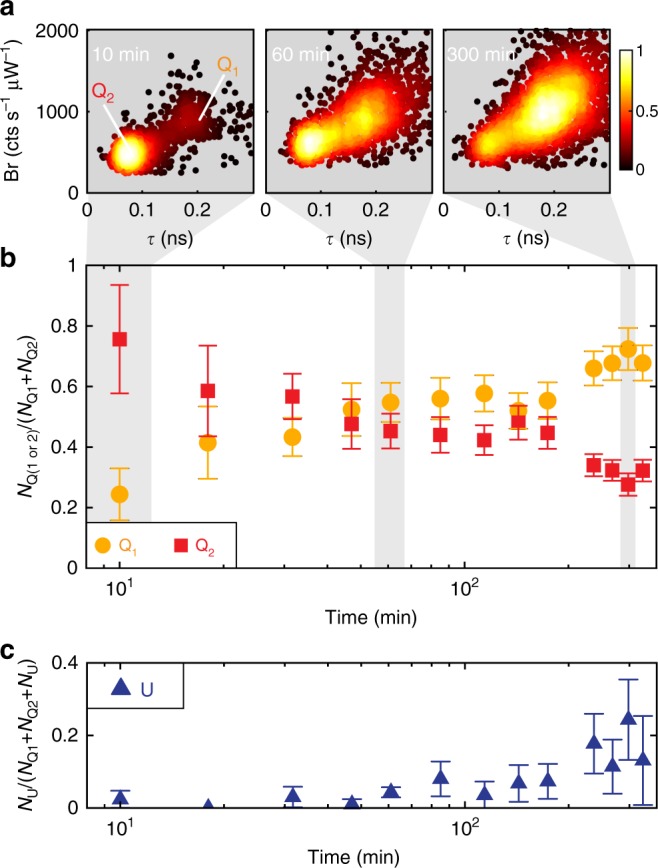
The Orange Carotenoid Protein (OCP) is a cytosolic photosensor that is responsible for non-photochemical quenching (NPQ) of the light-harvesting process in most cyanobacteria. Upon photoactivation by blue-green light, OCP binds to the phycobilisome antenna complex, providing an excitonic trap to thermally dissipate excess energy. At present, both the binding site and NPQ mechanism of OCP are unknown. Using an Anti-Brownian ELectrokinetic (ABEL) trap, we isolate single phycobilisomes in free solution, both in the presence and absence of activated OCP, to directly determine the photophysics and heterogeneity of OCP-quenched phycobilisomes. Surprisingly, we observe two distinct OCP-quenched states, with lifetimes 0.09 ns (6% of unquenched brightness) and 0.21 ns (11% brightness). Photon-by-photon Monte Carlo simulations of exciton transfer through the phycobilisome suggest that the observed quenched states are kinetically consistent with either two or one bound OCPs, respectively, underscoring an additional mechanism for excitation control in this key photosynthetic unit.
橙体蛋白(OCP)是一种胞质光感受器,负责大多数蓝细菌中光捕获过程的非光化学猝灭(NPQ)。在蓝绿光的光激活下,OCP 与藻胆体天线复合物结合,提供了一个激子陷阱,以热耗散多余的能量。目前,OCP 的结合位点和 NPQ 机制尚不清楚。使用反布朗运动电动(ABEL)陷阱,我们在游离溶液中分离出单个藻胆体,既有激活的 OCP 存在,也有不存在的,以直接确定 OCP 猝灭藻胆体的光物理和异质性。令人惊讶的是,我们观察到两种不同的 OCP 猝灭状态,寿命分别为 0.09 ns(未猝灭亮度的 6%)和 0.21 ns(11%亮度)。通过藻胆体传递激子的逐光子蒙特卡罗模拟表明,观察到的猝灭状态在动力学上分别与两个或一个结合的 OCP 一致,这突出了在这个关键的光合作用单元中,激发控制的另一种机制。