Campbell Amy, Grace Fergal, Ritchie Louise, Beaumont Alexander, Sculthorpe Nicholas
School of Health and Life Sciences, Institute of Clinical Exercise and Health Sciences, University of the West of Scotland, Hamilton, United Kingdom.
Faculty of Health, School of Health Science & Psychology, Federation University Australia, Ballarat, VIC, Australia.
Front Physiol. 2019 Feb 26;10:31. doi: 10.3389/fphys.2019.00031. eCollection 2019.
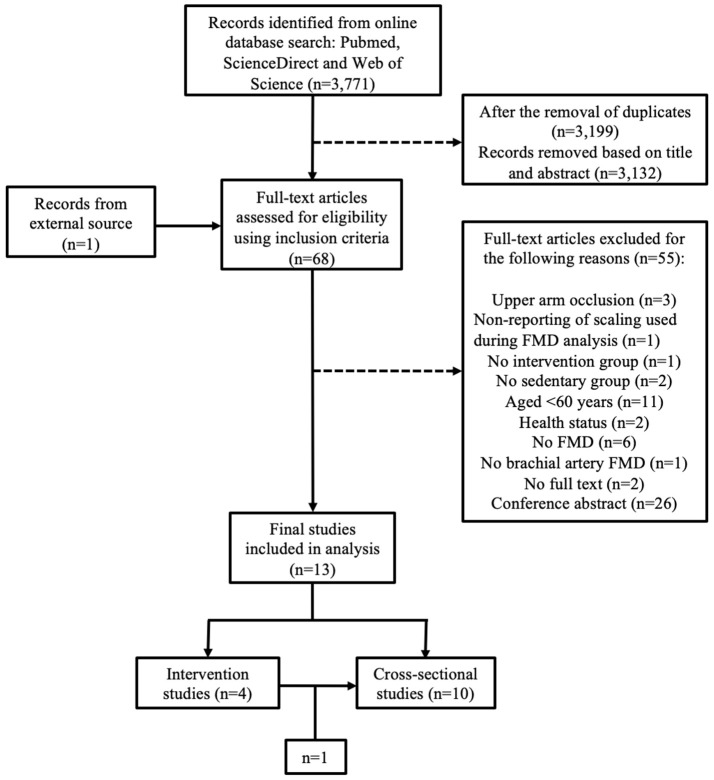
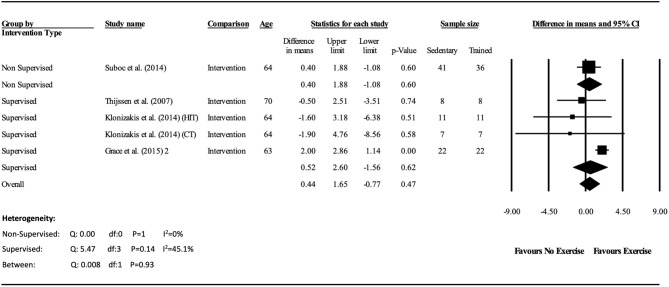
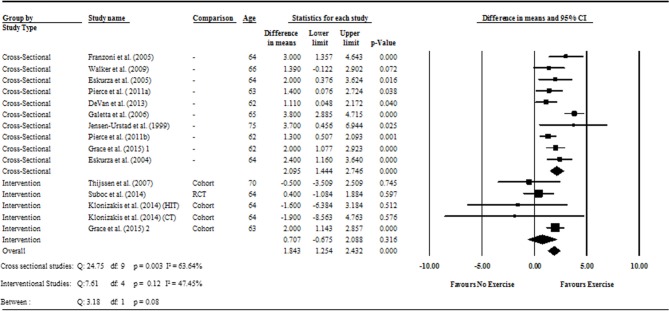
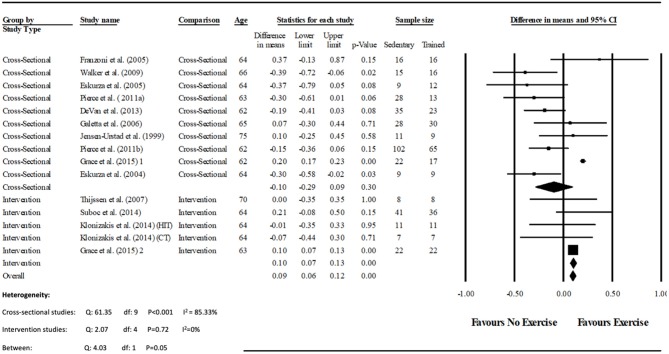
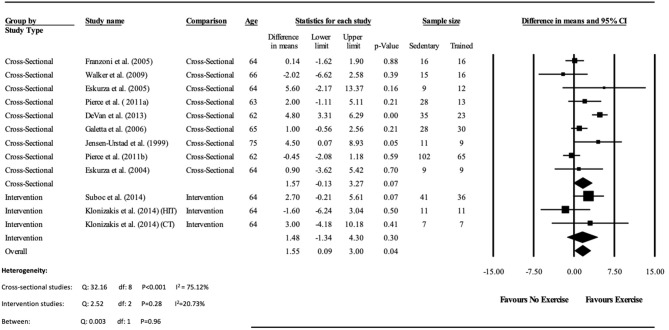
There is an emerging body of literature relating to the effectiveness of frequent aerobic exercise as a prophylactic for age-associated dysfunction of large arteries, yet systematic evaluation and precise estimate of this effect is unknown. We conducted a systematic review and meta-analysis of controlled studies examining flow mediated dilatation (FMD) of athletic older persons and otherwise healthy sedentary counterparts to (i) compare FMD as a determinant of endothelial function between athletes and sedentary individuals and, (ii) summarize the effect of exercise training on FMD in studies of sedentary aging persons. Studies were identified from systematic search of major electronic databases from inception to January 2018. Study quality was assessed before conducting a random effects meta-analysis to calculate a pooled ES (mean difference) with 95% CI's. Thirteen studies [4 interventional ( = 125); 10 cross-sectional [including one study from the interventional analysis; ( = 485)] with age ranges from 62 to 75 years underwent quantitative pooling of data. The majority of study participants were male. Older athletes had more favorable FMD compared with sedentary controls (2.1%; CI: 1.4, 2.8%; < 0.001). There was no significant improvement in the vascular function of sedentary cohorts following a period of exercise training (0.7%; CI: -0.675, 2.09%; = 0.316). However, there was a significant increase in baseline diameter from pre to post intervention (0.1 mm; CI: 0.07, 0.13 mm; < 0.001). In addition, there was no significant difference in endothelial independent vasodilation between the trained and sedentary older adults (1.57%; CI: -0.13, 3.27%; = 0.07), or from pre to post exercise intervention (1.48%; CI: -1.34, 4.3%; = 0.3). In conclusion, long-term aerobic exercise appears to attenuate the decline in endothelial vascular function, a benefit which is maintained during chronological aging. However, currently there is not enough evidence to suggest that exercise interventions improve vascular function in previously sedentary healthy older adults.
有越来越多的文献探讨经常进行有氧运动作为预防大动脉衰老相关功能障碍的有效性,但对这种效果的系统评估和精确估计尚不清楚。我们对对照研究进行了系统评价和荟萃分析,这些研究检测了老年运动员和健康久坐者的血流介导的血管舒张(FMD),以(i)比较FMD作为运动员和久坐个体内皮功能的决定因素,以及(ii)总结在久坐的老年人研究中运动训练对FMD的影响。通过对主要电子数据库从创建到2018年1月的系统检索来识别研究。在进行随机效应荟萃分析以计算合并效应量(平均差)及95%置信区间之前,先评估研究质量。13项研究[4项干预性研究(n = 125);10项横断面研究[包括一项来自干预性分析的研究;(n = 485)],年龄范围为62至75岁,进行了数据的定量合并。大多数研究参与者为男性。与久坐对照组相比,老年运动员的FMD更有利(2.1%;置信区间:1.4,2.8%;P < 0.001)。经过一段时间的运动训练后,久坐组人群的血管功能没有显著改善(0.7%;置信区间:-0.675,2.09%;P = 0.316)。然而,从干预前到干预后,基线直径有显著增加(0.1毫米;置信区间:0.07,0.13毫米;P < 0.001)。此外,训练后的老年人和久坐的老年人在内皮依赖性血管舒张方面没有显著差异(1.57%;置信区间:-0.13,3.27%;P = 0.07),运动干预前后也没有显著差异(1.48%;置信区间:-1.34,4.3%;P = 0.3)。总之,长期有氧运动似乎能减轻内皮血管功能的下降,这种益处会在自然衰老过程中持续存在。然而,目前没有足够的证据表明运动干预能改善之前久坐的健康老年人的血管功能。